


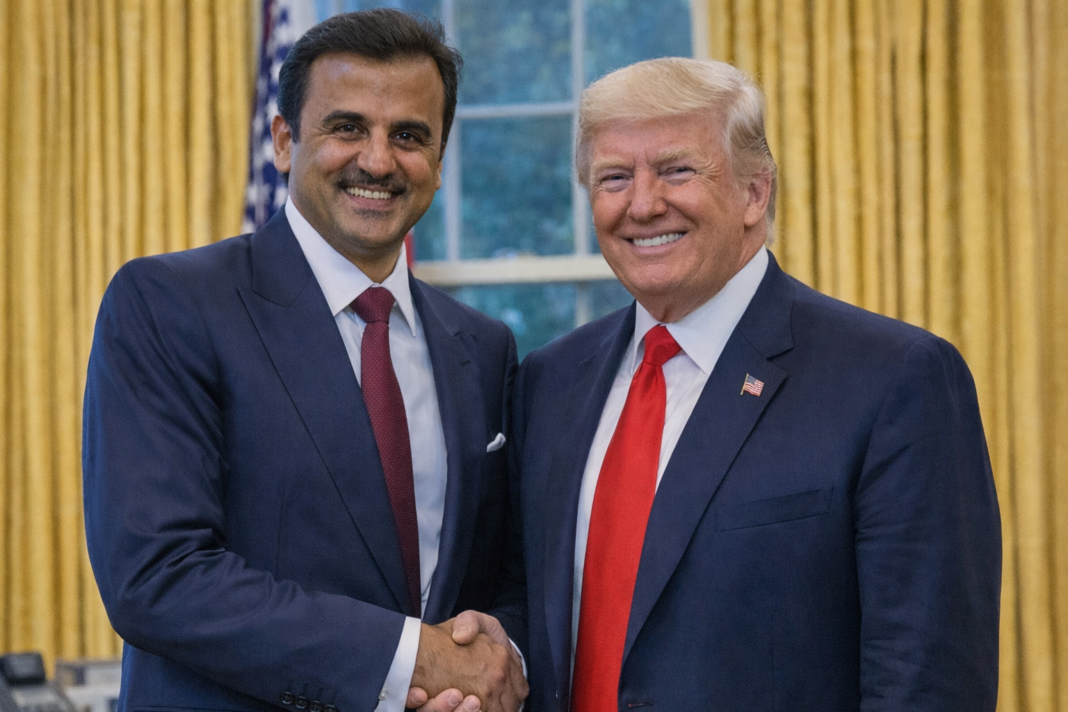

Less than a decade ago, Qatar was portrayed by several regional capitals as a problematic actor—too independent, too active, too willing to engage with interlocutors others preferred to isolate. Today, the reality could not be more different. Doha has emerged as one of Washington’s most important diplomatic relays in the Middle East. This shift is neither cosmetic nor accidental. It reflects a deeper transformation in the regional balance of power and, more significantly, in the way the United States now exercises influence.
The 2017 Gulf crisis marked a defining moment. Accused of supporting Islamist movements and maintaining ambiguous ties with certain non-state actors, Qatar found itself diplomatically and economically isolated by a coalition led by Saudi Arabia and the United Arab Emirates. At the time, under President Donald Trump’s first administration, the rhetoric from Washington appeared aligned with that pressure campaign.
Yet what many interpreted as a strategic weakening became, in practice, a catalyst for resilience. Faced with blockade and isolation, Doha accelerated its logistical and food security independence, deepened alternative partnerships, strengthened defense cooperation, and refined a foreign policy built on diversification. Rather than retreat, Qatar recalibrated. The crisis sharpened its strategic culture and reinforced its determination to preserve autonomous decision-making.
Throughout this turbulent period, one constant remained: the United States continued to rely heavily on Qatar’s territory for its regional military posture. Al Udeid Air Base remained central to American operations in the Middle East. This enduring security cooperation exposed a structural reality: Washington could criticize Doha politically, but it could not afford to disengage from it strategically.
When intra-Gulf reconciliation gradually took shape, Qatar did not emerge diminished. Instead, it re-emerged repositioned—less dependent on regional consensus and more confident in its diplomatic latitude. Crucially, it had strengthened the tool that would define its growing relevance: the capacity to maintain dialogue with a wide range of actors, including those others refused to engage.
In an increasingly fragmented Middle East—marked by asymmetric conflicts, powerful non-state actors, and overlapping spheres of influence—mediation has become a form of strategic capital. Qatar recognized early that maintaining open channels across ideological and geopolitical divides would enhance its value. Dialogue, not dominance, became its leverage.
In the context of Gaza, Doha has played a central role in facilitating indirect negotiations involving Hamas and other stakeholders. This mediation does not signify ideological alignment; it reflects calculated pragmatism. For Washington, which faces domestic political constraints and diplomatic sensitivities, delegating certain channels to a trusted intermediary reduces exposure while preserving influence.
The same logic applies to tensions with Iran. Between open confrontation and formal diplomatic normalization lies a gray zone where indirect communication is essential. Qatar occupies that space. Its relationship with Tehran is sufficiently functional to enable dialogue, yet sufficiently balanced to remain acceptable to Washington. In moments of escalation, this positioning becomes strategically invaluable.
Since Donald Trump’s return to the White House in January 2025, this relationship has continued along a pragmatic trajectory. Beyond partisan shifts in Washington, the structural logic remains unchanged: the United States seeks to limit direct entanglement while retaining strategic reach. Qatar facilitates that calibrated approach. It absorbs part of the diplomatic risk, sustains communication lines, and operates as a stabilizing intermediary.
Energy dynamics further reinforce this centrality. Qatar is one of the world’s leading exporters of liquefied natural gas. In a global environment reshaped by supply disruptions, geopolitical tensions, and shifting energy corridors, Doha’s role in stabilizing international gas markets enhances its geopolitical weight. The United States, itself a major LNG exporter, does not view Qatar as a strategic rival in this domain but rather as a complementary actor in sustaining global energy equilibrium.
Compared to other Gulf partners, Qatar’s positioning is distinctive. Saudi Arabia remains a structural heavyweight with significant financial and military influence. The United Arab Emirates has cultivated a sophisticated and proactive diplomatic profile. Oman maintains a respected tradition of quiet neutrality. Qatar, however, combines firm security alignment with Washington and an active, visible mediation strategy. This dual posture grants it unusual flexibility.
Such a role is not without cost. Acting as a mediator exposes Doha to criticism from multiple directions. It invites suspicion, pressure, and heightened security risks. Engaging across fault lines inevitably generates controversy. Yet Qatar appears to have internalized these risks as the price of relevance.
Ultimately, Qatar’s rise as a central diplomatic actor mirrors a broader shift in American strategy in the Middle East. The era of large-scale intervention and direct political engineering has given way to calibrated engagement. Washington increasingly relies on regional partners capable of managing complex local dynamics on its behalf.
Qatar did not become indispensable by accident. It identified an emerging strategic gap and positioned itself within it. In a world defined less by binary alliances and more by fluid alignments, the ability to serve as a bridge between adversaries is itself a form of power.
The journey from suspicion to centrality is therefore more than a diplomatic rehabilitation. It represents the consolidation of a model of influence grounded in mediation, resilience, and strategic flexibility. For Washington, Doha is no longer merely a Gulf partner. It has become a structural lever in managing the evolving crises of the Middle East.