



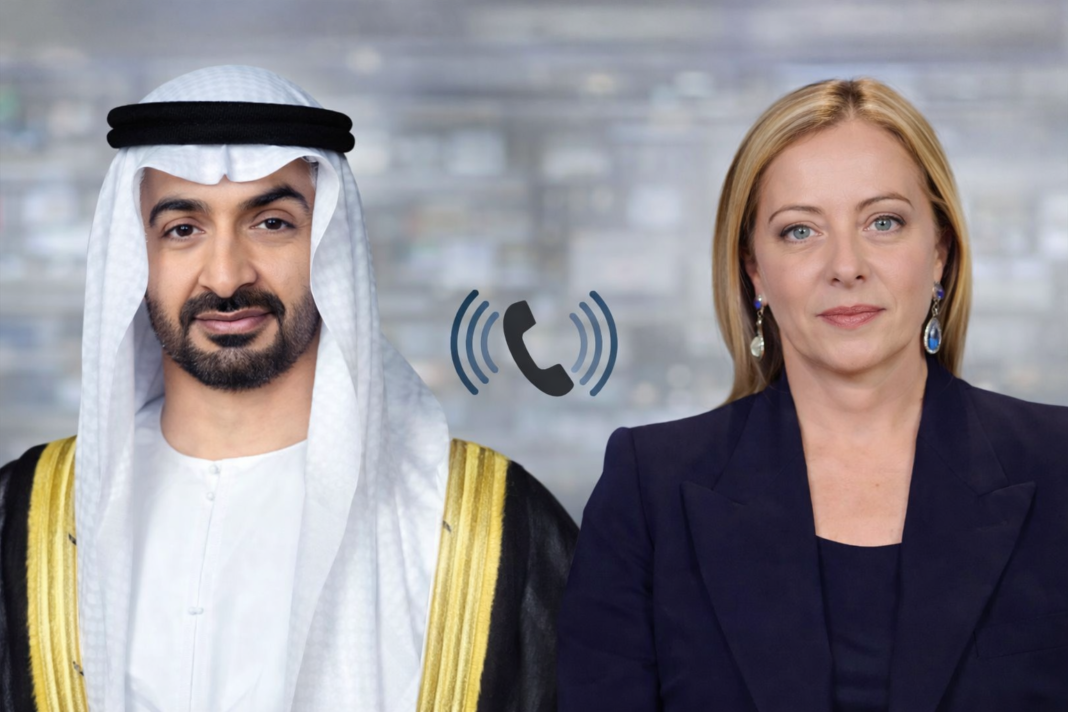
In a context of rising tensions in the Middle East and growing international concern over the risk of a wider regional escalation, an important diplomatic exchange took place between the Italian Prime Minister, Giorgia Meloni, and the President of the United Arab Emirates, Mohammed bin Zayed Al Nahyan. This telephone conversation, confirmed by several diplomatic sources, forms part of an intense phase of diplomatic contacts during which several European capitals are seeking to coordinate their positions with the countries of the Gulf in response to the rapidly evolving security situation in the region. Contrary to certain interpretations that have circulated in some political and media circles, this contact was not initiated by the United Arab Emirates in order to request European support, but rather by Giorgia Meloni herself, who took the initiative to call the Emirati leader in order to express Italy’s solidarity with the Gulf states and to assess the possibilities for strategic cooperation in the current context.
According to information reported by several diplomatic sources, the conversation focused mainly on the deterioration of the security situation in the Middle East, particularly the concerns generated by tensions involving Iran and their potential consequences for the Gulf states, maritime security in the region, and the overall strategic balance. Giorgia Meloni expressed to President Mohammed bin Zayed the Italian government’s concern about the risk of the conflict expanding and reaffirmed Rome’s commitment to the principle of regional stability, while condemning any action likely to threaten the sovereignty and security of states in the region. She also stressed the importance of preserving the security of the energy and commercial routes that pass through the Gulf, an issue that is particularly sensitive for European economies dependent on the stability of these flows.
During this exchange, the Italian Prime Minister assured her counterpart that Italy remains ready to strengthen its strategic cooperation with Gulf partners, particularly in the areas of maritime security, defense, and the monitoring of asymmetric threats. Among the forms of support discussed were the possibility of strengthening cooperation in air defense and surveillance, increasing intelligence sharing on regional threats, and Italian participation in international mechanisms aimed at protecting navigation and energy infrastructure in the region. Rome also recalled the presence of its military forces in several international missions in the broader Middle East area and emphasized that Italy remains committed to collective security mechanisms intended to prevent any further destabilization.
The conversation between Giorgia Meloni and Mohammed bin Zayed also reflects a broader evolution in Italian foreign policy under the current government. Since coming to power, the Italian leader has sought to strengthen strategic relations between Italy and the Gulf states, which are regarded in Rome as essential partners both in terms of energy and security. The United Arab Emirates occupies a particularly important place in this framework because of its growing diplomatic role in the region, its economic influence, and its central position in the strategic balances of the Gulf.
Relations between Italy and the UAE have indeed intensified in recent years across several areas, ranging from military cooperation to economic investment, as well as technological and energy partnerships. In an international context marked by geopolitical uncertainty and the fragmentation of traditional alliances, Rome sees the United Arab Emirates as a stable actor and an interlocutor capable of contributing to the management of regional crises. For the Italian authorities, maintaining a direct dialogue with Abu Dhabi makes it possible not only to assess developments in the Gulf security environment but also to strengthen coordination with regional partners in the face of common challenges.
From the Emirati side, the exchange with the Italian Prime Minister was perceived as an important political signal coming from a country that is a member of both the G7 and the European Union. Emirati authorities emphasized the need to strengthen international mechanisms for crisis prevention and recalled the importance of cooperation with European partners in preserving the stability of the Gulf. Mohammed bin Zayed is also said to have highlighted the role that the United Arab Emirates seeks to play as a stabilizing and mediating actor in several regional issues, while insisting on the need to protect critical infrastructure and maritime routes from emerging threats.
This conversation more broadly illustrates the transformation of the diplomatic landscape in the Middle East, where European countries are seeking to maintain a strategic presence while avoiding direct involvement in regional military confrontations. For Italy, the objective is to support stability in the Gulf, protect its economic and energy interests, and strengthen its diplomatic credibility in a region where balances remain particularly fragile.
By taking the initiative to contact the President of the United Arab Emirates directly, Giorgia Meloni sought to send a double political message. On the one hand, she aimed to demonstrate that Italy remains an attentive and committed partner to the Gulf states at a time of regional tension. On the other hand, she intended to affirm Rome’s diplomatic role in managing international crises and in building strategic partnerships with key actors in the Middle East. In a context where geopolitical balances are evolving rapidly, this kind of direct dialogue between leaders increasingly appears to be a central instrument for preventing escalation and preserving margins of stability in a region whose developments continue to have repercussions far beyond its borders.


