



As the Middle East enters a new phase of tension and uncertainty, the President of the United Arab Emirates, Sheikh Mohammed bin Zayed, has chosen a method of leadership that contrasts with the often distant image of power in the region: direct presence among the population.
In recent days, as the regional crisis and attacks targeting Emirati territory have raised concerns, the Emirati leader visited a hospital in Abu Dhabi to meet people injured in the recent incidents. At the bedside of the patients, he took the time to speak with them and their families, inquiring about their health and praising the work of the medical teams. Among the wounded were nationals from several countries — Emiratis, Indians, Pakistanis, Sudanese and Iranians — reflecting the human diversity that characterizes the United Arab Emirates.
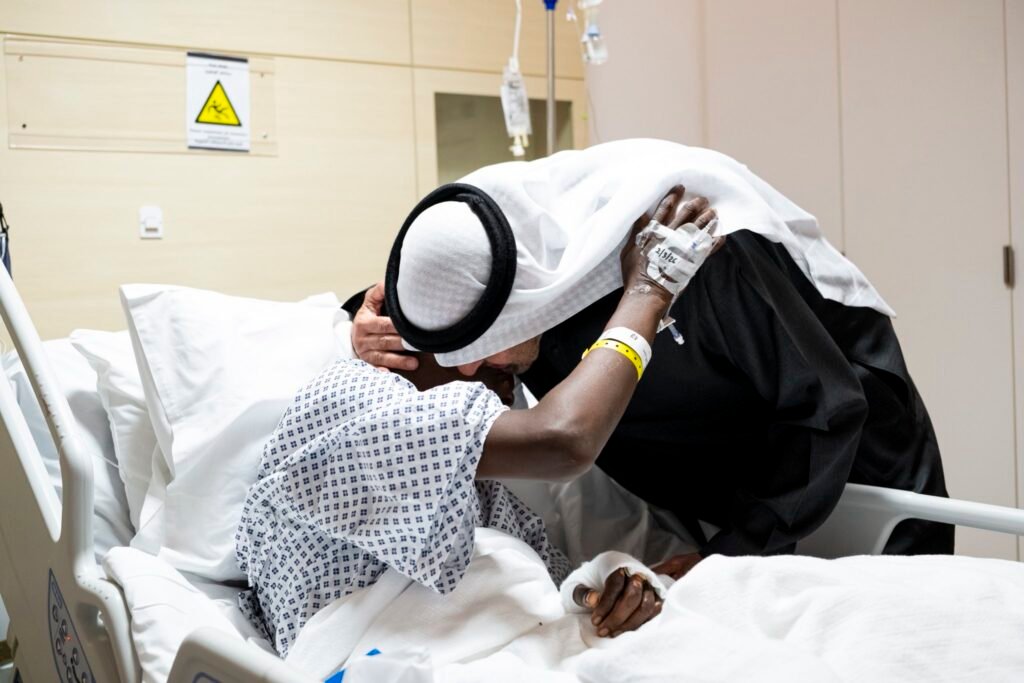

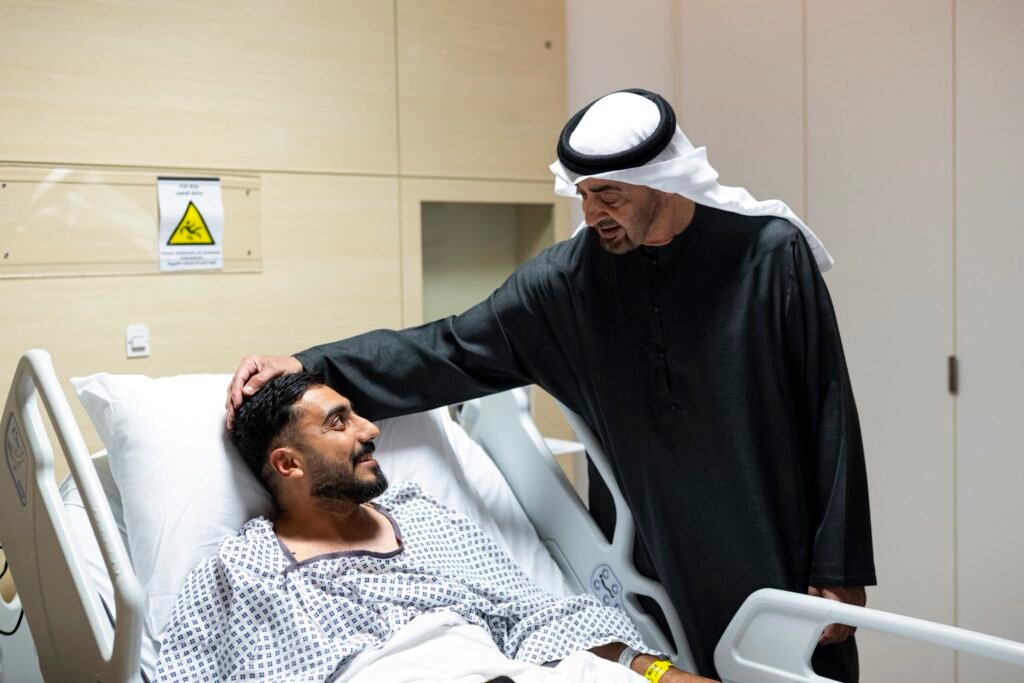

À chacun d’eux, Mohammed ben Zayed a exprimé le même message : leur sécurité, comme celle de tous les habitants du pays, est une responsabilité et une priorité pour l’État. Dans un pays où les travailleurs et résidents étrangers constituent une composante essentielle de la société, ce geste n’est pas seulement humanitaire. Il est aussi profondément politique. Il nous rappelle que la stabilité du modèle émirati repose sur un pacte tacite entre l’État et tous ceux qui vivent et travaillent sur son territoire.
Mais c’est peut-être ailleurs que le message a eu le plus d’impact. Dans les jours qui ont suivi, le président émirati est apparu dans un lieu inattendu : un centre commercial. Au Dubai Mall, l’un des espaces publics les plus fréquents de la région, on l’a vu se promener parmi les visiteurs, échanger avec des familles, discuter avec des résidents et prendre un café dans une ambiance simple et étendue.
These images, widely circulated on social media, quickly spread across the country. They show a head of state who chooses to be visible in places of everyday life, among citizens and expatriates, rather than withdrawn in palaces or surrounded by heavy protocol.
In a region where the perception of power often passes through demonstrations of strength, Mohammed bin Zayed seems to want to send a different message: trust is also built through proximity. By walking among residents in the streets or in shopping centers, the Emirati president is not merely making a symbolic gesture. He is taking part in a subtle exercise of political communication intended to maintain calm and confidence.
Car en période d’incertitude, les sociétés se tournent vers leurs dirigeants comme vers des baromètres émotionnels. Lorsqu’ils apparaissent sereins et proches de la population, ils véhiculent implicitement l’idée que la situation reste sous contrôle.
Amid the geopolitical tensions shaking the region, Mohammed bin Zayed seems to have understood that leadership is not only played out in command rooms or diplomatic meetings. It is also played out in these simple moments when a head of state takes the time to walk among his people, to listen, to reassure and to show that the nation continues to move forward.

