



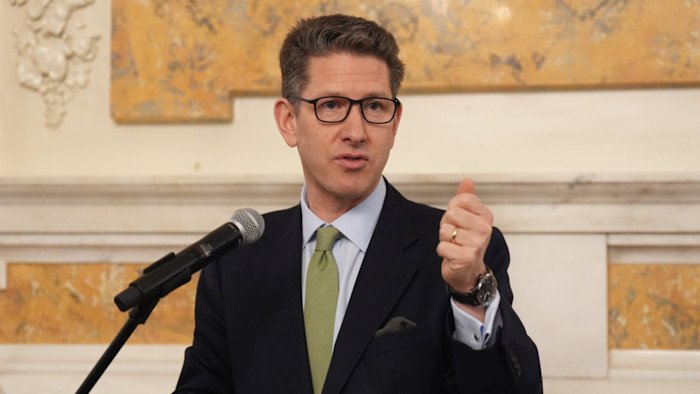

Britain’s ambassador to Washington has said that America’s only “special relationship” is “probably Israel”, not the UK, in remarks that risk embarrassing King Charles during his visit to the US this week.
Sir Christian Turner also criticised America’s political system for failing to hold US associates of the sex offender Jeffrey Epstein to account, saying it was “extraordinary” that the scandal “hasn’t touched anybody” in the US.
He noted that, by contrast, senior British figures, including his predecessor as ambassador Lord Peter Mandelson and “potentially the prime minister”, had been “brought down” by the affair.
A recording of the remarks, made in mid-February at an event with UK students visiting Washington, shortly after Turner started in post, was shared with the FT this week.
In comments that are outspoken for a senior diplomat, he said UK Prime Minister Sir Keir Starmer had been “on the ropes” earlier this year from the fallout over the appointment of Mandelson, and that the Labour Party could “remove” him after local elections in May.
During a question-and-answer session, Turner said he disliked the phrase “special relationship” to describe Anglo-American ties, complaining that it was “quite nostalgic, it’s quite backwards-looking, and it has a lot of baggage about it”.
He added: “I think there is probably one country that has a special relationship with the United States — and that is probably Israel.”
The comments were made in the weeks running up to the US-Israeli strikes on Iran that began the current conflict in the Middle East.
Turner said that London’s link to Washington was nonetheless “so strong”, adding: “There is a deep history and affinity between us. Particularly on defence and security, we are intertwined.”
But he added that: “The relationship will carry on, if you want, being ‘special’, but I think it’s going to have to be different.”
Britain and the rest of Europe must “work to redefine” the relationship, particularly on defence grounds, instead of relying on a US security umbrella, he said. The UK also needed to make clear what it brought to the table in the bilateral relationship, he said.
Turner answered questions about the Epstein scandal and the contrast in how it had played out on either side of the Atlantic.
He said it appeared to him “extraordinary” that the scandal over the convicted sex offender had “brought down a senior member of the royal family [Andrew Mountbatten-Windsor], a British ambassador to Washington, potentially the prime minister, and yet here in the US, it really hasn’t touched anybody”.
He said it was an “interesting question” about the “different levels of accountability in our systems”.
The remarks have come to light ahead of the King’s address to Congress on Tuesday afternoon, as he and Queen Camilla undertake a four-day state visit to the US, which will also take in New York.
The King and Queen have resisted intense pressure from campaigners and US congressman Ro Khanna to meet some of Epstein’s victims while in the country.
The royal visit has been regarded by British government figures as a salve for the bilateral relationship at a time of severe strain following US President Donald Trump’s repeated attacks on Starmer and criticism of Britain for refusing to offer more support to the US-Israel war against Iran.
Turner acknowledged that US legislators aimed to “bring to account some of those senior figures” associated with Epstein, including inviting Mandelson and Mountbatten-Windsor to testify before Congress.
However, he added: “How many Americans have been called to testify before Congress when the Epstein files show very, very senior people, politicians, business folks, Bill Gates, all having a close association with Epstein?” Since Turner’s remarks, Gates, the Microsoft co-founder, has agreed to testify.
Turning to the appointment and subsequent sacking of Mandelson, Turner said the saga was a “crisis” that “has nearly brought down the government and ended the prime minister’s tenure”.
The diplomat said of Starmer’s premiership earlier in February that “at one stage he was pretty clearly on the ropes” and his future looked “quite touch and go”.
The Labour Party’s rules set a high threshold to remove a sitting prime minister, Turner noted, highlighting that it required 80 MPs to “sign a letter in public, which is like signing a death warrant”.
Reaching such a bar was “still quite difficult” and Starmer was “a stubborn guy” who would be unlikely to quit, the ambassador said. However, he added: “The moment I would look to is the May elections. If Labour does very badly . . . I suspect the party will be able to go over that threshold and remove him — seems to me to be the conventional thinking.”
He added: “If they do OK, he might carry on going . . . That’s just for me as a citizen speculating because I have to serve whomever is there.”
Turner offered his view of the key issue governing Mandelson’s appointment, saying “the vetting thing’s a bit of a red herring”.
“The problem was he had a bunch of associations that were embarrassing to him and the government that had not been revealed,” he added. “And, arguably, once they were uncovered, the prime minister moved to sack him.”
Turner’s comments were never intended as public statements of government policy, UK officials stressed.
Sir Peter Westmacott, a previous UK ambassador to the US, defended Turner. He told the FT: “It can be embarrassing when remarks intended for a private audience are made public, but I see no reason why what he said to a group of students a couple of months ago need affect his ability to continue the excellent start he has made in DC.”
A Foreign, Commonwealth and Development Office spokesperson said: “These were private, informal comments made to a group of UK sixth-form students visiting the US in early February. They are certainly not any reflection of the UK government’s position.”
Turner was approached for comment.
Source:
www.ft.com