




See All Key Ideas
In May 2025, a delegation of angry politicians and agribusinessmen from the Brazilian state of Pará traveled to the national capital to protest against the actions of the federal environmental agency, IBAMA. Their frustration stemmed from embargoes imposed by IBAMA on 544 rural properties in the municipality of Altamira, one of the Amazon’s deforestation hotspots. In each case, satellite imagery had detected illegal forest clearing, prompting authorities to block the areas from further production activities.
“Everyone came here to present their concerns and ask for solutions regarding productive areas in the state of Pará,” Pará Governor Helder Barbalho said at the time.
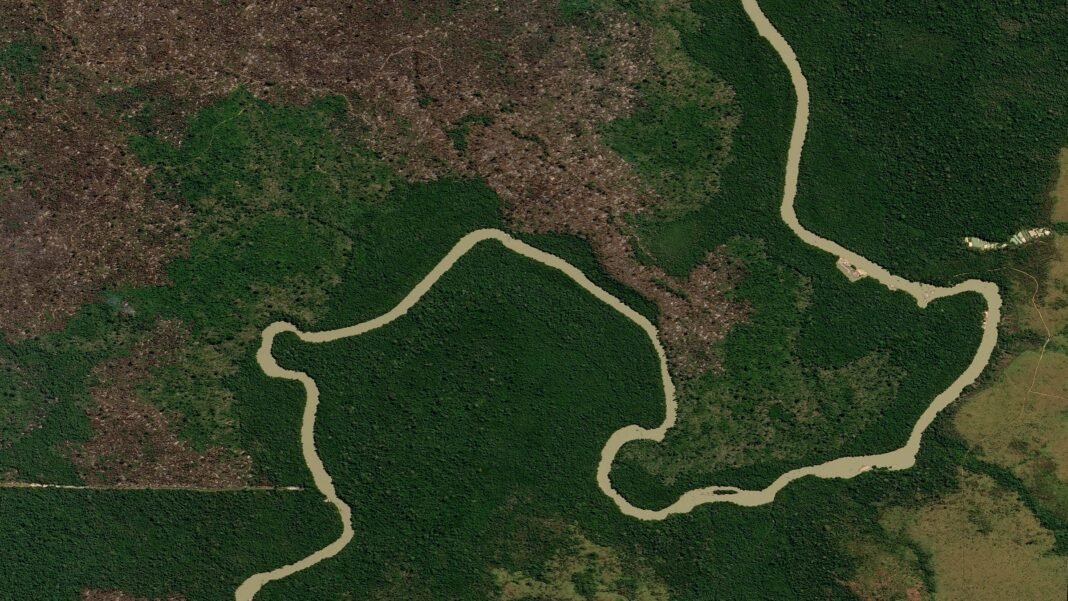
Almost a year later, their resentment has been distilled into a new bill proposing a ban on the so-called remote embargoes. Today, IBAMA uses satellite imagery to identify where illegal deforestation is occurring. Once they detect a recently deforested area, environmental agents verify whether there’s an environmental license authorizing that clearance — in the Amazon, around 90% of forest felling is illegal. If there’s no authorization, the agency issues an embargo as a preventive measure from behind its computers.
The system is one of the tools that helped the administration of President Luiz Inácio Lula da Silva halve deforestation numbers in the Amazon since taking office at the start of 2023.
“Today we have a wealth of ultra-high-resolution satellite imagery, and we can cross-reference information from various databases,” Wallace Lopes, a representative of the federal environmental agents association, ASCEMA, told Mongabay.
Jair Schmitt, director of environmental protection and acting president of IBAMA, said the agency issues around 4,000 embargoes in the Amazon per year, accounting for about 500,000 hectares (1.2 million acres) of land. Around half of these embargoes are issued remotely, which means more efficiency at lower costs.
An agent on the ground traveling long distances in the Amazon issues an average of two embargoes per day at the cost of about 50 reais per hectare ($10 per hectare, or $4 per acre), Schmitt said. By issuing remote embargoes, however, productivity reaches up to 10 embargoes per day, at a cost of 3.54 reais per hectare (70 U.S. cents per hectare, or 29 cents per acre).
Lawmakers argue that the system undermines owners’ rights to present a defense before the measure is issued. Owners can still appeal the decision after the embargo.
The new bill, if approved, would establish a new protocol. It would require IBAMA officials to first notify the violators so they can present their defense before the embargo takes effect.
Once an area is embargoed, it cannot receive loans from banks and can be banned from suppliers’ lists of slaughterhouses and grain traders that don’t want to be associated with illegal deforestation. The goal is to hit deforesters’ bottom line and dissuade them from further clearances.
“Anyone whose property has been seized cannot access public credit,” said Márcio Astrini, executive secretary of the Climate Observatory, a network of nonprofits advocating for climate solutions. “This creates an additional penalty for the offender.”
The bill is one of 70 proposals under the so-called Destruction Package, a set of measures currently before the Brazilian Congress that critics warn undermines environmental legislation and Indigenous rights in favor of the interests of land grabbers, deforesters and illegal miners.
One of these measures, deemed as Brazil’s largest environmental setback in 40 years, was approved in 2025 and loosened the environmental licensing framework. In 2026, the situation is particularly concerning given the October elections, when Brazilians will choose a president, governors, federal deputies and senators.
According to the Climate Observatory, backing anti-environmental bills is seen by many legislators as a key reelection tactic. It also tends to concentrate key votes in the first half of the year, “which further reduces the space for public debate and civic engagement.”

Back to the fax machines
The new bill also questions all environmental agencies’ “precautionary measures,” which include the seizure and eventual destruction of machinery during ground operations, and which are invoked in 70% of IBAMA’s raids.
In raids against illegal mining, for example, environmental agents often set fire to dredges and backhoes, since removing this heavy equipment from the middle of the forest is far too complicated. “If we leave the machinery there, within 10 minutes [the illegal miners] will be operating it again and destroying the forest,” Lopes said.
Like the embargo, machinery seizures also mean an immediate financial loss for offenders. “You are seizing the instrument used to commit the crime, and at the same time, that item is an asset; it has value,” Schmitt told Mongabay. “That is why these precautionary measures are so feared — because they have a practical impact on a person’s life.”
Both embargoes and equipment seizures can be legally contested afterward and are followed by the issuance of environmental fines. According to Lopes, however, offenders usually pay less than 5% of the fines’ value. In many cases, they pay nothing, since the processes are prescribed after multiple court appeals.
“A fine today does not impose any restrictions on the offender. What causes the offender headaches is precisely the precautionary measures, which take effect immediately upon being imposed,” Lopes said. “The text [of the new bill] is terrible because it will undermine the most effective enforcement tools.”
IBAMA has been using satellite imagery to detect illegal deforestation and issue embargoes throughout Brazil since 2016. When Marina Silva took office as environment minister in 2023, she intensified this strategy to get around the agency’s reduced number of agents — IBAMA has only 750 inspectors to cover all Brazilian biomes, including remote and hard-to-reach areas.
“That is what has contributed to these record-breaking declines in deforestation during the Lula administration,” Astrini said. “The bill exists solely to try to block a measure that works.”
The bill is under accelerated review in the Chamber of Deputies, Brazil’s lower house of Congress, and could be voted on any day. Given the strength of the agribusiness caucus, the chances of approval are considered high.
“It’s like wanting to put down our cellphones and go back to sending messages by fax,” Schmitt said. “The people behind this bill are trying to hinder enforcement efforts and, in a way, give offenders preferential treatment.”
Banner image: High-resolution satellite imagery allows IBAMA to detect deforestation in almost real time. Image courtesy of Airbus/Earthrise.
Amazon deforestation on pace to be the lowest on record, says Brazil
FEEDBACK: Use this form to send a message to the author of this post. If you want to post a public comment, you can do that at the bottom of the page.

Source:
news.mongabay.com