



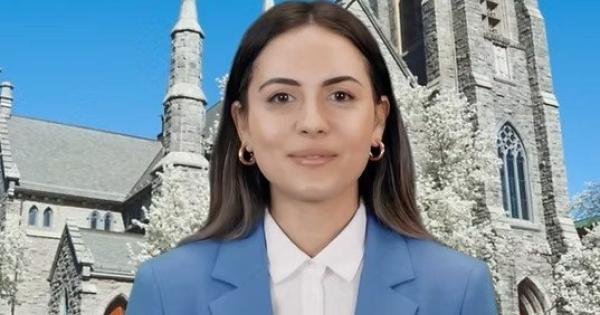

A Connecticut diocese has a new fundraising officer on its team, and her name is Maria – but don’t expect to find her sitting at a desk in the pastoral center or making the rounds at parishes.
That’s because she was generated by artificial intelligence.
“We are piloting an AI Virtual Engagement Officer, Maria, to help us discern how technology may support deeper connection and accompaniment,” Bishop Frank J. Caggiano of Bridgeport said in a statement posted to the diocese’s dedicated webpage announcing the initiative earlier this month.
“Technology, when used wisely, becomes a tool of evangelization,” said Caggiano. “Today, our mission field includes the digital world and artificial intelligence.”
Maria is the centerpiece of a pilot program the diocese has launched to enhance its development strategy – an AI-generated agent who will contact program participants to gauge their pastoral and charitable donation interests, and then connect them with flesh-and-blood diocesan staffers for further follow-up.
Members of the diocese can opt in to participate in the pilot – set to run from one to two years – by providing their name, mobile phone number and parish via the program’s webpage.
“Maria will help us learn how digital tools can deepen our listening and foster more personal responses, while always keeping human relationships at the heart of the Church’s mission,” said Caggiano in his statement.
The agent was developed in collaboration with the Boston-based firm Givzey, which in 2024 rolled out the autonomous fundraising platform Version2.ai.
The platform uses virtual engagement officers, or VEOs, to expand and streamline donor engagement efforts – something The Catholic University of America did last year when it debuted a Version2.ai-created VEO named Grace.
Transparency is key to that process, said Deacon Patrick Toole, the diocese’s chancellor and secretary of the curia.
“We make it very clear when you’re contacted that Maria is a virtual agent, and that you can decide to opt in and receive messages from Maria or not,” said Toole. Prior to joining the diocesan staff in 2018, the deacon worked for more than three decades at tech giant IBM, receiving one of the company’s highest technical honors in 2017 for his work.
He noted that the pilot program is capped at 1,000 participants, a ratio set by Givzey to allow for optimum human oversight.
“Technologically, an AI agent could speak with a million people,” said Toole. But with that reach, “there’s no way we could have all of the checks and balances that they and we desire,” he cautioned.
Toole also stressed that Maria, as a VEO who will communicate through text and email, is not designed to provide any kind of counsel or theological insight – and her human counterparts will swiftly respond to any interactions indicating the need for such support.
“If someone is identified as being in crisis, we need to get them to the appropriate people or authorities immediately. That’s ‘Ministry 101,'” he said.
Caggiano dedicated the April 15 episode of his podcast “Let Me Be Frank” to an hour-long discussion of the AI initiative, with Toole and Emily Groccia, Givzey’s vice president of customer success.
The group detailed how the pilot program works, and addressed several moral and ethical questions posed by the use of AI in general.
Speaking during the podcast, Groccia distinguished between AI powered by LLMs, or large language models – such as ChatGPT and Claude, which provide responses to user-generated prompts – and autonomous AI, which allows for the completion of multi-step tasks.
She said the autonomous AI on which VEO platforms rely helps to compensate for the gap between the number of potential donors and fundraising staff. She noted “only about 3% of nonprofit supporters” have actual contact with a fundraiser at an organization they support.
“Organizations could never have a fundraiser for every donor,” said Groccia, adding that VEOs offer “an experience that feels more similar to what those 3% are getting.”
Groccia stressed that this kind of autonomous AI is “additive”: It does not replace a human person, a fundraiser in her example, but it is helping them address an unmet need and has human oversight.
“It’s expanding your team. It’s giving your current supporters something that they could not be getting with humans,” she said. At the same time, she said, “you have to figure out, ‘How is my autonomous AI going to work in partnership with my humans?'”
Caggiano – who joked he was “technologically a Neanderthal” – said that concerns over whether autonomous AI could “ever get to the point where it could resist human control” were not related to the diocesan VEO pilot program.
However, he said, that possibility is among the reasons Pope Leo XIV has prioritized AI as an issue for moral and theological reflection.
During the podcast episode, Toole highlighted the importance of the information on which an AI initiative is trained to interact with humans.
“I think the Holy Father has concerns there, because if you look at some of these general tools, they’re pulling in totally unbridled information from around the globe, and it could be very biased,” said the deacon.
Source:
www.ncronline.org