




See All Key Ideas
In a zoo, a crisis often begins before anyone names it as such. An animal stops responding to treatment. A pregnancy fails to progress. A procedure goes as planned but the animal does not recover as expected. The work is technical and uncertain, and the margin for error is narrow. Outcomes depend on biology, timing, judgment, and factors that are not immediately apparent.
Over time, this shapes the people who do the work. Some grow detached; others become more deliberate. What matters is not only what is done for the animal, but how people carry the outcome when it goes against them. Leadership, in such settings, tends to show itself in small ways: who turns up, who listens, and who steadies the room.
Don Janssen, a wildlife veterinarian who spent more than three decades at the San Diego Zoo and its Safari Park, came to see his profession in these terms. Early on, he had assumed that liking animals more than people was an advantage. A senior veterinarian corrected him. If you do not learn to work well with people, he was told, you will spend your career in conflict, and the animals will bear the cost. Janssen returned to that lesson often.
Janssen trained at the University of California, Davis, graduating in 1978, and went on to build a career that helped shape modern zoological medicine. At San Diego, he rose to become director of veterinary services and later vice-president of animal health. His work ranged from routine clinical care to complex interventions involving endangered species, often requiring collaboration across institutions and disciplines. In one widely recalled case, a young orangutan named Karen survived a demanding period of post-operative care through the coordinated effort of dozens of specialists and volunteers. Janssen saw such episodes less as triumphs of technique than of cooperation: proof that outcomes depended on how well people worked together.
Colleagues described him in similar terms. He was measured, attentive, and not inclined to assert authority for its own sake. He listened closely. He made time. He was careful in how he judged others. These were not incidental traits. Janssen wrote frequently about what he called “servant leadership,” but in practice it came down to habits: building trust before problems arose, clarifying roles before tensions formed, and staying present when things went wrong.
Much of his writing drew on encounters with animals, though the lessons were directed at people. An ostrich dismissed as foolish prompted a reflection on the tendency to judge others by inappropriate standards. A panda protecting her cub became an example of restraint: power held in check for the benefit of something smaller and more vulnerable. These were not elaborate metaphors. They were observations carried into a different domain, where the stakes were less obvious but no less consequential.
He returned often to moments that did not end well. In one account, he described the death of a female African elephant after several days of treatment. The details are clinical, but what stayed with him was what followed: a manager arriving late at night, not to direct the team, but to stand with them. From that, Janssen drew a conclusion he repeated in different forms: in a crisis, attend to the people first. Results follow from that.
Such views were tested later in his life by circumstances outside his professional control. In his early sixties he was diagnosed with Parkinson’s disease, after a period of private uncertainty marked by small, persistent symptoms. He wrote about the diagnosis without sentimentality. It limited him. It introduced new constraints. But it also altered his perspective, reinforcing an idea that runs through his work: that control is never complete, and that response matters more than circumstance. He resisted describing himself as a victim. The condition, he suggested, imposed a certain discipline, keeping “a lid on” his ego and sharpening his attention to others.
Janssen retired from his formal role but remained active as a mentor and writer. His book, Upside-Down Leadership, set out the principles he had come to rely on: build trust before conflict arises, clarify roles to reduce friction, and approach authority with restraint. He did not present these ideas as new. If anything, the tone was corrective, aimed at habits he believed were widespread and often unnoticed. Leaders, he argued, are prone to focus on weaknesses—both their own and those of others—while neglecting strengths that might be more relevant to the task at hand.
He was not inclined to grand claims about his profession. Yet his career coincided with a period in which zoological medicine expanded in scope and ambition, moving beyond the treatment of individual animals toward a more integrated approach that included conservation, research, and population management. Janssen contributed to that shift through clinical work, teaching, and institutional leadership. He also helped train and influence a generation of veterinarians who would carry those practices forward.
Janssen died last week. He was 70.
His work left few simple markers in the animals he treated. Its influence was clearer in the people he trained and the habits he encouraged. Animals lived or died for reasons that could not always be traced back to a single decision. Change was often incremental. Standards rose over time. The more enduring legacy may lie in the people he worked with: in the habits he encouraged, the judgments he shaped, and the example he set. In a field where outcomes are uncertain and pressures are constant, that may be the more durable contribution.
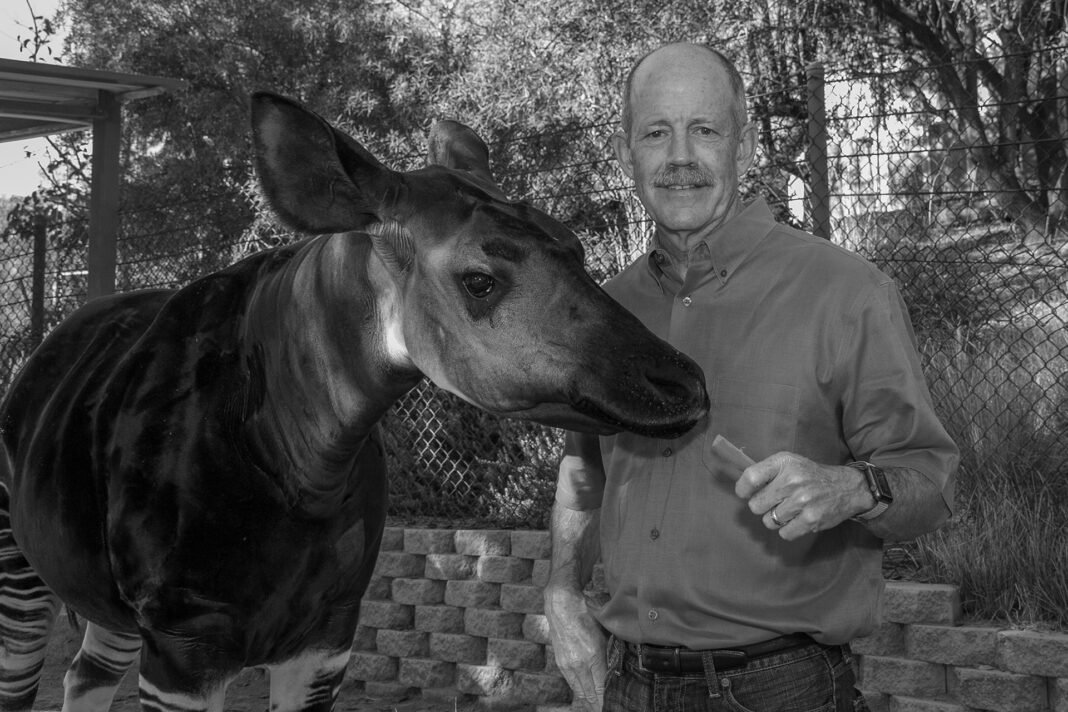
Banner image: Don Janssen with an okapi. Courtesy of the Association of Zoos and Aquariums (AZA).

Source:
news.mongabay.com