



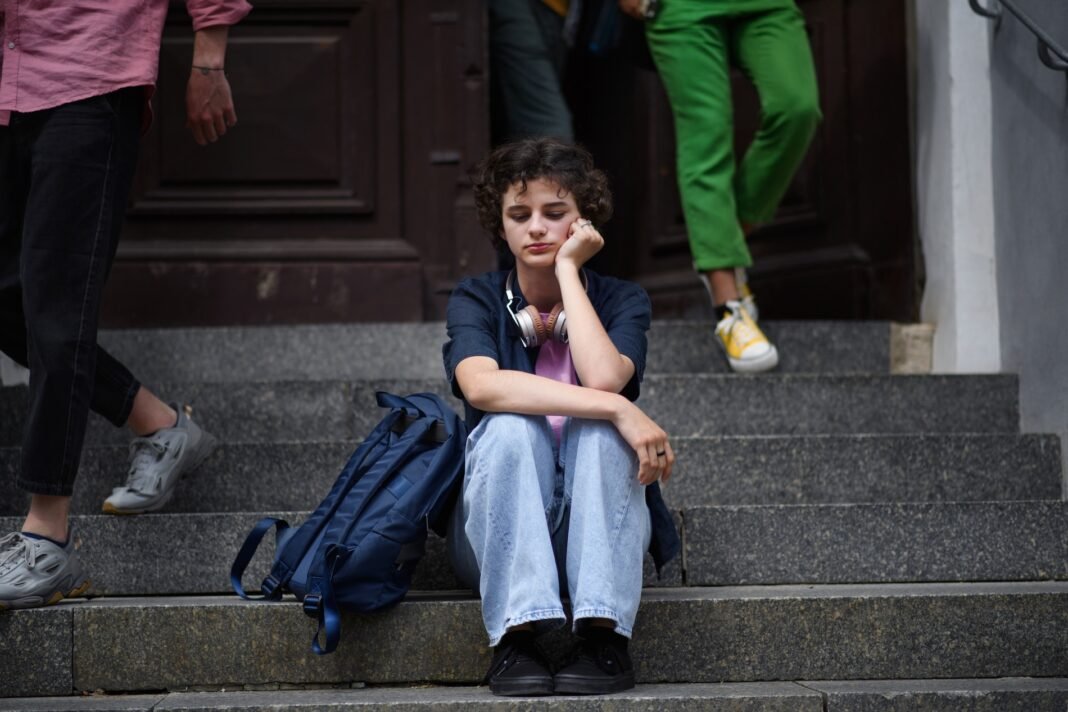

A new major national report reveals Poland’s youth are facing a deepening mental health crisis, with rising levels of stress and loneliness compounded by limited access to care.
The “Youth Diagnosis 2026” study, the largest of its kind in over two decades, highlights a growing gap between adolescents’ needs and the systems meant to support them.
“These alarming statistics are nothing more than a cry from children to adults [declaring] that they cannot cope with the reality we have created for them,” said Aleksandra Lewandowska, Poland’s national consultant in child and adolescent psychiatry.
Alarming data
The report points to a sharp deterioration in young people’s wellbeing, with high levels of chronic stress, emotional distress and social isolation. According to the report, 60% of teenagers live with chronic stress and exhaustion, 40% show depressive symptoms, while 17% report self-harm behaviours.
The findings also highlight widespread exposure to peer violence and persistent gaps in access to psychological and psychiatric support. Beyond individual outcomes, the data suggests deeper structural pressures linked to education systems, social expectations and the rapid expansion of digital environments in young people’s daily lives.
The publication of the report comes at a critical moment, as policymakers move into a phase of public consultations that will feed into a new national youth strategy coordinated by the Ministry of Education.
These consultations are expected to gather input from institutions, experts and youth organisations before the government moves to draft concrete policy measures. The strategy is set to define priorities across mental health, education, digital safety and civic participation, with a focus on prevention and earlier intervention.
Experts warn of systemic failure
Lewandowska told Euractiv that the findings reflect long-standing trends rather than a sudden deterioration. “I am not surprised by these results,” she said, noting that similar signals have been coming from young patients for years.
She pointed to growing pressure linked to education and digital environments. “Children disappear into digital technology, while companies are effectively shaping future consumers,” she said.
Lewandowska warned that isolated policy measures will not be enough. “Regulation without education will not be effective,” she said, calling for cross-ministerial cooperation. She added that without coordination between sectors such as health, education and digital policy, interventions risk remaining fragmented and ineffective. “We do not have time,” she added.
‘We are not being heard’
For young people, the report confirms both the scale of the crisis and a growing sense of exclusion. “We thought we still had time. The situation is much worse,” Filip Hornik from the Polish student organisation Akcja Uczniowska told Euractiv. He pointed to schools as a key source of pressure rather than support. “School does not support young people. It imposes pressure without giving them the tools to navigate the future,” he said.
Hornik also warned of a broader erosion of trust. “Lack of trust in public institutions translates into declining trust in democracy,” he said, calling the trend “very dangerous”. He criticised youth participation as largely ineffective. “We take part, our voice is heard, but it has no real impact,” he said.
His remarks reflect a wider concern that current consultation processes risk remaining symbolic unless they translate into binding policy outcomes and concrete institutional change.
Commissioner calls for clearer support system
The Office of the Commissioner for Children’s Rights also highlighted the need for stronger systemic action. The Commissioner told Euractiv of the ongoing efforts to improve access to mental health support, including calls for clear, publicly available information on where children and adolescents can receive free psychological and psychiatric care. Legislative work is also underway to strengthen protections for young people and prevent crises, including proposals developed together with youth organisations.
The Commissioner has previously raised concerns about online safety, including harmful content, weak age verification and risks linked to artificial intelligence, calling for coordinated action across institutions.
The report adds to growing pressure on policymakers to deliver tangible results after years of fragmented reforms and pilot programmes. With consultations now underway, the effectiveness of the upcoming strategy will depend on whether it leads to coordinated action across ministries and measurable improvements in access to care.
The issue has also been elevated at the European level. During Poland’s EU Council presidency, youth mental health was treated as a top priority, with young people actively involved in shaping recommendations alongside experts and officials.
[VA, BM]
Source:
www.euractiv.com