



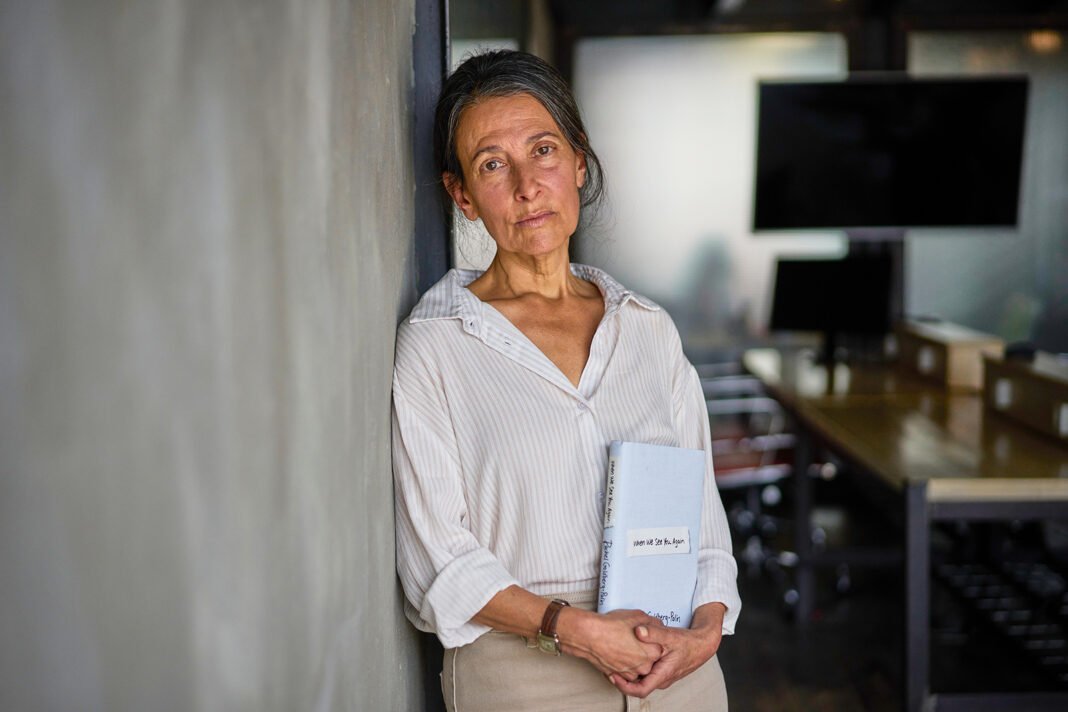

LISTEN TO THE INTERVIEW: RNS national reporter Yonat Shimron in conversation with Rachel Goldberg-Polin
(RNS) — Hersh Goldberg-Polin, a 23-year-old American-Israeli, became the public face for the 251 hostages abducted by Hamas from Israel on Oct. 7, 2023, largely because of his mother’s fevered efforts to win his release.
Rachel Goldberg-Polin, a native of Chicago who had moved to Jerusalem in 2008 with her family, made it her life’s mission to win Hersh’s release. Now, she’s written a book about her very private ordeal, “When We See You Again.”
In it, she describes not only the agonizing 11 months during which Hersh was held hostage in Gaza, and the immense grief she carries after his killing at the hands of Hamas on Aug. 31, 2024. She also explores the Jewish traditions her modern Orthodox family has leaned on in mourning their son, and she paints an endearing portrait of Hersh, a mystic of sorts who was forming his own spiritual journey.
RNS invited Goldberg-Polin to talk about her book. The following is a transcript of the conversation, which has been edited for length and clarity.
Yonat Shimron: Thank you for joining us.
Rachel Goldberg-Polin: Thank you so much for having me.
I wanted first to offer my condolences to you on Hersh’s death. We had spoken before his killing. Your book is really a searing testament to the grief that a mother feels for her dearly beloved son. Did writing the book help you ease the pain? How are you holding up these days?
I wish I could say that it eases the pain. I wish that there was some sort of difference in the suffering. But I think what writing the book did was, first of all, I felt that my soul was buckling from the weight of the pain and that I couldn’t shoulder it anymore. It was just too heavy and I couldn’t carry it inside my body anymore.
What I realized is that this book is the answer to, “How are you?” It very much spilled out, and I am hopeful that it will even have some of what you suggested — some sort of beginning of a whisper of a relief.
Relatives of U.S. citizens that are missing since the Hamas attack attend a news conference in Tel Aviv, Israel, on Tuesday, Oct. 10, 2023. Seated from left: Jonathan Dekel-Chen, father of Sagui Dekel-Chen (35) from Nahal Oz; Ruby Chen, father of Itay Chen, 19, a soldier in the armored corps; Ayala Neta, daughter, and Nahal Neta, son of Adrienne Neta, 66, a nurse living in Kibbitz Be’eri; Rachel Goldberg-Polin, mother of Hersh Goldberg-Polin, 23, who was attending the music festival, and Jonathan Polin, Hersh’s father. (AP Photo/Maya Alleruzzo)
Your book doesn’t delve into the politics surrounding the Hamas terrorist attack, or more broadly, the Israeli-Palestinian conflict. It’s really kind of apolitical. Why did you decide to stay silent on that?
I very much feel that this is a love story that’s swaddled in pain, or it’s a pain story that’s doused in love. But this book is about Hersh and my love for him. And you mentioned, I’m not a political person and I’m not a military tactician. And I’m also someone who very much believes that you can hold multiple truths.
You know, we have been endowed with this godliness of having insight and intellect available to us. And I think when we start looking at the world as if it’s a team sport, particularly with politics or with conflicts in the world, it’s playing into that very construct that is so dangerous. I was constantly talking when Hersh was being held captive. I kept saying, “You can hold two truths. I am terribly worried and concerned for the innocent civilians in Gaza, and I am terribly worried and concerned for the innocent civilians in Gaza who were dragged there on Oct. 7, and I happen to know one of them very well and share his DNA.” You don’t have to choose a side.
And so, for this book, it was irrelevant. Sort of the backdrop to me was irrelevant. What I really wanted to connect with people about is the human enterprise of loss, grieving, mourning, suffering and pain.
You and your husband, Jon, are modern Orthodox. You keep Shabbat, you keep kosher, you pray daily. Did these practices, and maybe especially the Jewish guidance around grieving the loss of a loved one, help you? Did it provide a structure that gave you comfort?
Tremendously. I mean, indispensable. I would actually say more so, in the day-to-day while Hersh was still alive, and in the day-to-day now, there certainly are prescribed traditions and laws that we adhere to immediately after a loved one is no longer with us. The seven closest relatives — mother, father, brother, sister, daughter, son, spouse — there is a whole structure of how we mourn for them. And that certainly is something that we can plug into. And when you’re in a crisis, when you plug into something, it certainly gives direction when you’re feeling unmoored and feeling that you’re not anchored. But what I get more groundedness from is the prayers that are prescribed for all of us regularly. So, for example, upon waking, many Jewish people say, as soon as we open our eyes, “Thank you, God, for giving me back my soul. You have tremendous faith in me.” And that’s an incredible line. I’ve been saying it since I learned it when I was a girl.
And it’s changed over time because I think I said it somewhat robotically as a girl. And then at some point, it started to make sense to me: The very first thing we say upon waking is, “Thank you. You have faith in me. You’ve given me back my soul today because I am not done.”

Hersh Goldberg-Polin was attending a music festival in southern Israel on Oct. 7, 2023, when he was taken hostage by Hamas. (Photo courtesy of Goldberg-Polin family)
And there is power in that. And so, when I was saying that, especially when Hersh was still alive, and I was feeling so tortured and angst and misery and torment. It was extremely grounding to say, “No, no. God has given you back your soul. Get up, get out there, run. Hope is mandatory. Flip that blanket off. Don’t you curl up in a ball. That will not save him or anyone.” And there’s real power still for me with that. And when I start my daily prayers — there’s prescribed daily prayers that we say three times a day, and there’s a paragraph that not everybody says, I really find it to be affirming. And it talks about, God has given me my soul and it will be guarded and protected until it’s time for it to go. And I say it in Hebrew, and then I say it in English for Hersh. I say, “You gave Hersh his soul. You guarded it. You protected it. You created it. You formed it. You breathed into it, and you protected him. You protected that soul until you took it from him. And I am so grateful that that soul still exists.” And then I start my prayers. And it kind of gives me a perspective where I can feel that he’s right here, even though I have to experience him in a very different way, in a very painful way.
You paint a very beautiful portrait of Hersh. He had already begun to build his own spiritual path, which was different from yours. He was something of a mystic. He bought tickets to go to India. Were you aware of his growing sense of spirituality before he was captured, or only afterwards?
I was aware of it, and I was relieved, even if he wasn’t doing exactly what we did. Hersh came to us a couple of years before he was kidnapped and he said to Jon and me, “Listen, I’m not going to be keeping Shabbat the way that you guys keep Shabbat and the way that our family keeps Shabbat for now, but I will always be respectful.” And I remember thinking, well, “What in the world is that going to look like?” And that was very painful as a parent in general, when our children come to us and they say, “This thing that you feel is a treasure, it doesn’t speak to me.” That’s always very painful as a parent. It doesn’t have to be about religion, it could be about many different things, myriad things.
But what it looked like really touched me because the biggest example of what he meant by that when he said, I’ll always be respectful, is we’re a family that goes to synagogue both Friday night and Saturday morning. And Hersh continued to come with us to both. And I was thinking a lot about how when we do things that are easy for us or that we want to do, that’s not really a test of who we are. It’s when you do things that actually don’t speak to you and are not integral to what you feel like doing, but you’re doing it because you love someone else, that is really holy.
And so I knew that he still had this very holy essence. And as you mentioned, he was intrigued and on his nightstand still today — I haven’t touched it — he is on Chapter 6 of “The Art of Happiness” by the Dalai Lama. He was in the middle of a book about Buddhism. He had just gone out on Yom Kippur, two weeks before he was kidnapped on Oct. 7, with two of his friends into the forest to do an ancient mystical practice of what’s called Hitbodedut, which is aloneness and fasting and reading spiritual passages. And I think he was searching. He was on a path. He wasn’t sure exactly where that path was going, but he was excited to be forging his way down that path. And I was really open to the reality that maybe he wasn’t doing exactly what I was doing, but that he was still within the framework of being very much respectful of us and still very curious. I think that curiosity was a really gorgeous part of him.
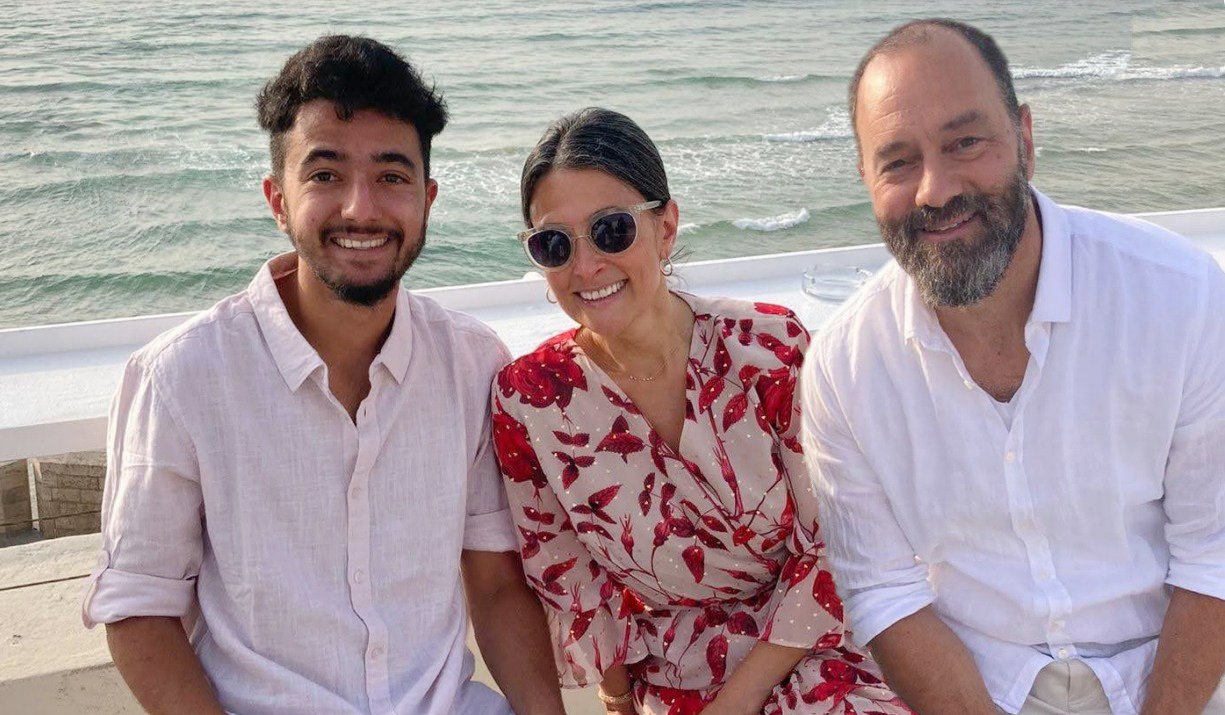
Hersh Goldberg-Polin, left, with his parents Rachel Goldberg-Polin and Jon Polin. (Photo courtesy of Goldberg-Polin family)
One of the most moving parts of the book is that you learned later that Hersh had read Viktor Frankl’s book, “Man’s Search for Meaning,” and its lessons really helped him and his fellow hostages deal with their captivity. Describe how you learned about this.
That was one of the most remarkable moments of my life that will stay with me until I go on to the next world and I’m buried next to Hersh. One of the other young men who had been kidnapped with him from the bomb shelter that he was hiding in was named Or Levy. The word Or in Hebrew means light, and I’m mentioning that because it will become evident. But Or Levy was released from captivity on day 491.
But on day 52, Or Levy was in a tunnel and in walked Hersh with another hostage named Ori Danino. And Hersh and Or Levy started to talk. And suddenly Hersh said to him, you were in the bomb shelter with me. And they jumped up and they hugged each other. Or told us this. And then Or talked about how for the next few days, all they did all day long was talk to each other. They were bored out of their minds, so they were so excited that new people had come into their tunnel. And Or told us that Hersh was constantly saying this mantra: “When you have a why, you can get through any how.” This is something that was said by Viktor Frankl in his book, “Man’s Search for Meaning,” which he wrote after the Holocaust. It’s a riff on what Nietzsche originally said, and it was what helped Viktor Frankl get through the Holocaust. And Hersh was saying to all the men who were in that tunnel, including Eli Sharabi, Eliya Cohen and Alon Ohel, he said, “You have to figure out your why.” They continued for the next 440 days saying that line over and over again, the four men together.
I had never read that book. So, of course you can imagine, I went running from the hospital late on a Thursday night and really wanted to read that book, and I have since. I actually have it in my bag. I travel with it. I bring it everywhere I go. To me, it’s a religious book.
I will always be eternally grateful to Or Levy. It absolutely changed our lives because until that moment, I can tell you, I was in complete darkness. And he let a little shaft open and a little ray of light came back into my life.
Or also told you that at one point, Hersh had heard your voice, either on the radio or TV, pleading for the release of the hostages. And that also was a turning point for you. It gave you a lot of comfort to know that Hersh knew you were fighting for him.
There are millions of mothers and fathers who have buried their children. And right now, there are thousands of people maybe listening to this who’ve buried children or know people who’ve buried children. But the situation that we were in for those 330 days of such horrific torture and torment, knowing that your child, knowing — we had video footage of his arm blown off, of his jagged bone sticking out — knowing he was being tortured, knowing he was starving, knowing he was in pain, and not being able to get to him and not being able to create a sense of urgency with decision-makers to get these deals going faster, to save these people. And suddenly, Or tells us that Hersh knew, he did know, that we were fighting for him. He heard my voice on the radio. And at first when Or was describing it, I thought he meant he heard on the news on the radio, Rachel Goldberg-Polin spoke to X, Y and Z. And he said, “No, no. He heard you being interviewed. He heard your voice.” And there was something about that, like a flutter of energy went through me of solace, knowing that this child, who will always be a child for me — he’ll always be frozen at 23, and he had just turned 23 four days before that — he knew his parents were running to the end of the earth to save him. And that is very important for me.
I also get the sense from your book that you are a very firm believer in the “Olam Ha-ba,” the world to come — the name of your book is, “When We See You Again.” Did you come to that after Hersh’s death or before?
In the Jewish tradition, there’s “olam hazeh,” this world, and “olam haba,” the world to come. And the many of our wisest commentators throughout the millennia have talked about this idea. Originally, it’s in Ethics of Our Fathers in a section of the Mishnah, that this world is a hallway. The world to come is the banquet hall. You’re going through this world in order to get somewhere else. And I’ve always felt that, but now certainly it’s very visceral, it’s very touchable, it’s very swallowable to me. When I stood six miles from my home and put my son in the ground, I knew I was burying part of myself. I kept saying to people, “I feel like I’m living on another planet, I feel like I’m in another galaxy.” And finally I have this wonderfully wise friend who said to me, stop saying that — it’s that part of you is in the world to come. Part of you is already in the world to come. And the rest of you is here, but that’s what you’re feeling.
And it’s true, and it was a sense of real comfort to know that. That the void that I’m feeling is actually something to look forward to. Because part of me is already holding a seat on the bus, and one day the rest of me will be there. And there is comfort in that. There is consolation in that for sure.
One last question. What’s next for you? Has Hersh’s death helped you find your why for now?
The Baal Shem Tov, who was sort of the founder of the mystical Jewish movement 300 years ago, was once asked, “Why does a soul come to this world?” Like, what is this world about? What’s the point? And he said, “A soul comes to this world so that one day in their whole lifetime, they will do one act of kindness for one person.”
Now, that doesn’t mean that you don’t do thousands of acts of kindness and do thousands of things to make this world different and better and improved, but we’re all here. There’s one time specifically that you do your act that your soul was created and sent here to do, and then you leave. Now that might be for some people, it might take them 98 years. And for some people it might take them seven years. And for Hersh, it’s clear to me that within those 23 years, he did do his act of kindness.
But I’m very aware that I’m not done, and that maybe I still have to have someone else do their act of kindness to me. So we’re all interwoven and I am very much trying to hone in on what is my “why” now. And stay tuned because we definitely feel the fire under us of, we have to really help make a difference for good.
I will stay tuned. Thank you so much for this.
Source:
religionnews.com