



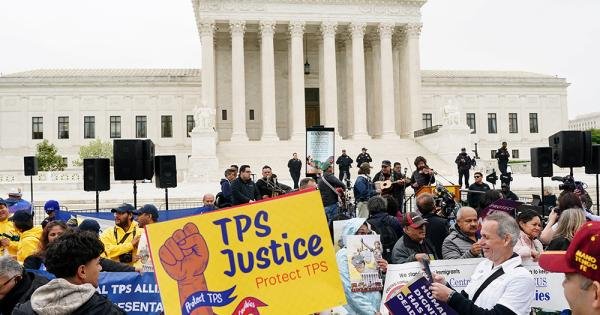

The U.S. Supreme Court justices appeared closely divided during April 29 oral arguments about the Trump administration’s attempts to end temporary protected status for Haitian and Syrian immigrants.
The justices grilled U.S. Solicitor General D. John Sauer, who argued that a provision in the federal statute that created the Temporary Protected Status program in 1990 prohibits judicial review of TPS determinations that are made by the secretary of Homeland Security.
“That provision means what it says,” said Sauer, who added that “attempts to carve out exceptions to the review bar would eviscerate it.”
“Congress could have said any termination of TPS status is unreviewable, but it didn’t,” said Justice Sonia Sotomayor, who added that the law seems to allow legal challenges to the procedural steps an administration takes when deciding whether to extend or remove TPS protections.
“What you’re basically saying is Congress wrote a statute for no purpose,” Sotomayor said.
Temporary Protected Status is granted by the Department of Homeland Security to people from countries who are unable to return to their homes safely and allows them to live and sometimes work in the United States without fear of deportation.
The Obama administration granted TPS protections for Haitians in 2010 after a catastrophic earthquake in Haiti that killed and displaced hundreds of thousands. Those protections have been extended several times since then amid political instability, a cholera epidemic and widespread gang violence.
In 2012, Syrians were granted protected status during a civil war that lasted until President Bashar Assad’s government fell in 2024. The U.S. government has also repeatedly extended TPS for Syrian immigrants because of persistent armed conflict in the country.
After Donald Trump took office in January 2025, then-Secretary of Homeland Security Kristi Noem moved to end the TPS designation for Haiti and Syria. The administration said the decision was based on U.S. national interests and the conditions in both countries.
In January, two bishops who are chairmen of committees at the U.S. Conference of Catholic Bishops called on the Trump administration to extend TPS status for Haiti.
“There is simply no realistic opportunity for the safe and orderly return of people to Haiti at this time,” said Bishop Brendan Cahill, chairman of the Committee on Migration, and Bishop A. Elias Zaidan, chairman of the Committee on International Justice and Peace.
Chief Justice John Roberts signaled skepticism toward Sauer’s argument that the court should draw on its 2018 decision in Trump v. Hawaii, when the court declined to block Trump’s travel ban in his first term that targeted several Muslim-majority countries.
“You rely on Trump v. Hawaii in your argument, but that involved the president and entry restrictions,” Roberts said. “Here, we are concerned with the [Homeland Security] secretary and aliens that are already present. Your argument is a significant expansion of Trump v. Hawaii, isn’t it?”
The majority of the court’s justices focused on the administration’s argument that the federal courts are not allowed to review TPS decisions made by the Department of Homeland Security.
“It is always going to be possible … to raise procedural objections” to TPS decisions, said Justice Samuel Alito Jr., who added that “there was some consultation” among administration officials before TPS was removed from Syria in September.
“It was very brief, and maybe it was not what one would hope for, but still,” Alito said.
In response to a question from Justice Brett Kavanaugh, who asked why Congress would have wanted to prohibit judicial review of TPS decisions, Sauer said that making a TPS determination is “the sort of foreign policy-freighted decision that lies at the heartland” of the executive branch’s competence.
Attorneys representing the approximately 6,000 Syrian and 350,000 Haitian TPS beneficiaries said that while final TPS decisions may not be reviewed by a federal court, the judiciary is within its purview to examine the process by which the administration decides to remove the designation.
And in the case of the Syrian and Haitian beneficiaries, the attorneys said the process was influenced by Trump’s “racial animus” toward them.
During a 2018 White House meeting with lawmakers, Trump complained about the United States having to take immigrants from Haiti and “shithole countries” in Africa. During the 2024 presidential campaign, Trump amplified falsehoods that Haitian immigrants in Ohio were eating their neighbors’ pets.
In February, U.S. District Judge Ana Reyes ruled that the removal of TPS protections for Haiti were likely motivated, in part, by “racial animus,” which she noted would violate the Constitution’s equal rights protections. Reyes also wrote in her 83-page decision that it appeared “substantially likely” that Noem’s decision to terminate Haitian immigrants’ protected status was “preordained” due to “hostility to nonwhite immigrants,” and did not follow proper procedures.
Justice Ketanji Brown Jackson cited Reyes’ ruling during the April 29 arguments and suggested that it deserved deference since it was a factual determination made by a federal district court judge.
Sauer has said that Trump’s comments about Haiti had been taken out of context and that the court should not take political campaign rhetoric into consideration. During arguments, Sauer said Trump’s statements were references to poverty and crime.
“It’s important to understand that the Trump administration’s actions to cancel TPS are part of a broader effort to take away immigration status from more than a million persons in the country legally, who have parole, TPS or some other form of legal status,” said Dylan Corbett, executive director of the Hope Border Institute, an El Paso-based nonprofit that partners with the Diocese of El Paso to advocate for migrants.
“The fate of those here legally for decades, their U.S.-born children, and their vital economic contributions as taxpayers all hang in the balance with this Supreme Court case,” he told Our Sunday Visitor. “We need to pivot away from mass deportation to real solutions so that we can manage our border responsibly, protect families and address migration in a way that benefits everyone.”
A decision in the case is expected by the summer.
Source:
www.ncronline.org