




As the robotics world races to mature beyond closed demonstrations, founders and CEOs in the robotics space told Business Insider that experience with deploying self-driving cars into the real world makes AV employees ideal candidates for hire.
Loading audio narration…
“We definitely look for AV experience,” Adrian Macneil, cofounder and CEO of Foxglove, a data infrastructure platform for robotics companies, told Business Insider. “The reason is that AV was the first big application of physical AI, so people who have worked at AV companies have seen what it takes to ship complex physical AI at scale.”
Macneil himself was an alum of General Motors’ robotaxi venture, Cruise, before founding his startup in 2021. At his startup, which has 75 employees, roughly 40% are from AV or AV-adjacent companies, he said, including Waymo, Motional, Aurora, Applied Intuition, Luminar, and Cruise.
Autonomous vehicles are a marriage of software and hardware, roughly boiled down to turning noisy real-world data into safe and reliable physical action, i.e., steering a car. Zoom in further, and the cycle could entail data collection, training the driving models, validating safety, and, finally, deploying autonomous cars.
Robots, whether utilized for home or industrial applications, will require a similar process.
Tony Zhao, CEO and cofounder of Sunday Robotics, which is building home robots, told Business Insider that seeing AV experience on résumés is a plus. He sees talent transfer on both the software and hardware sides.
“When it comes to hardware, there are just not that many exciting hardware companies that combine AI and cutting-edge technology,” he said.
From a software perspective, Zhao said the pipeline from data input to driving output requires what’s called “systems-level thinking,” in which engineers must ask questions such as which sensors are most appropriate or how messy data will translate into real-world action.
That’s different from working with Large Language Models, where the input and output are all text, which is “very straightforward,” the cofounder said.
At his company of about 70 people, Zhao said between 30% to 50% of his startup have AV-related backgrounds, including experience at Tesla. Zhao and his cofounder, Cheng Chi, are also AV alums: Zhao worked with Tesla’s Autopilot team, and Chi was a software engineer at Nuro, which is now preparing for a commercial launch of robotaxis with Uber later this year.
‘A very small community’
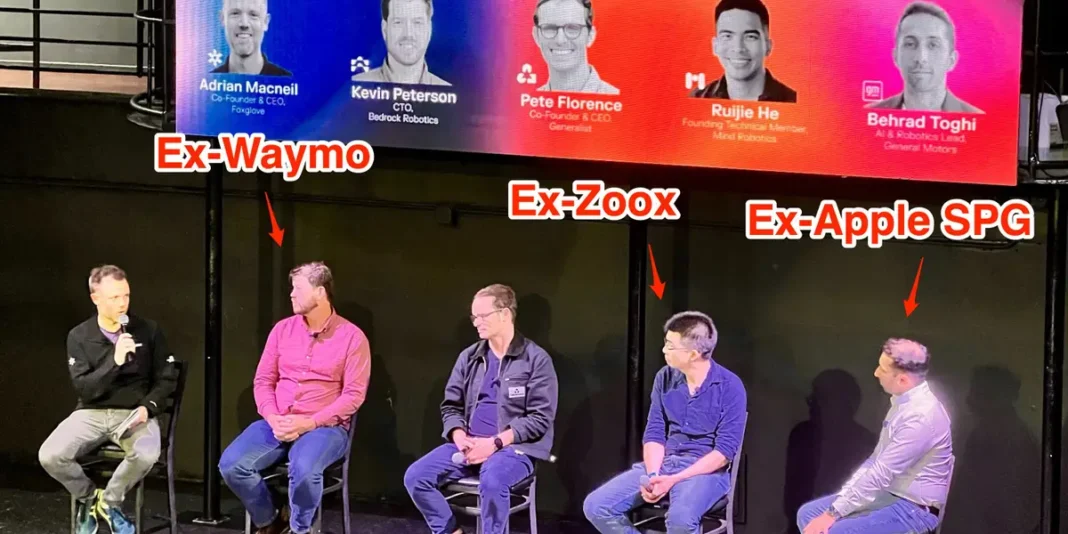
On a Thursday night in San Francisco’s South of Market neighborhood, Macneil’s Foxglove and VC firm Eclipse Capital turned a nightclub into a gathering space for its first “Physical AI Industry Night.”
Lloyd Lee/BI
Three out of the four speakers for the evening’s panel were robotics executives who graduated from the AV industry: Kevin Peterson, CTO of Bedrock Robotics, who came from Waymo; Ruijie (RJ) He, founding technical member of Mind Robotics, who was a director at Zoox; and Behrad Toghi, AI & Robotics lead at General Motors, who was part of Apple’s Special Projects Group working on autonomous cars.
Each of the ex-AV panelists spoke on the transferability of autonomous vehicle experience to robotics.
“Some of the best people to hire today to work on robotics are AV people, because it’s very similar,” Toghi said, adding that the robotics field is starting to mirror some of the trends and maturity curve AVs went through from 2014 to the present.
Toghi said folks in the AV space also have experience working in large teams because evaluating and validating autonomous vehicle technology is a “massive operation.”
Lloyd Lee/BI
Ritika Shrivastava, who was a Tesla Autopilot engineer before cofounding Ember Robotics in 2024, told Business Insider that AV engineers have recognized the challenges that robotics now faces.
“The mindset is exactly the same,” she said. “In AVs, you have a lot of planning, sensing, and actuation, and then you have the same exact thing in robotics as well.”
More than 200 people from over 110 robotics companies attended Thursday’s Physical AI night, a Foxglove rep said. And nearly 30 of those companies came from the mobility sector, including Waymo, Tesla, Zoox, Nissan, and Toyota Research Institute.
Some of those employees who asked not to be named for this story said they were merely curious attendees.
Zhao didn’t attend the Physical AI night, but he told Business Insider he was familiar with a few of the speakers and companies, including Pete Florence, CEO of Generalist robotics, who was another panelist. Zhao recalled being in the same room with Florence and others around 2023 when they were at Google DeepMind before they moved on to start a robotics outfit.
“It’s a very small community,” Zhao said.
Source:
www.businessinsider.com