



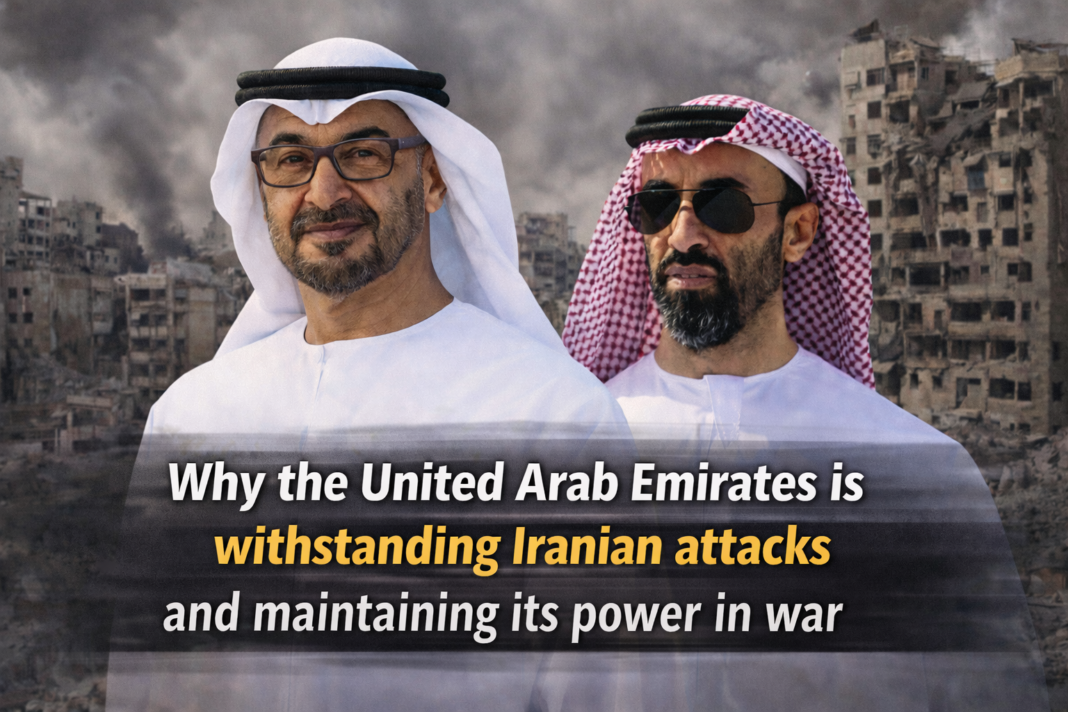
In a region once again dominated by the logic of power balances, where the confrontation between Iran, the United States and Israel is reshaping the strategic landscape of the Middle East, one actor stands out for its ability to absorb shocks without yielding: the United Arab Emirates. Targeted by repeated waves of missiles and drones, the UAE has not merely resisted. Over the course of recent weeks, it has demonstrated a form of modern power built on anticipation, technology and stability.
The first explanation is military, but it goes far beyond equipment alone. It is true that the UAE now possesses one of the most advanced defense architectures in the world, capable of intercepting the vast majority of ballistic and asymmetric threats. Yet what is most striking is not only technical efficiency, but the ability to transform a saturation war—based on the massive deployment of drones and missiles—into a controlled operational environment. While Iran’s objective is to exhaust defensive systems, Abu Dhabi responds with an integrated approach, combining interception technologies, allied coordination and rapid execution. The result is clear: the real impact of attacks remains limited, and the psychological effect sought by Tehran is largely neutralized.
This effectiveness cannot be understood without considering a dimension that often remains invisible but is decisive: intelligence. The UAE has gradually developed one of the most advanced security and intelligence apparatuses in the region, built on technological surveillance, international cooperation and threat anticipation. A significant portion of interceptions is not merely reactive, but preventive. In other words, the battle is not fought only in the sky, but well before, in data analysis, strategic foresight and the ability to predict. This silent war has become one of the central pillars of Emirati resilience.
Behind this security architecture lies a key political factor: leadership. Under the direction of Mohamed bin Zayed Al Nahyan, the UAE has embraced a long-term strategic vision focused on investing in critical capabilities and maintaining a clear-eyed understanding of regional threats. Alongside him, in a more discreet but equally decisive role, Tahnoon bin Zayed Al Nahyan embodies the growing influence of security and intelligence institutions at the heart of decision-making. This alignment between political authority and security structures enables both rapid response and a level of strategic coherence rarely seen elsewhere in the region.
Yet the true singularity of the UAE may lie in its ability to combine military strength with internal stability. Unlike other states weakened by political or social tensions, the UAE presents a remarkably solid domestic front. This stability, rooted in a centralized political model and carefully managed social dynamics, prevents disruption in times of crisis. It ensures continuity of governance, efficiency in decision-making and consistency in execution.
It is precisely this internal strength that explains why, despite ongoing attacks, the economic impact remains limited. Key hubs such as Dubai and Abu Dhabi continue to operate as global centers of trade, finance and logistics. Critical infrastructure remains protected, energy flows are secured, and investor confidence has not been significantly undermined. In fact, amid regional instability, the UAE increasingly appears as a safe haven for capital, reinforcing its attractiveness rather than diminishing it.
This resilience is further supported by substantial financial power. Emirati sovereign wealth funds, among the largest in the world, provide exceptional capacity to absorb shocks. This financial depth allows the country not only to stabilize its economy during crises, but also to sustain high levels of investment in strategic sectors such as defense, technology and innovation.
Ultimately, the UAE is not merely a defensive military power. It represents a technologically integrated state, where advances in artificial intelligence, cybersecurity and critical infrastructure management directly enhance security capabilities. This fusion of civilian and military domains, of economy and defense, is one of the most advanced features of its strategic model.
Finally, its geopolitical positioning plays a decisive role. By aligning clearly with the United States and Israel, the UAE benefits from a framework of cooperation that strengthens its deterrence capacity. Beyond this alignment, it is also emerging as a stabilizing actor, committed to securing global trade routes and energy flows, particularly in strategic areas such as the Strait of Hormuz.
Does this mean the UAE is invulnerable? Certainly not. Some attacks have caused damage, and pressure remains constant. But the essential point lies elsewhere. The UAE has demonstrated that a state can, even in a highly hostile environment, absorb repeated shocks without losing its coherence, stability or attractiveness.
In the end, its resilience does not rely on a single factor, but on a rare combination: advanced technology, effective intelligence, strategic leadership, political stability and financial power. In this war, the United Arab Emirates is not simply holding the line. It is quietly redefining the contours of power in the Middle East.


