




Hong Kong and Singapore imported more than 1 million live wild birds between 2006 and 2020, according to a new analysis of customs data published in Conservation Biology. Nearly two-thirds of the birds were from Africa.
The study highlights a massive, often under-regulated trade that threatens wild populations and poses significant risks for the spread of invasive species and deadly diseases, Mongabay’s Spoorthy Raman reports.
Rowan Martin, director of bird trade at the World Parrot Trust, and his colleagues used U.N. Comtrade data to track the trade of wild birds. They found that Singapore accounted for nearly three-quarters of the imports, and Hong Kong was a second hub. Canaries (Crithagra spp.) topped the list of birds entering Hong Kong, with the yellow-fronted canary (C. mozambica) and white-rumped seedeater (C. leucopygia) making up 84% of African imports between 2015 and 2020.
Martin’s team found that about 65% of the birds came from Africa. Mali, Guinea, Tanzania, and Mozambique were the primary exporters.
“African birds are prominent because there’s been very little regulation of the exports,” Martin told Mongabay. “There are relatively few large-scale exporters operating in West Africa, and often these family businesses have big holding facilities where they aggregate birds prior to export.”
Martin and his colleagues found bird imports to Hong Kong and Singapore increased after 2006. He credits this to rising middle-class wealth in Asia, more flight connectivity, and social media, which facilitates connections between exporters and buyers.
Simon Bruslund, a bird trade researcher from the Copenhagen Zoo who was not involved with the study, noted that “exporters quickly adapt to opportunities.”
In 2007, Ghana removed 114 bird species from the Convention on International Trade in Endangered Species (CITES) Appendix III, which regulates and monitors the legal trade. A 2025 study by Bruslund and his colleagues found some U.S. imports of those bird species surged fourteenfold after the CITES change.
Transporting birds tightly packed together creates ideal conditions for the spread of pathogens that cause avian influenza, circovirus, and psittacosis, which can transmit to humans. Furthermore, escaped pets can become invasive. For example, the pin-tailed whydah (Vidua macroura) in parts of the U.S. and the Caribbean is outcompeting native birds.
Birds collected from across Africa are often brought together in open air markets which create, “perfect conditions for the horizontal transfer of pathogens between different species,” Martin said. “The biosecurity risks are pretty terrifying.”
To mitigate these risks, Bruslund suggests adopting a registration and documentation system for all wild animals kept in captivity. South Korea, Singapore, and some EU countries are adopting “positive lists” of animals that are sustainably-sourced and aren’t potentially invasive or a health threat.
Read the full story by Spoorthy Raman here.
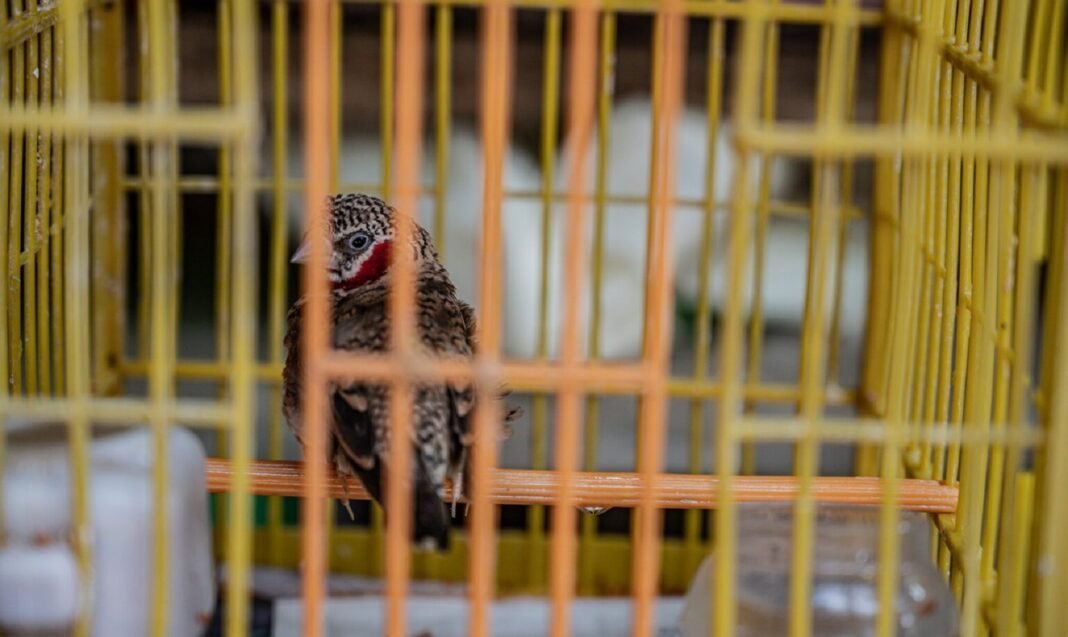
Banner image of a cut-throat finch (Amadina fasciata) for sale in Hong Kong. Image courtesy of Sam Inglis.
Source:
news.mongabay.com