



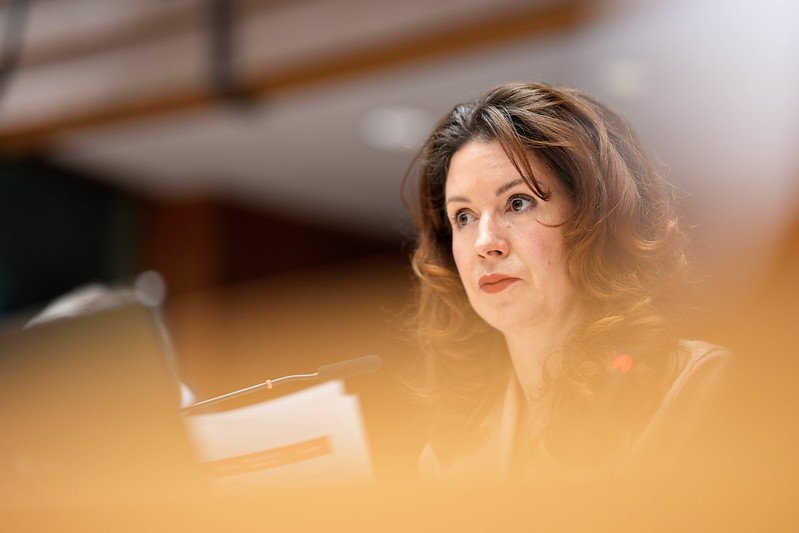
As the gloves come off in the negotiations on the EU’s next long-term budget, Kata Tüttő, the Committee of Regions president, told Euractiv why regional and cohesion policy must not be treated as a second-class concern.
Tüttő fears that a European Commission’s structural overhaul of the budget, now signed off by capitals, will weaken cohesion policy – designed to make sure poorer regions don’t fall behind.
Under the €1.76 trillion budget plan, cohesion is ultimately nationalised whereas competitiveness becomes the big-ticket item as an explicit EU priority for the 2028-2034 spending plan.
“Cohesion policy is not a European policy in the budget proposal,” Tüttő, a Hungarian socialist, argued. “Europe creates the winners, member states are left to deal with the losers, with fewer resources.”
‘Just a bag of money’
Under the new structure, regional funding will be folded into cash-for-reforms national plans, where multiple policy areas will have to compete for funds. The controversial plans would be centralised and negotiated between the Commission and capitals.
“Introducing national envelopes reduces cohesion policy to just a bag of money,” said the president, who has been representing European regions and local authorities since early 2025, adding that the Commission’s touted simplicity of the budget shifts responsibilities from Brussels to capitals.
“All the conflicts are put from the European Commission level to the level of member states,” Tüttő said. “The European Commission can tell major cities looking to Brussels for solutions on housing, or islands facing specific challenges, to turn to their national governments … the Commission can simply say: the money is there, go to your member state government.”
The national plans, a core piece of the new budget, would take up the biggest chunk of the budget, with €771 billion earmarked. The proposed new budget architecture foresees merging a plethora of policy areas into a “mega fund”, centred around the national plans, with more flexibility in spending and allocating funds.
“It’s a big danger that the proposed flexibility turns long-term investment resources into a short-term emergency fix,” the Hungarian politician warned.
Agriculture and cohesion, two historically separate budget lines worth about two-thirds of the whole budget together, would also be bundled together with trimmed resources to the tune of less than half of the proposed budget.
“We see there’s less appetite in spending more together,” Tüttő said, warning that the ever-growing laundry list of demands on the budget isn’t met with enough financial ambition.
Though the recent Cypriot budget proposal left the national plans almost untouched, this is likely to change over the course of the tough negotiations with fiscally hawkish countries demanding drastic cuts, eying cohesion and agriculture spending in particular.
BUDGET BRIEF: Can the MFF fix the single market?
This is Victoria Becker bringing you this week’s BUDGET BRIEF on the EU’s next seven-year…
11 minutes
Eyes on the price
For Budapest’s former deputy mayor, the fight about the budget often overlooks a crucial part of the original bargain between competitiveness and cohesion.
“Many don’t see cohesion policy as a long-term decentralised investment policy connected to the single market, but it is: it was born together, to rebalance the single market,” she said.
In her view, cohesion funds can’t simply be seen as a transfer from richer to poorer countries but as a complementary mechanism, backed by the EU’s treaties, helping to offset unevenly distributed single market gains.
“Those who contribute in net value to the budget are the biggest recipients from the single market,” the Hungarian politician said. “Every single cent they invest in the EU budget has a three, four, five, six times return through the single market.”
“The narrative of net contributors turns cohesion policy into a charity fund,” Tüttő said. “It’s not, without it the single market would turn into an extraction model.”
(bw, aw)
Source:
www.euractiv.com
