



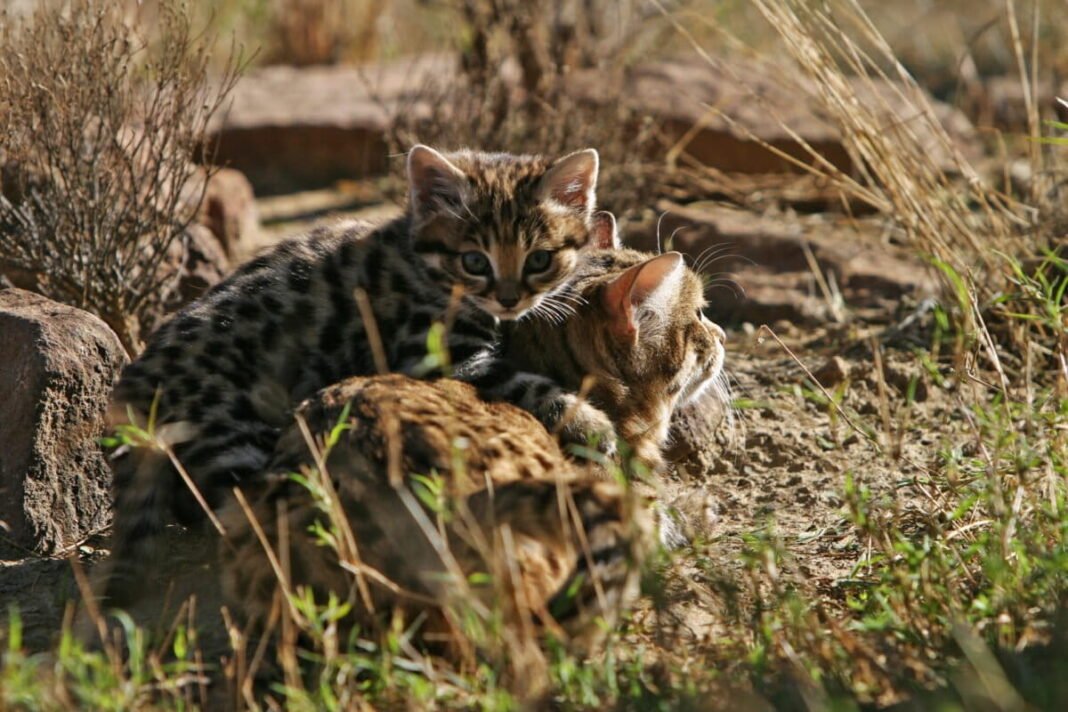

Africa’s smallest wildcat uses abandoned springhare burrows to raise its kittens, according to new research.
There are fewer than 10,000 black-footed cats (Felis nigripes) left in the wild and studies on these nocturnal animals are rare. To learn more about them, a team of researchers tracked five female black-footed cats (Felis nigripes) with radio collars and scanned more than 50 burrows in southern Namibia between 2020-21.
The research found that 98% of the dens used by the cats had originally been dug, then abandoned, by springhares (Pedetes capensis), an endemic rodent which looks like a cross between a small kangaroo and a rabbit. The cats depend on springhares to provide the underground dens where the felines raise their kittens for the first six to seven weeks of life.
“I can’t prove black-footed cats would disappear without springhares, but at this site they would be much more vulnerable,” Harold Brindley, the study’s lead author and a researcher at the University of Cape Town, South Africa, told Mongabay contributor María de los Ángeles Orfila.
Researchers used laser-based, remote-sensing technology to measure tunnel dimensions and determine which species created them. The cats selected burrows with tunnel entrances between 10 and 27 centimeters (4 and 11 inches) in diameter. They ignored smaller rodent holes and larger aardvark or porcupine burrows.
After the kittens reached about seven weeks of age, mothers typically transitioned from staying in one location for nearly a week at a time, to moving to a new burrow nearly every night. On average, each cat used 12 different shelters over the course of the study.
According to the authors, cat mothers likely switch dens more frequently once kittens begin exploring to reduce the risk of being hunted and killed by black-backed jackals (Lupulella mesomelas), caracals (Caracal caracal) and other predators.
“I can make the obvious assumption that predation risk is high when those little furballs first start exploring the world and playing with everything while mom is trying to hunt and keep them safe,” Brindley said.
Black-footed cats are the world’s most efficient feline hunters with success rates higher than that of lions or leopards.
Read the full story by María de los Ángeles Orfila here.
Banner image: Black-footed cats (Felis nigripes) in southern Namibia. Image courtesy of Alex Sliwa.

Source:
news.mongabay.com