



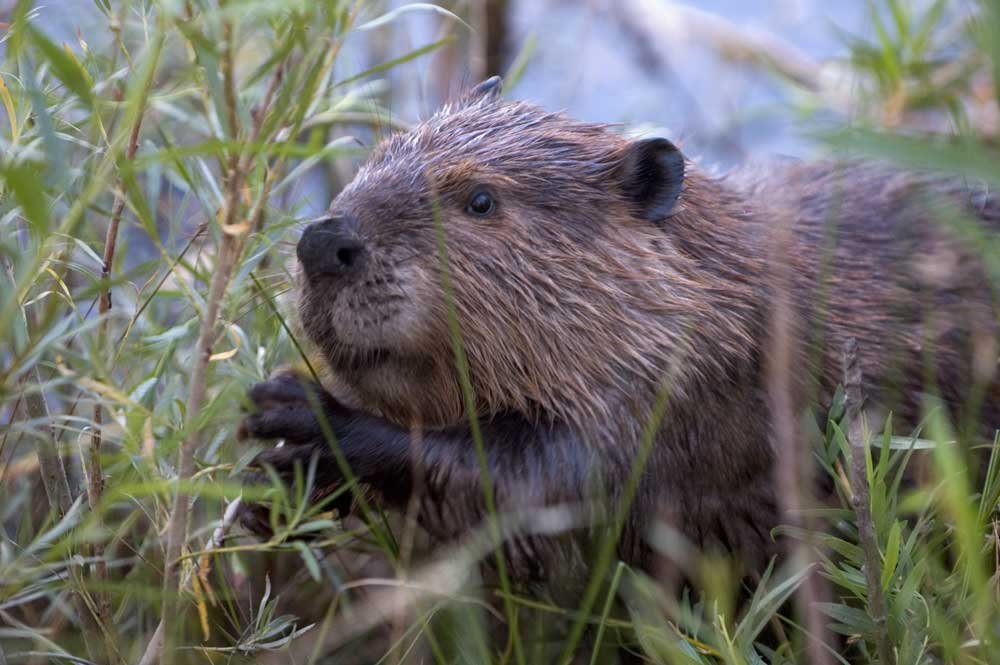

Beavers are well-known residents of rivers, lakes and streams across North America. New research finds they are also far more common in estuaries and tidal wetlands than was previously understood. The study suggests the rodents are critical ecosystem engineers in a habitat where twice-daily tides raise and lower water levels, bringing saltwater inland from the sea.
Estuarine ecologist and self-described “accidental beaver biologist” Greg Hood surveyed estuaries and tidal wetlands across coastal British Columbia and the U.S. states of Washington and Oregon. He found beavers (Castor canadensis) in those ecosystems by surveying places other scientists tend to overlook.
“Estuarine scientists and beaver biologists are generally working in other areas — the beaver biologist in normal streams and lakes where they expect to find beavers; the estuarine ecologists typically in herbaceous tidal marshes or even in eelgrass,” Hood told Mongabay in an email. Adding that scientists rarely work in “tidal shrub and forest habitats (tidal swamps) where beaver are most likely, because tidal swamps are very hard to move around in.”
Hood found that beavers are widespread in tidal habitats across the Pacific Northwest. In some tidal channels of the Snohomish and Skagit rivers, he found beaver dams at twice the density of such dams on non-tidal rivers.
Beaver dams in tidal habitats are shorter than those on non-tidal rivers, according to Hood’s research. He hypothesizes that since these dams are flooded at high tide, that their main function is to trap water at low tides, which allows beavers to continue moving freely through the river system even when the tide is out.
Hood found that tidal beaver dams likely provide important low tide refuges for many fish species, possibly including endangered salmon species like Puget Sound Chinook salmon (Oncorhynchus tshawytscha) and Oregon Coast coho salmon (O. kisutch).
To continue the research, Hood and beaver biologists from the Tulalip Tribes put a GPS tag on one tidal beaver to follow it in otherwise impenetrable habitat; they hope to tag 20 more.
“Tagging data will tell us what kind of habitat they use in tidal wetlands; how much habitat they need (territory size); how their movements relate to tides; perhaps what kinds of tidal channels they most often frequent; perhaps how they partition time between multiple lodges; and perhaps things that we haven’t even thought about (surprises!),” Hood said.
Environmental journalist Ben Goldfarb has written extensively about beavers and their role as a freshwater keystone species. “Hood’s research suggests beavers are equally indispensable along the coast, engineering deep pools for fish, including juvenile salmon, in estuaries plagued by habitat loss,” Goldfarb wrote in 2019 of Hood’s previous work on tidal river beavers. “Acknowledging the importance — indeed the existence — of coastal beavers might just be vital to re-creating a lost intertidal world: an ecosystem sculpted by rodent teeth, undone by human hands.”
Banner image: North American beaver. Image by Chuck Szmurlo via Wikimedia (CC BY-SA 3.0)
Source:
news.mongabay.com