



See All Key Ideas
MANAUS, Brazil — On June 20, a 50-member team led by NGO Asas de Socorro and Rede Reviva walked about 1.5 kilometers (1 mile) along the shoreline of the Puraquequara Lake in eastern Manaus during a garbage-collection effort. When the activity finished covering a stretch of beach on a lake with a water surface estimated at 20-25 km2, the group had gathered a dumpster full of plastic waste. A similar effort in June 2023 had collected two dumpsters.
The group’s experience helped illustrate the results of Eletuza Uchôa Farias’s master’s research: Half of the fish collected at the lake, from two jaraqui species (Semaprochilodus insignis and Semaprochilodus taeniurus), had ingested microplastics. Once inside an organism, the particles can remain in the intestinal tract, reach other tissues and organs, and move through the food chain — from the base to predatory fish — potentially ending up in humans. The jaraqui is the most consumed fish in Amazonas state.
All particles found in the fish intestines were fibers: 0.5-4.37 millimeter-thin, elongated filaments. Most of them — 85.7% — were identified as polyamide, a polymer widely used by the textile industry for its strength and flexibility.
The Puraquequara’s surroundings are home to communities with no effective basic sanitation. Water from sinks, tanks and washing machines is dumped directly into water bodies, which may explain the presence of polyamide that reach the jaraquis — which, in turn, end up on the plates of Amazonian residents.
The Puraquequara case serves as a snapshot of plastic contamination in the Amazon. While microplastics are extensively studied in other parts of the world, in this biome there are cities with poor infrastructure, inadequate sanitation, and households without regular waste collection. Moreover, this area has aquatic ecosystems with unique characteristics, in conditions that are not easily comparable to those elsewhere on the planet.
“We need to start thinking about what we can do to keep this population living in their territories and solve the problems created by urban occupation itself, as is the case with microplastics,” Farias said.
Puraquequara: A portrait of urban Amazon
Located 27 km (17 mi) from downtown Manaus, the Puraquequara Lake is part of an Amazon still under-represented in national and international environmental debate: Urban Amazon. In the early 1900s, the area received its first settlers, who had migrated from other parts of the state. Starting in 2005, urban expansion accelerated the replacement of shoreline vegetation — which then covered 81% of the basin — with a mix of exposed soil and housing.
The lake is now strategically located in Manaus. It receives residents and community members from smaller towns who travel to the state capital in search of services, jobs or other opportunities, creating a heavy flow of boats. Proximity to the Industrial District has also turned the area into housing for workers. In addition, the roughly 5,000 people living nearby use the lake for subsistence fishing, family farming, animal husbandry and recreation.
William Gomes, 26, is a manager at Asas de Socorro. He was born and raised in Puraquequara and helps organize lakeshore trash collection efforts, usually by volunteers using canoes. According to him, household waste is often left in front of houses or discarded improperly. When it rains, it is carried by the water and ends up in the lake.
He was surprised to learn that the lake’s jaraquis contained microplastics in their intestines. “Over the years, we have carried out several awareness actions and even installed recyclable waste collection points, but we’ve had a hard time engaging the community,” he said.
In 2024, the NGO Asas do Socorro installed five collection points at strategic spots in the village. However, Gomes said residents soon began using them as regular dumping sites. Even after educational sessions and door-to-door visits, the recyclable waste collection program failed and was discontinued in 2026. Gomes and his team are now planning new ways to revive the project and make it more effective.
He doesn’t blame individual Puraquequara residents. “Before I got involved with the issue, I also used to think that environmental talk was nonsense,” he said. For him, the area’s poor infrastructure marked by irregular occupation and floating houses is a primary driver of pollution.
Until 2023, for example, the city used to collect waste in the area only once a week. After Asas do Socorro sent a letter to the Municipal Urban Cleaning Department (SEMULSP), the frequency rose to three times per week.

The water supply in the Puraquequara village and surrounding riverside communities comes from artesian wells and underwater pumps that draw it directly from the river. Families pay a fee to the residents’ association that manages the wells.
Without a waste-collection and sewage-treatment network, household wastewater is discharged straight into the river, compromising water quality, especially during the dry season when water volume is lower.
“While it’s not possible to tell the source of these microplastics with absolute certainty, it’s safe to say that lack of basic sanitation and proper waste collection is one of the main factors linked to the contamination,” Farias said.
She added that further studies are needed to map microplastic distribution in the Puraquequara’s water, sediment and fish tissues other than intestines, such as in the liver.
Microplastics in the Amazon: From major rivers to the estuary
What Farias found in the Puraquequara is not an isolated case. Amid a growing body of scientific work, studies have documented microplastic contamination throughout the Amazon basin, even though the biome poses significant logistical challenges.
Andreu Rico, a Spanish researcher specializing in contaminants in Amazonian waters, spent a month and a half in Nov.-Dec. 2019 on a boat expedition to collect water samples and analyze microplastics and other pollutants. The journey illustrated the scale of research efforts in the Amazon. It began in Manaus, followed the Negro River up to the Anavilhanas Archipelago located in a national park, then continued down the Amazon to Belém.
Years later, in April 2022, Rico spent another two weeks in mangrove forests at the Amazon’s mouth in Macapá.
Rico said microplastics were found in every area crossed by the expedition — even in a protected zone like the Anavilhanas National Park. “The particles travel not only by water, but also by wind, which would explain their arrival at these remote areas,” he said. However, concentrations in those remote sites are far lower than in urban centers.

According to Rico’s research, major rivers such as the Amazon, Negro, Tapajós and Tocantins work mainly as conveyors of plastic to the ocean. Because of their massive water volume, the pollutants are diluted and remain below critical thresholds that are a threat to species. Still, they match levels found in European rivers that have endured centuries of urbanization and industrialization, such as France’s Seine and the Tagus in the Iberian Peninsula.
In the Negro, however, studies conducted on sediment accumulated on the river bottom recorded extreme concentrations: More than 13 million particles per cubic meter. That figure approaches levels seen in heavily polluted rivers like China’s Yangtze.
Lakes and floodplain areas function as deposition zones where microplastics interact intensely with aquatic animals and even aquatic plants, which also retain large amounts of those pollutants. In the estuarine environment of the Amazon’s mouth, mangroves function as “sinks,” because their roots slow down currents and capture fragments. There, microplastics were found in 85% of soil samples, having accumulated over decades.
In line with the plastic types found by Farias in jaraqui intestines, Rico said large rivers contain a balanced mix of fibers (51%) and fragments (42%) — with the former prevailing on riverbeds. “The presence of fibers is a strong indication that the pollution comes from untreated sewage,” he said. Sewage treatment plants are highly efficient and capable of removing up to 99% of plastic fibers before they reach water bodies, according to Rico.
Contamination in Igarapés: Where the greatest threat lies
Rico said while most attention in Amazonian pollution debates is given to major rivers, the risk of microplastic contamination is more diluted in those waters. The most critical situation appears inside cities, in the streams known as igarapés that cut through urban areas and receive untreated sewage and irregularly discarded waste.
In Manaus, Rico’s research found that 20% of the urban igarapés monitored had microplastic levels considered unsafe for aquatic organisms. This suggests that some animals may already be experiencing “food dilution” by ingesting plastic instead of nutrients.
The most emblematic case is that of the Mindu Igarapé. About 22 km (about 14 mi) long, the stream runs through 10 of Manaus’ most populous neighborhoods before flowing into the Negro River. Its source lies within a municipal park, the only stretch that is not polluted yet. Along its course, however, there is strong channelization, dense population and shopping malls. And plastic: a study found up to 0.4 grams of microplastics per liter of water in the stream, most of which were polyester, nylon and polypropylene.
Manaus ranks among Brazil’s largest 20 cities with the worst basic sanitation indicators. According to data from Trata Brasil Institute, only 22% of the sewage generated by the city is treated, even after a historic investment of R$ 1.4 billion ($270 million) between 2020 and 2024.
What are microplastics?
Microplastics are tiny fragments smaller than 5 millimeters (0.20 inches). They are currently among the most common forms of river, soil and ocean pollution. Some are manufactured at that size, such as microbeads used in certain cosmetics and personal care products. Others are formed when larger waste breaks down — bottles, bags, packaging, fishing nets and synthetic fabrics. Exposed to sunlight, heat, water, wind and friction, these larger plastics fragment over time until they become particles.
Because they are made of highly resistant materials, these plastics remain in the environment for hundreds or, even, thousands of years. Once they are present in water or soil, they can be ingested by insects, fish, birds or mammals, entering the food chain and potentially be consumed by humans.
Biologist Adalberto Val is the head of the National Institute of Science and Technology for Aquatic Biota Adaptations in the Amazon (INCT-ADAPTA). He said the overall dynamics of microplastic pollution is well established: These particles are widely distributed in the environment. There is also evidence that very small particles, especially nanoplastics, can cross vital human barriers such as the blood-brain barrier and the placental barrier.

Because microplastics have become an “omnipresent” issue, Val said, they still pose many scientific questions. Today, any body of water in the world is likely to contain these particles at some level. The challenge is to understand their action mechanisms.
“What is now being studied worldwide is the dynamics of this contamination in ecosystems, the differences among marine, freshwater and terrestrial environments. And, of course, the effects within the body,” he said.
The challenge also grows with the diversity of plastic types. Giovana Bataglion, a professor in the chemistry department at the Federal University of Amazonas (UFAM), said each polymer has its own characteristics.
“Since each type of plastic is made up of different substances, they end up having distinct characteristics. Moreover, the biggest concern is not the plastic itself, but the additives and contaminants that plastics carry, each with different intoxication and absorption characteristics in the environment and in humans,” she said.
There is also another aggravating factor: Microplastics can also retain other pollutants present in water, such as heavy metals and pesticides. When ingested, these particles can carry those contaminants into organisms. Consequently, the effects of microplastic pollution are multiple and hard to isolate, since they depend on plastic type, particle size, associated substances, the surrounding environment, and the exposed organism.
What are the proven effects of chemical additives in plastics?
Plastics receive additives during the production process itself. When ingested, the effects of plastic contamination on living organisms (including humans) have been associated with these additives:
Additive
What is it used for?
Main effects
Bisphenols (BPA, BPAF)
To make plastics harder, clearer and heat-resistant; found in coatings.
Disrupting the endocrine system, thus causing behavioral changes, negative effects on growth and metabolic interference linked to obesity and diabetes.
Phthalates (e.g., DEHP)
To make some plastics, especially PVC, more flexible, bendable and durable; found in hoses, plastic films and toys.
Also endocrine disruptors; associated with cell death, cancer and infertility.
Heavy metals
As pigments, stabilizers (to prevent plastic melting in heat) or as biocides to stop fungal growth; microplastics can absorb metals already present in polluted water.
Cadmium: Metabolic changes, cancer development and cell death. Lead: Brain and kidney damage. Arsenic: Congenital defects and cancer.
Flame retardants (TBBPA, PBDEs)
To prevent plastics from catching fire easily; used in electronics and synthetic fabrics.
Interfering with thyroid hormones; they can be neurotoxic and cause developmental damage to embryos.
Organostannic compounds (tin/TBT)
To help stabilize PVC against heat and light and prevent organism growth on plastic surfaces.
They may cause egg death, obesity, heart palpitations and skin eruptions.
Alkylphenols (e.g., nonylphenol)
Antioxidants that prevent plastic aging, cracking or breaking over time.
They affect the reproductive system.
Barium and antimony compounds
To color plastics and protect them from heat, also to prevent organism growth on the surface.
They are associated with breast cancer, heart disease, kidney damage and mental disorders.
Isocyanates
To create foams for mattresses, sponges and shoe soles.
They pose risks to respiratory health and cause severe irritation.
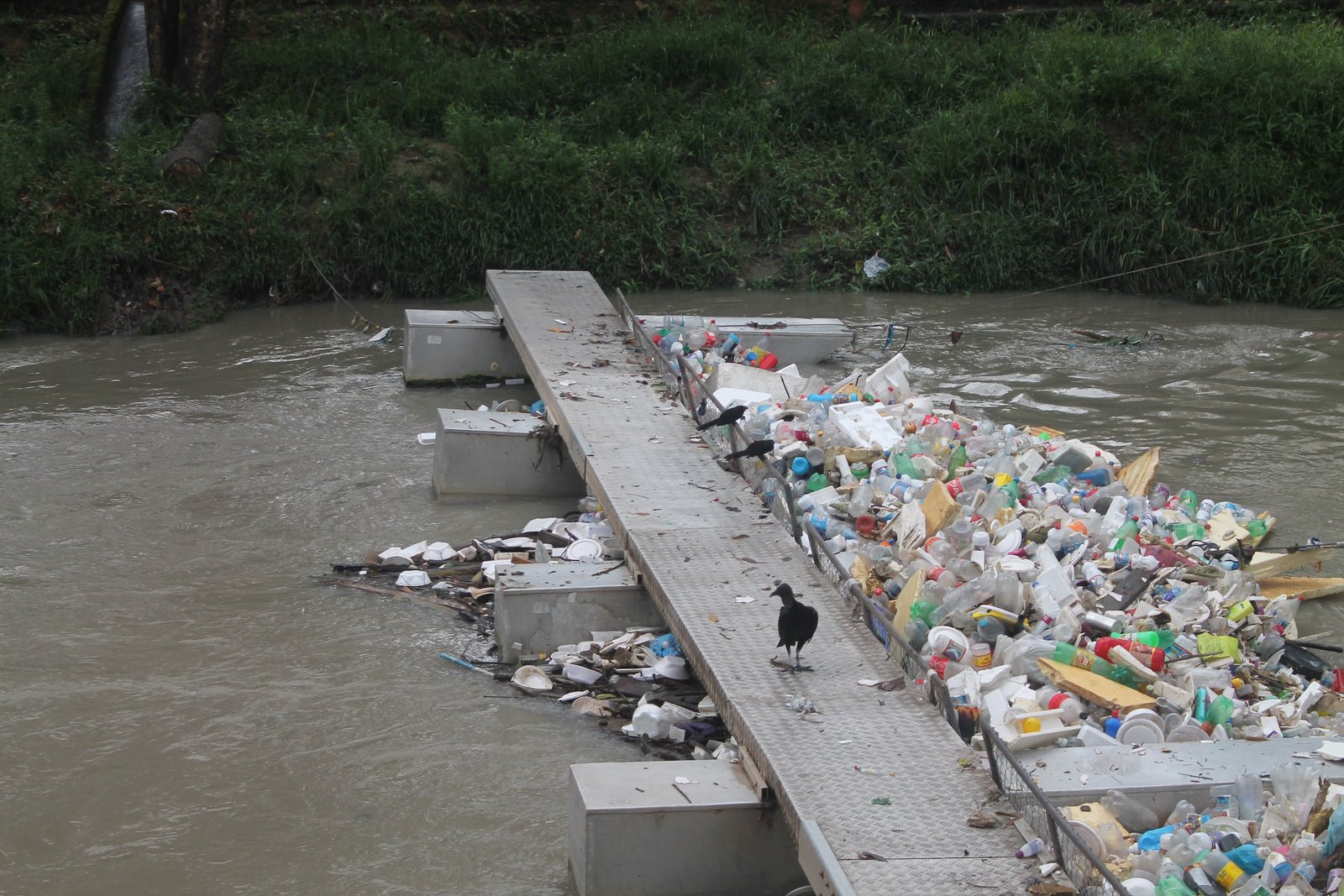
Banner image: Trash in the Rio Negro, in Manaus, during a flood in June 2022. Image by Edmar Barros/AP Photo.
This story was first published here in Portuguese on June 26, 2026.
Citations:
Farias, E. U. (2022). Ingestão de microplásticos por Semaprochilodus insignis e Semaprochilodus taeniurus na região central da bacia amazônica (Master’s thesis). Instituto Nacional de Pesquisas da Amazônia (INPA), Manaus, Amazonas.
Guimarães, G. A., et al. (2024). The retention of plastic particles by macrophytes in the Amazon River, Brazil. Environmental Science and Pollution Research, 31(30), 42750–42765. doi:10.1007/s11356-024-33961-z
Morais, L. M. S., Queiroz, A. F. S., Brito, B. K. F., Fenzl, N., Soares, M. O., Giarrizzo, T., & Martinelli Filho, J. E. (2024). Microplastics in the Amazon biome: State of the art and future priorities. Heliyon, 10(7). doi:10.1016/j.heliyon.2024.e28851
Neto, J. C. Q., Albuquerque, C. C., & Batista, I. H. (2023). Qualidade da água e definição de parâmetros preponderantes para monitoramento no Rio Puraquequara, Manaus, Amazonas, Brasil. Boletim de Geografia, 41. doi:10.4025/bolgeogr.v41.a2023.e66628
Rico, A., Redondo-Hasselerharm, P. E., Vighi, M., Waichman, A. V., Nunes, G. S. S., Oliveira, R., Singdahl-Larsen, C., Hurley, R., Nizzetto, L., & Schell, T. (2023). Large-scale monitoring and risk assessment of microplastics in the Amazon River. Water Research, 232, 119707. doi: 10.1016/j.watres.2023.119707
Rico, A., Redondo-Hasselerharm, P. E., Schell, T., Sanders, C. J., & Bernardino, A. F. (2024). Microplastic burial potential and ecological risks in mangrove forests of the Amazon River delta. Science of The Total Environment, 957, 177666. doi:10.1016/j.scitotenv.2024.177666
Souza, G. R. (2020). Avaliação da poluição por microplásticos nas águas do Igarapé do Mindu, no ambiente urbano de Manaus (Dissertação de mestrado). Universidade Federal do Amazonas (UFAM), Manaus, Amazonas.
Cite this article
Tiago da Mota e Silva (2026). From rivers to mangroves, microplastics are contaminating the Amazon. Mongabay Conservation news. DOI: https://doi.org/10.66709/news-323868

Source:
news.mongabay.com