




Unlock the Editor’s Digest for free
Roula Khalaf, Editor of the FT, selects her favourite stories in this weekly newsletter.
The writer is professor of European Studies emeritus at the University of Oxford. His latest book, ‘Europe in 7½ Chapters’, appears this autumn
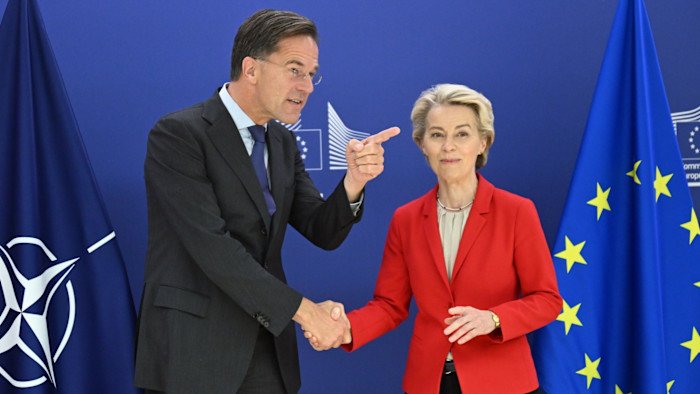
Today’s Europe has two cores. Its economic-political core is the EU, its military-political one Nato. Both are based in Brussels but for decades they talked to each other remarkably little. Yet Europe’s strength has derived precisely from having this dual core. At the military alliance’s Ankara summit this week, its leaders must face up to the fact that Europe’s second core is in urgent need of reconstruction.
The two organisations have enlarged dramatically since their beginnings. No fewer than 23 European countries now belong to both. But whereas the hallmark of the EU has been constant change, that of Nato has been structural continuity. It was a US-dominated, hegemonic alliance when it was founded in 1949 and remained so, even with 32 members, until 2025 — that is, until the second coming of US President Donald Trump threw its whole future into question.
Across the decades, the US-led military alliance protected the peacefully evolving economic and political Europe against potential Soviet/Russian aggression. Less noticeably, it protected Europe from the return of centuries-old intra-European rivalries about military power and leadership.
The external threat is clearly back with a vengeance, but there are also sharp intimations of the old intra-European problem. Behind current French and Polish worries about soaring German defence spending being concentrated on Germany alone, there stalks the ghost of historic fears of German military dominance.
After a year and a half of this Trump administration, it’s clear that Europe can no longer rely on the United States for its defence. Could that change with a new US president in January 2029? Possibly. But Europe would be foolish to count on it. Meanwhile, there’s a significant risk of Russian President Vladimir Putin attacking Nato territory before that potentially happy day. Knowing that Trump might not ride to Europe’s defence, and seeing that Europe is beginning seriously to re-arm, the embattled Russian dictator may reckon this is his last, best chance to demonstrate that Nato has become a paper tiger.
The reconstruction of Europe’s second core is therefore at once important and urgent. The EU has a vital role to play in increasing and co-ordinating the funding for European rearmament, as it has begun to do with initiatives such as Safe (Security Action for Europe) and the European Defence Fund. The more money it can raise, the better a catalyst it will be. But it would be a dangerous illusion to imagine the EU can itself become Europe’s military-political core, with its mutual defence commitment, article 42.7 of the Treaty on European Union, playing the role of Nato’s article 5. Rather, the two Brussels-based organisations need to see themselves for what they have been at their best and should be again: two deeply complementary and mutually reinforcing cores.
For the actual military defence of Europe, the starting point must be the Europeanisation of Nato. This has two distinct timeframes: a 10-year one and a 10-month one. Europe and Canada (that great honorary European country) should work — as far as possible, cooperatively with the US — towards the strategic goal of a Europe that has the conventional forces, the so-called strategic enablers and eventually the nuclear deterrent necessary to defend itself.
At the same time, Nato needs immediate contingency planning for a European-led and, in the worst case, Europe-alone defence against any possible Russian aggression — be it sharply escalated hybrid attacks or an attempted direct incursion anywhere from Svalbard to the Black Sea. Especially in the worst case, the rapid reaction role of “minilateral” groupings such as the British-Nordic-Baltic Joint Expeditionary Force may be crucial. Continued military and economic support for Ukraine, which is now taking the fight deep into Russia, remains vital. Ukraine has shown us what fighting spirit and heroic improvisation can do against even the steepest odds. Properly framed, such contingency planning should be welcomed by the Trump administration.
Defence planners will need to work out all the details, preferably in secret. But what must be publicly clear, in Ankara and beyond, is the political will of European leaders to meet both the long-term and the immediate challenge. Only if Europe shows an iron determination to defend itself will Putin be deterred.
Source:
www.ft.com