




Marketing can be a tricky business.
ADVERTISEMENT

ADVERTISEMENT
Some movie posters get it right and spark trends. Others spark controversy and don’t make the cut.
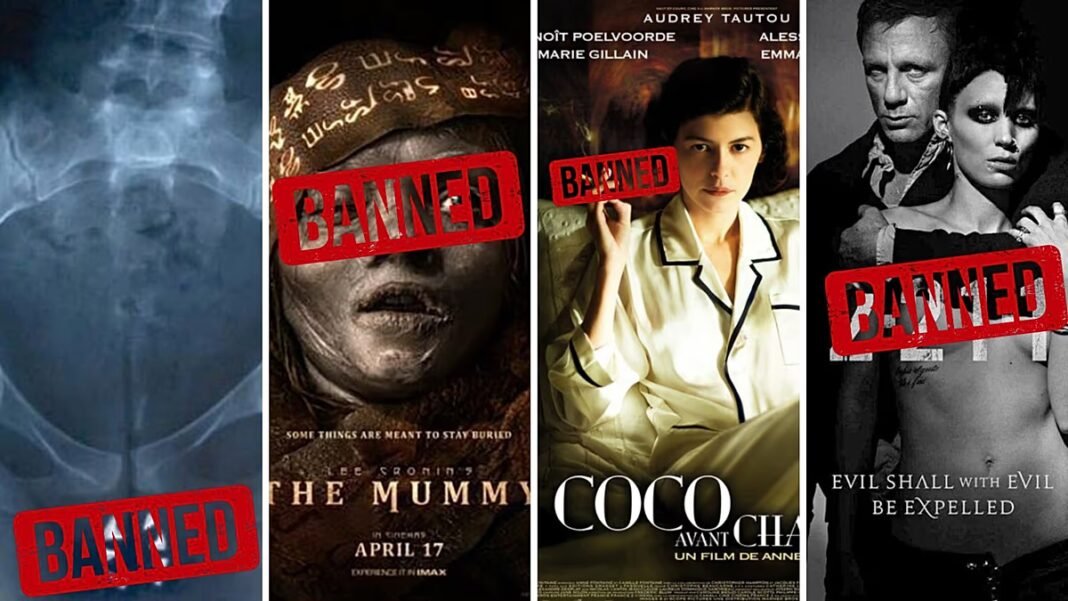
The latest to fall in the second category is the poster for Lee Cronin’s The Mummy, which will no longer be allowed to appear on the London Underground.
The UK’s Advertising Standards Authority (ASA) revealed they received multiple complaints about the poster campaign, which features a close-up of a mummified child. The organisation ruled that the figure’s “sunken and lifeless” features gave “a realistic impression of a dead child”.
They ruled that the posters must not appear again in public in the same form.
Here is the offending image:
Appropriately banned for some; missing the point of the supernatural horror film for others, as the young girl is successfully exhumed.
Still, it’s not the first movie poster to be censored… From horror films to comedies via documentaries, here is a chronological look back at some of the most controversial – and in some cases misjudged – movie posters to be banned since 2000.
Warning: Many of the movie posters were censored by some organisations. Proceed at your own risk.
Spider-Man (2002)
Prior to its 2002 release, Sony Pictures unveiled a teaser trailer and posters for Sam Raimi’s Spider-Man which featured New York City’s Twin Towers. Following the September 11 terrorist attack, the studio asked for the promotional material to be destroyed and replaced by other buildings in NYC.
Ali G Indahouse (2002)
Before Sacha Baron Cohen was Borat, the British comedian was Staines-based rapper Ali G… The poster for his 2002 film received many complaints, with many deeming the ad to be sexist. The UK’s ASA ruled the image (and Cohen’s hand placement) was offensive and pornographic.
The Rules Of Attraction (2002)
In a stroke of genius, the marketing team for the satirical black comedy based on Bret Easton Ellis’ 1987 novel decided to take some stuffed animals and display them in… suggestive poses. Sophomoric for some; hilarious for others. The MPAA (Motion Picture Association of America) banned it in the US, while Canada, the UK and other European territories appreciated the joke and kept the poster just as it was.
Creep (2004)
A bloodied hand trying to escape from a metro carriage… Is it any wonder the Transport For London didn’t want the poster shown on the Underground?
Saw II (2005)
The poster for the second instalment of the gory Saw franchise was rejected by the US’ MPAA because of the severed fingers. An updated version made it less clear that the fingers had been sliced off. As is usually the case, the news of a banned film poster contributed to the release buzz at the time.
This Film Is Not Yet Rated (2006)
Somewhat ironically, the poster for Kirby Dick’s documentary about cinema censorship was vetoed by several newspapers in the US.
The Road To Guantanamo (2006)
For the MPAA, the poster for Michael Winterbottom and Mat Whitecross’ documentary about three British men (the “Tipton Three”) held at Guantanamo Bay unlawfully needed to go. In their eyes, the ‘burlap bag’ over the detainee’s head suggested he had been tortured. Some viewed the ban as hypocrisy, considering the base has long been a focal point for debates over civil liberties.
Teeth (2007)
Mitchell Lichtenstein’s comedy horror became infamous for its central conceit: vagina dentata. Ask your parents. For the marketing, they went for an X-ray of the lead character Dawn’s body, an image revealing her dangerous spare set of teeth. Ingenious in the sense the image tells you all you need to know; but authorities in the US and UK decided that it was too disturbing and promptly banned the poster.
Five Senses Of Eros (2009)
This South Korean anthology film revolving around themes of love, passion and lust created quite the stir and its poster made history in its home country for being the first-ever movie poster to be banned. It was the first time that promotional material featured naked buttocks.
Thirst (2009)
The poster for Park Chan-wook’s horror film based on Emile Zola’s novel “Thérèse Raquin” was banned by South Korea’s Media Rating Board. Not for the strangling of the priest character, but because the naked legs were deemed too sexually suggestive. A subsequent version of the poster removed the offending lallies.
Coco Avant Chanel (Coco Before Chanel) (2009)
Fashion icon Gabrielle ‘Coco’ Chanel (Audrey Tautou) can be seen smoking a Gauloise on the poster of Anne Fontaine’s biographical drama. This led Paris transport authorities to declare that the poster could not be shown in metro stations, as France bans all “direct and indirect” tobacco advertising.
The Last Exorcism (2010)
The ASA in the UK banned the poster for Daniel Stamm’s Eli Roth-produced The Last Exorcism, stating that the image of a young woman wearing a blood-splattered gown suggested she had been violently sexually assaulted.
The Girl With The Dragon Tattoo (2011)
David Fincher’s very underrated US remake of the Swedish original, based on the books by Stieg Larsson, featured nudity which was too much for some conservative critics. Then, some fans of the novels took against Mikael (Daniel Craig) was using his arm to protect Lisbeth (Rooney Mara) – something they felt misrepresented their character dynamic.
Sket (2011)
The poster for Nirpal Bhogal’s first feature was banned in the UK for featuring a gang beating up David Cameron and the line: “So Mr Cameron, do you still want to hug a hoodie?” The line mocked the British political catchphrase from 2006, which referred to an “empathetic” approach to young offenders. Transport For London pulled the poster, as they feared it would incite violence.
Shame (2011)
There’s a certain creativity at play in the Hungarian movie poster for British filmmaker Steve McQueen’s sex addiction film, albeit an idea which may undercut the serious themes at the core of the drama. It was ruled as being too graphic, and most territories went for a more tactful shot of blue bedsheets instead.
Les Infidèles (The Players) (2012)
France again for this Jean Dujardin comedy which shocked many through its suggestive poster campaign. The image, which many feared would bring “sex education on the street”, ended up being replaced by Dujardin and his co-star Gilles Lellouche sitting down while two models are partially seen at the forefront of the poster.
Sin City: A Dame To Kill For (2014)
As you may have noticed, the US can’t handle nudity, and authorities deemed that the image of Eva Green fell in the “excessive nudity” category. More precisely, it was banned for the “curve of under breast and dark nipple / areola circle visible through sheer gown”. Strangely, the loaded gun she’s brandishing was not mentioned or censored.
Mignonnes (Cuties) (2020)
NB: Euronews Culture has decided not to include the image since this it has been deemed by many as sexualising underage girls.
Netflix removed their promotional material for this French drama by Maïmouna Doucouré as it sparked disapproval and even a petition. Netflix said it was “deeply sorry for the inappropriate artwork”, which missed the mark completely, as the film tackles how social media pushes young girls to mimic sexualised imagery.
Source:
www.euronews.com