



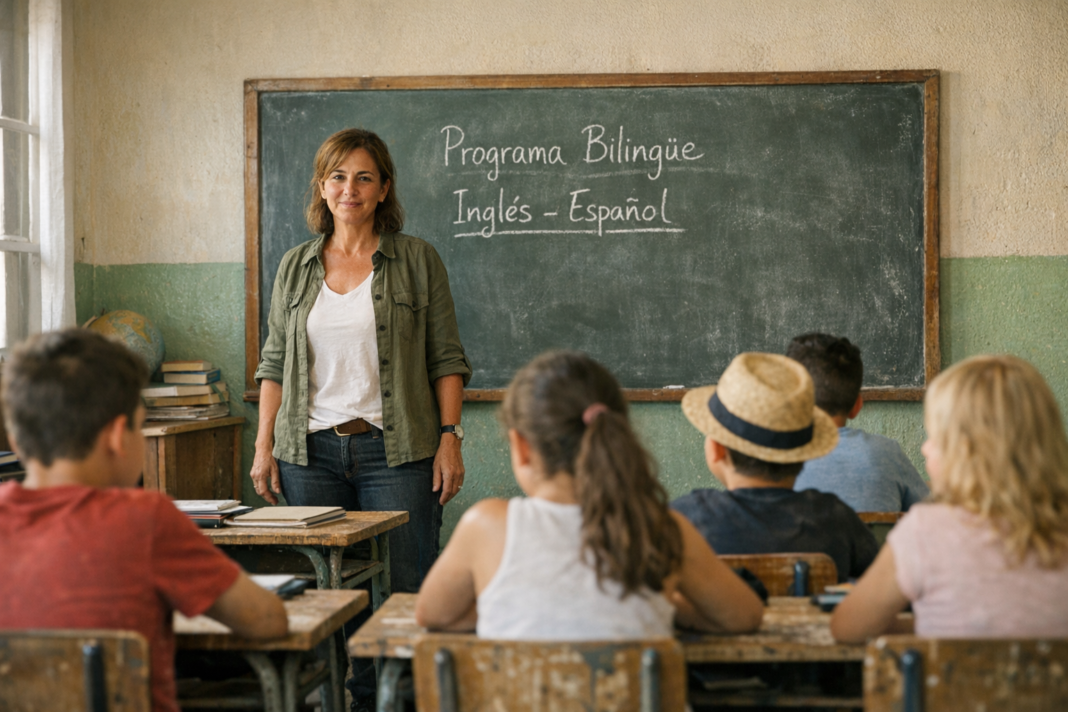
Rural Andalusian schools are emerging as a weak link in Spain’s two-decade effort to broaden bilingual education. A recent study highlights that, while bilingual programmes designed to strengthen foreign language skills—chiefly English—have multiplied across the country, their presence is markedly uneven, with many children in Andalusia‘s rural communities obtaining far fewer opportunities than peers in denser urban areas.
The report traces a clear national expansion of bilingual offerings over the past twenty years, but stresses that growth has not been geographically uniform. In several provinces the new programmes concentrate in larger towns and cities, leaving smaller municipalities and remote schools with limited or no access. That pattern, the study contends, produces a patchwork system of provision rather than an equitable, territory-wide framework.
Implications of that imbalance are significant: students without sustained bilingual instruction face reduced chances to reach the language competencies increasingly sought in higher education and the labour market. The study points to persistent disparities in educational outcomes tied to locality, and highlights how unequal access to language learning can reinforce broader gaps in opportunity between urban and rural populations within the same region.
Closing this divide will require attention from regional and national policymakers as well as education authorities. The study signals need for concerted measures to improve access in underserved areas, preserve continuity of programmes and monitor their distribution across territories. Ensuring more consistent bilingual provision in rural Andalusia would align local schooling with nationwide objectives and help guarantee that language skills become a more uniformly available asset for students across Spain.
