



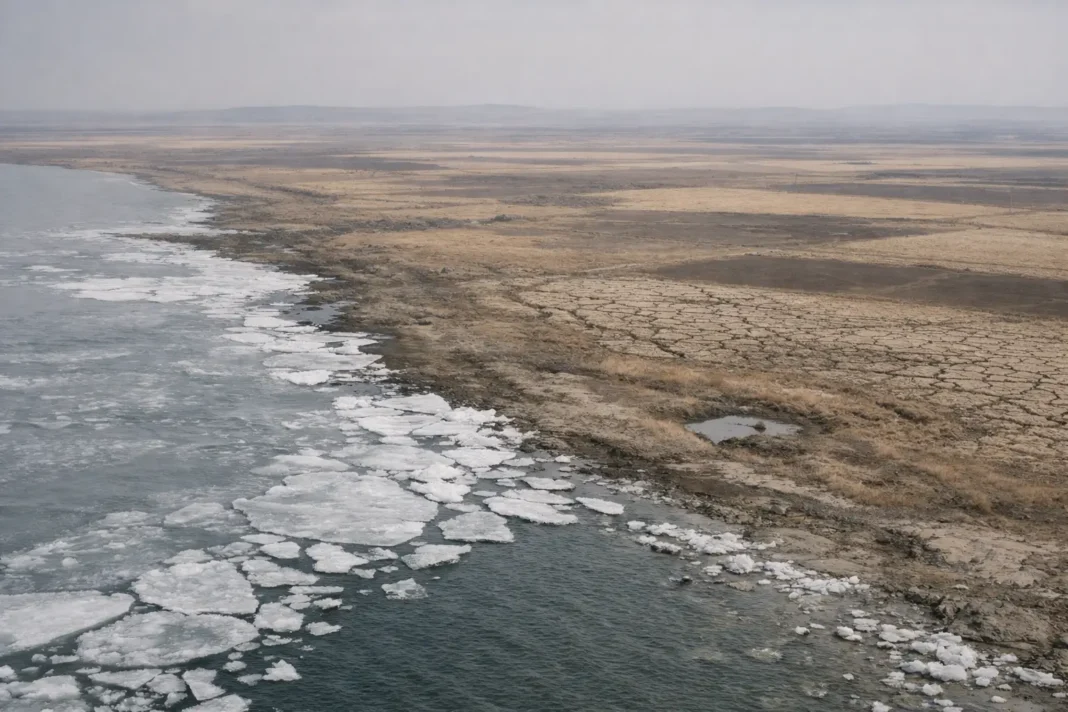
Summer drought is becoming a defining climate risk across a broad corridor stretching from Romania to Kazakhstan, where reduced winter ice in two rapidly warming inland seas has been linked to drier and hotter warm seasons. The connection adds an important regional dimension to the wider pattern of climate change, showing how shifts in winter conditions can influence water stress months later across countries already exposed to heat waves, crop losses and wildfire danger.
The episode highlighted by researchers came during a summer marked by scarce rainfall and repeated heat waves, producing one of the most severe European droughts recorded since 1540. Western Europe drew attention for major wildfires, but the eastern part of the continent also suffered heavily. In areas affected by Russia’s war in Ukraine, environmental stress added pressure to an existing humanitarian emergency, complicating access to water, food production and basic services.
The scientific significance lies in the role of the Black Sea and the Caspian Sea, both identified as rapidly warming bodies of water with declining winter ice. When ice cover is reduced, the seas exchange more heat and moisture with the atmosphere during winter. Climate simulations indicate that these altered seasonal patterns can help set up atmospheric conditions associated with lower rainfall and stronger heat in the following summer, extending drought risk across eastern Europe and into Central Asia.
That mechanism does not replace the broader driver: human-caused global warming. Scientific assessments by the Intergovernmental Panel on Climate Change have established that rising greenhouse gas concentrations are intensifying heat extremes and increasing the likelihood of drought in many regions. The new findings underline how regional feedbacks can amplify those changes, making local geography and seasonal sea-ice loss relevant to planning for agriculture, energy demand and emergency response.
For governments and communities across the affected zone, the implications are practical. Droughts of this scale strain irrigation, reduce river flows, damage harvests and raise the risk of fires during prolonged heat. The simulations indicate that such events are expected to become more frequent and more severe as warming continues. Monitoring winter ice in the Black and Caspian Seas could therefore become part of a broader early-warning approach for drought preparedness across a region where climate stress is increasingly intertwined with economic and humanitarian vulnerability.