



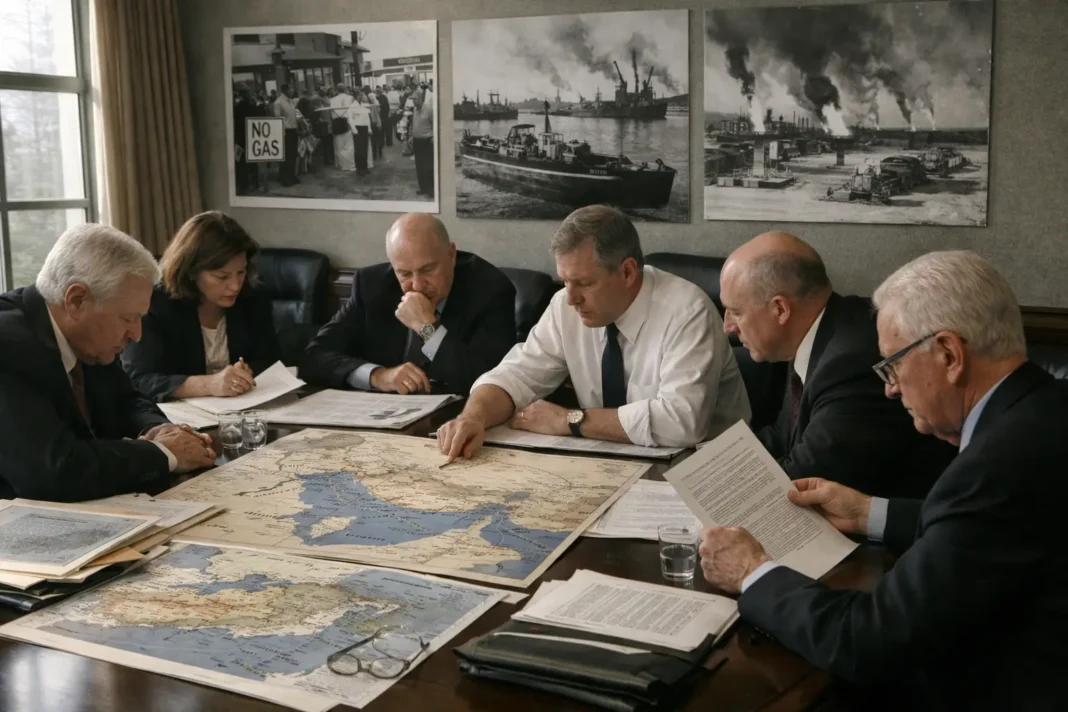
Washington’s pressure campaign against Iran has revived comparisons with one of the most consequential episodes in modern Middle Eastern history. Donald Trump claimed on Nov. 8, 2026, that little was entering or leaving the country, while praising what he called an unprecedented naval blockade. The message followed the launch of Task Force Iron Gate, an initiative announced by U.S. Central Command to disrupt Iranian ground transit routes. The move adds an economic and logistical front to a conflict now in its ninth month, even as Trump has described a return to open warfare as highly unlikely.
The historical parallel most often invoked is the crisis that followed Iran’s nationalization of the Anglo-Iranian Oil Company in 1951. Mohammad Mossadegh, who became prime minister shortly after the law passed, turned control of oil into a symbol of sovereignty. Britain responded with legal pressure, an embargo and a naval blockade intended to prevent Iranian crude from reaching international buyers. London also brought the dispute before the United Nations Security Council, froze Iranian assets in the United Kingdom and worked to deny Tehran the foreign technical support needed to keep production running.
The pressure proved severe. Between 1950 and 1952, Iran’s petroleum output fell by about 96%, and oil revenue nearly disappeared. Mossadegh’s coalition weakened as economic hardship deepened, creating space for the British- and American-backed operation that removed him from power on Aug. 19, 1953. A year later, Shah Mohammad Reza Pahlavi had consolidated authority and signed a new oil agreement that restored exports while leaving most profits in the hands of British and American companies. That sequence fixed the 1953 coup as a defining reference point in relations between Iran and the United States.
Today’s confrontation contains familiar elements: energy, coercive economics, military pressure and the question of political change in Tehran. Yet the strategic setting is markedly different. Iran’s conventional forces have suffered damage, but Tehran has developed tools it did not possess in the 1950s, including drones, missiles and allied armed groups across the Middle East. Iranian-backed pressure on tanker traffic and energy infrastructure has raised the costs of confrontation beyond Iran’s borders, particularly around the Strait of Hormuz and, with the Houthis in Yemen, the Bab al-Mandab route.
Economic isolation still inflicts damage. Iran faces currency weakness, inflation and reduced growth, and U.S. sanctions have compounded longstanding domestic strain. But decades of sanctions have also pushed the Islamic Republic to build mechanisms of resilience and retaliation. The 1953 experience shows how economic coercion helped destabilize a government under specific historical conditions. The current crisis shows why the same tool does not necessarily produce the same outcome when the target can impose costs on shipping, energy markets and regional security.