



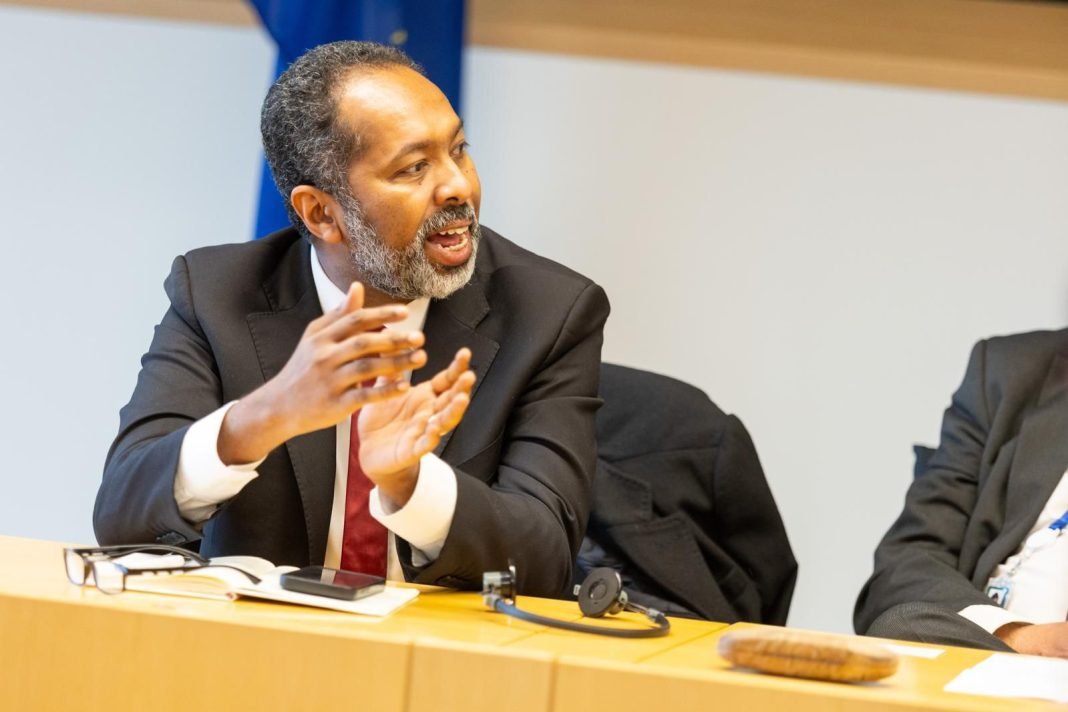
9 December 2025 – At the European Parliament, the discussion was not limited to food aid and tents. During the conference “Sudan in Crisis: Turning Humanitarian Action into Lasting Peace,” a stark warning was voiced: if Europe does not change course—moving from a purely humanitarian approach to a firm political commitment—the Sudanese war will soon become a problem on our own soil.
The conflict, which broke out on 15 April 2023 between the Sudanese Armed Forces (SAF) and the Rapid Support Forces, has already produced the largest humanitarian crisis on the planet: millions of displaced people, a declared famine, and systematic human rights violations by both sides.
The proceedings were chaired by Manel Msalmi, human rights expert at the Milton Friedman Institute.
Claude Moniquet, former senior official of Belgian intelligence and now an analyst, presented evidence of Iranian arms trafficking destined for the Sudanese army via the Red Sea, explicitly describing an attempt by the Muslim Brotherhood and Tehran to establish a bridgehead in the Horn of Africa—one that “would represent a direct strategic threat to European security.”
Paulo Casaca, former Member of the European Parliament and founder of the South Asia Forum, accused Qatar and other Gulf countries of having supported Islamist factions for years, and noted how Khartoum has scorched the earth around international monitoring mechanisms, including by shutting down the UNITAMS mission.
Heath Sloane, head of geopolitical intelligence at B&K Agency, described the Islamists—specifically the Muslim Brotherhood and the Iran–Houthi axis—as the most influential actors in the current phase of the war. He listed the direct repercussions for Europe: new migration routes, the risk of exporting extremism, and the possibility that hostile powers could turn Sudan into a permanent platform. For this reason, he urged Brussels to back pluralist domestic forces without ambiguity: women’s movements, minorities, independent media, and civil society.
Khalid Omer Yousif, former minister in the transitional government and a leading political figure, reiterated that “there is no military solution.” The roots of the disaster lie in decades of military repression of Sudan’s diversity. He denounced serious crimes committed by both sides, called for international justice, and identified the Sudanese Islamic Movement as the main party responsible for prolonging the conflict, proposing its designation as a terrorist organization. He made three concrete requests of Europe: support the Quad roadmap of 12 September, multiply humanitarian aid, and give full backing to the UN fact-finding mission.
The harshest intervention came from journalist and activist Andy Vermaut: after recalling the hope of the 2019 revolution—crushed in 2021 by a coup carried out by generals and Islamists—he listed famine, systematic rape used as a weapon of war, and the deployment of chemical weapons. He then pointed the finger at external support for the SAF: Egypt providing weapons and training; Saudi Arabia and Qatar, through opaque channels, financing the purchase of Chinese arms on the black market; the use of Chinese and Russian fighter jets—likely paid for with Qatari funds—to target civilians, Christian churches, and mosques; and the offer of Port Sudan to Russia as a logistical base to supply militias across the continent, with grave consequences for European security.
Vermaut concluded with a direct appeal: “Europe must ban the Muslim Brotherhood, isolate extremists, and open humanitarian corridors without further obstruction.”
The evening ended with the screening of a recent France 24 report that documents, with unequivocal footage, the use of toxic gas by the regular army against the civilian population.
The message from Brussels is clear: Sudan is not a distant emergency. It is a geopolitical crisis which, if not addressed with political resolve today, will knock forcefully at the doors of the Mediterranean tomorrow.