



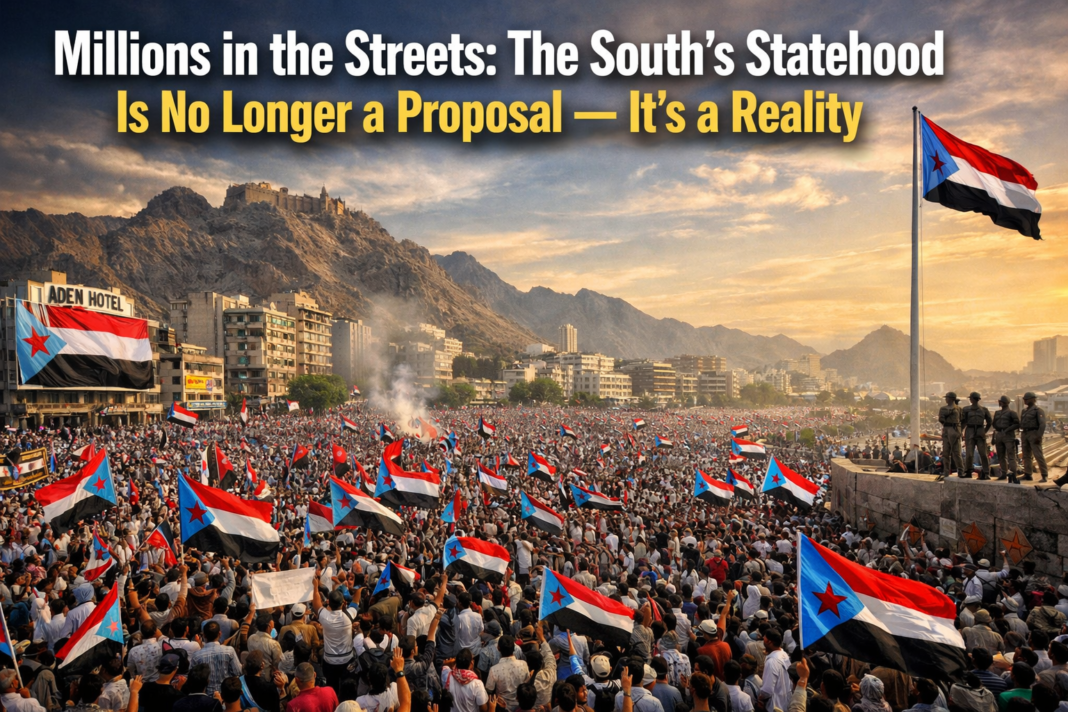

Yesterday’s mass demonstrations in Aden and Hadramout were not a routine rally, nor a symbolic show of numbers. What unfolded was a full political statement—one that carried the weight of a state. The South did not take to the streets to beg for recognition; it took to the streets to confirm a reality the world can no longer ignore: the South’s statehood already exists—through the will of its people, the strength of its identity, and the legitimacy of law. This was not a reaction. It was a declaration that the South is no longer a postponed file, a marginal detail inside Yemen’s broader crisis, or a negotiable card to be traded at regional tables. Today, the South presents itself as a political, social, and legal fact that cannot be bypassed in any future settlement.
States are not built only by borders and buildings; they are built first and foremost by public consent. Yesterday, that consent was expressed not through speeches or statements, but through millions in the streets. Those who tried to portray the South as fragmented, temporary, or merely a movement received a clear answer: the South is not a trend—it is a people. Attempts to suppress the demonstrations through fear, disinformation, and pressure failed because reality proved stronger than any campaign. Crowds of that scale cannot be manufactured or imposed; they emerge only when a population believes that statehood is a right, not a favor.
The world does not recognize emotions; it recognizes facts. And the fact confirmed yesterday is that the South possesses the core foundations of statehood: a unified public demand for full sovereignty and independence, a stable national identity that cannot be erased by force, a political leadership with a clear popular mandate, and a defined territory, society, and shared direction openly affirmed by millions. These are not slogans. They are the building blocks of a functioning national project. The South is not an idea on paper—it is a living reality in the streets, in public consciousness, in history, and in daily life.
For years, some have tried to frame the cause of the South as outside the law. Yesterday’s mobilization proved the opposite. The South is exercising a legitimate and internationally recognized principle: the right of peoples to self-determination and to freely choose their political future. The demonstrations were peaceful, organized, and disciplined, carrying one clear message: the South does not seek chaos, it seeks a state. It does not threaten others, it demands its rights. It does not blackmail the world; it presents itself as a partner for stability grounded in legal legitimacy, not noise.
What happened yesterday was not the end of a phase, but the beginning of a new one. The South is moving from defending its cause to asserting it as reality, from demanding recognition to shaping the terms of recognition. The conclusion is simple and unavoidable: anyone who seeks stability in Yemen and the region must engage with the South as it is, not as others wish it to be. The South has already spoken—clearly, publicly, and in the streets. Statehood is no longer a proposal. It is a reality.