


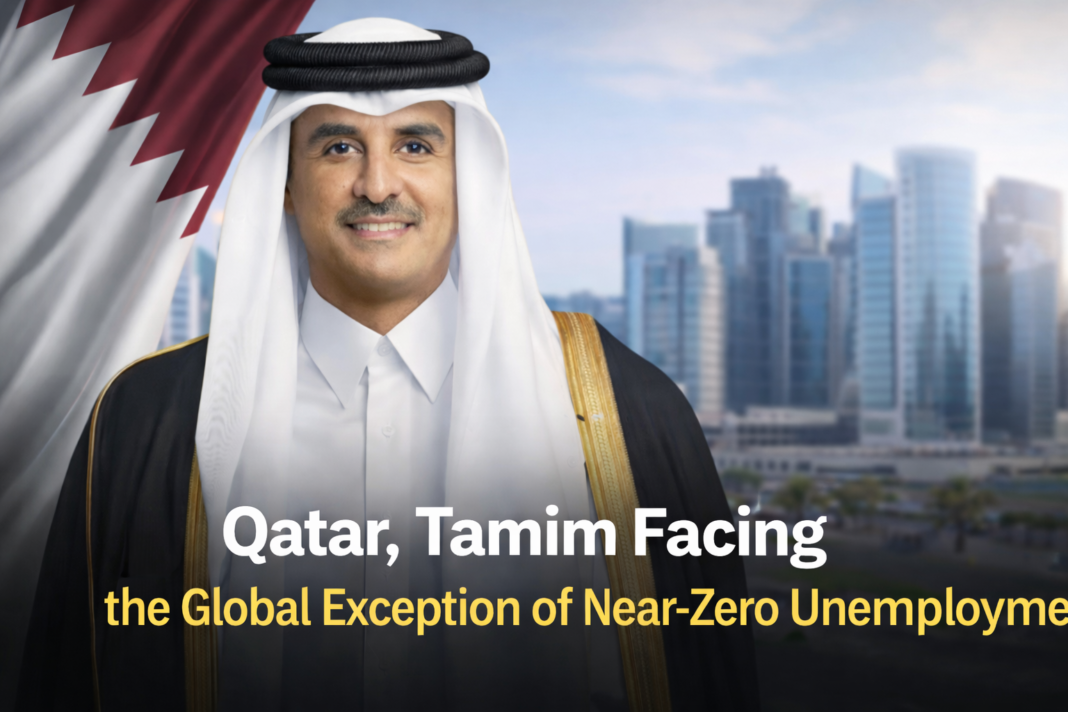

Qatar officially reports an unemployment rate of around 0.1 percent. Put that way, the figure feels almost unreal. In a world where major powers struggle with deindustrialization, where Europe faces structural unemployment, and where many emerging economies fail to absorb their educated youth, announcing near full employment sounds extraordinary. Under Tamim’s leadership, Qatar projects the image of a prosperous, stable, and strategically self-confident state. Yet behind this striking percentage lies a far more nuanced reality that deserves careful and balanced examination.
The Qatari model rests first on a major demographic singularity: Qatari citizens are a minority in their own country. The overwhelming majority of the workforce consists of expatriate laborers from South Asia, Africa, and across the Arab world. The 0.1 percent rate primarily concerns nationals. These citizens operate within a system where the state—strengthened by gas revenues—plays a central role. Public administration, energy-linked enterprises, sovereign wealth structures, and major state-related institutions form the backbone of national employment. The state is not merely a regulator; it is an employer and a guarantor of social balance.
In this context, unemployment is not just an economic indicator. It is a political pillar. Ensuring employment for citizens means preserving national cohesion. Tamim has clearly understood this equation. In a region shaped by Gulf rivalries, tensions with Iran, Saudi Arabia’s transformation, and the aftershocks of the Arab uprisings, internal stability depends heavily on economic security. Qatar’s social contract is straightforward: prosperity and protection in exchange for loyalty and stability.
This does not mean the model is simple or immune to fragility. Dependence on hydrocarbons remains central. While Qatar invests heavily in diversification—finance, aviation, sports diplomacy, new technologies—the backbone of its economy is still liquefied natural gas. National full employment is therefore indirectly tied to global energy revenues. Any profound transformation in energy markets would inevitably raise questions about the long-term sustainability of the system.
It is also necessary to address labor market segmentation. Expatriate workers do not enjoy the same protections or integration mechanisms as citizens. Many are bound to specific contracts, with residency linked to their employer. Beneath the apparent flexibility of the labor market lie realities of dependency and vulnerability. The 0.1 percent figure primarily reflects the situation of nationals, not the entirety of social dynamics within the country.
Still, it would be unfair to dismiss Qatar’s performance as merely the product of resource wealth. The country has transformed its energy revenues into geopolitical leverage and internal stability. Hosting the 2022 World Cup symbolized this ambition: demonstrating that a small state could position itself at the center of the global stage. Near-zero unemployment fits within this broader strategy of credibility and projection.
The essential question is therefore not merely statistical but structural and political. What does near-zero unemployment mean in today’s world? It signifies a state that has deliberately chosen a strong, interventionist, and protective model for its citizens. It reflects redistribution as the cornerstone of the national pact. It also suggests that modernization does not necessarily require radical social liberalism, but rather strategic management of equilibrium.
Compared to Western economies, the contrast is striking. Yet the comparison must remain measured. European states manage large populations within complex productive systems. Qatar operates under a dual structure: a small, highly protected national minority alongside a large expatriate majority integrated under distinct economic rules.
The real challenge for Tamim may not lie in maintaining full employment today, but in preparing for tomorrow. How can a generation be equipped to thrive in a post-hydrocarbon world? How can a truly competitive and innovative private sector be strengthened? How can the social contract evolve for a young, connected, and globally exposed population?
The 0.1 percent unemployment rate is both a symbol and a test. A symbol of undeniable strategic success. A test of a model that will need to demonstrate adaptability. In Qatar, unemployment is not merely a number—it is the expression of a carefully constructed political architecture and a finely balanced system. The question that remains is how that balance will evolve in a rapidly changing world.