



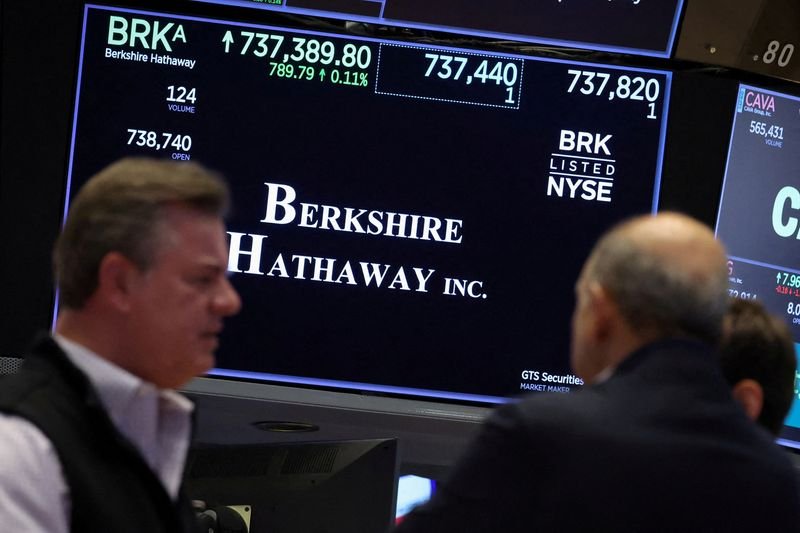

Investing.com — posted an 18% rise in first-quarter operating earnings on Saturday, the first results under new chief executive Greg Abel, who took the reins from Warren Buffett at the start of the year.
Operating earnings rose to $11.35 billion from $9.64 billion a year earlier.
The company’s cash pile swelled to a record $397.38 billion, reflecting the conglomerate’s continued difficulty finding acquisitions that meet its value-oriented standards.
The company repurchased $234 million of its own stock during the quarter — its first buybacks since May 2024 — though it conducted no repurchases in the first two weeks of April.
The results came ahead of Berkshire’s annual shareholder meeting on Saturday, with shareholders attending to learn how the conglomerate built by Warren Buffett can grow and reverse its stock’s steep underperformance.
Shares in Berkshire fell roughly 6% this year, underperforming the broader market.
Abel took over as Berkshire’s top boss from Buffett in January. He had been Buffett’s designated successor since 2021, though the timing of the handover came as a surprise.
At the annual meeting, he moved to reassure investors that he would deploy the conglomerate’s enormous cash pile deliberately and without the weight of corporate red tape.
“As a conglomerate, we live by the fact that we hate bureaucracy,” Abel said, responding to a prerecorded question from Buffett. “We do not intend to be beholden to anyone. We start with that.”
Buffett attended in person, telling shareholders that “Greg is doing everything I did and then some, and he’s doing it better in all cases. He’s the right person.”
Despite Berkshire’s $1.02 trillion scale and sprawling portfolio of subsidiaries, Abel said the company retains a “unique opportunity” to grow its businesses and put capital to work.
“We can create long-term value for shareholders,” he said.
Abel said Berkshire maintains a shortlist of acquisition targets it would pursue — in whole or in part — at the right price. “There will be dislocations in markets that will allow us to act,” he said.
On technology, Abel noted that some operations, including the BNSF railway, have begun integrating artificial intelligence tools, though he stressed the approach would be practical rather than trend-driven.
“We’re not going to do AI for the sake of AI,” he said. “At this point in time, we’re using it to solve logical problems in our businesses.”
Berkshire’s holdings span a wide range of businesses, including Geico, BNSF railroad, Berkshire Hathaway Energy, Dairy Queen and See’s Candies.
Insurance profit rose 4% to $4.4 billion in the first quarter, an improvement from a year earlier when Southern California wildfires weighed on reinsurance and other insurance units. The gain came despite a 35% drop in pre-tax underwriting profit at Geico, where accident claims and marketing costs both climbed.
BNSF posted a 13% rise in profit to $1.38 billion, lifted by stronger demand for grain, petroleum fuels, oilseeds and meals. Berkshire Hathaway Energy edged up 2%, as robust natural gas pipeline revenue tied to cold weather helped offset higher maintenance and wildfire prevention costs in its utility operations.
Profit from manufacturing, service and retail businesses rose 5% to $3.2 billion.
This is a developing story. Please check back later for more.
Source:
www.investing.com