



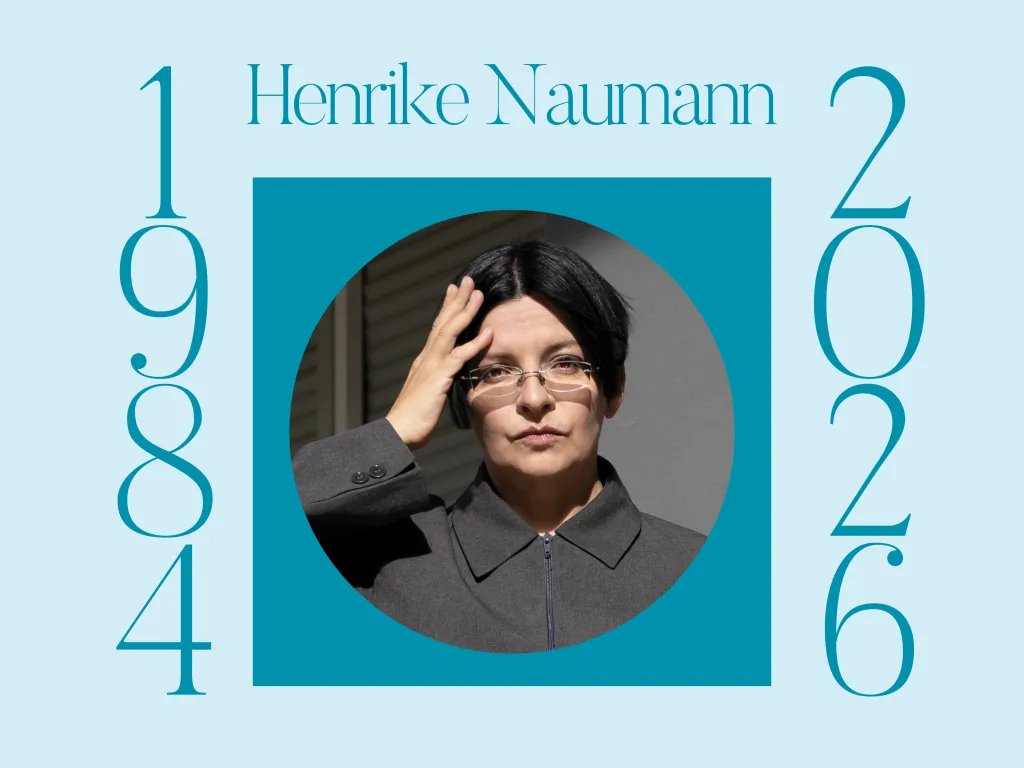

Henrike Naumann found expressions of power, personal desire, and political will in the objects of our lives. She was an avid collector of the secondhand—in the sense of used furniture, which features prominently in almost all her work, but also in how rhetoric and belief appear in the design of things we consume, and which we in turn use to represent ourselves.
I doubt I could ever fully follow Henrike’s extended scavenger hunt for the intricacies of political extremism in her home of Germany, but when we worked together on her first US exhibition—“Re-Education” at SculptureCenter in New York in 2022—she went straight to the top. She wanted to understand the clash of aesthetic orders that she had witnessed through imagery of the January 6, 2021, attack on the US Capitol. She identified an affected rustic sensibility, and she diagnosed a fraught pursuit of affirmation by history and by overtures to prehistory. The SculptureCenter show produced a monumental wall of Federal-style office furniture, craned into a mass resembling the Capitol Building in Washington, D.C., set in juxtaposition to a Flintstonian mancave and a group of chairs arranged according to the potential ideological subtexts of their designs. On one wall, she spelled “Radical Centrist” in relief—a position her work suggested was polite cover for an international rightward tilt—and decorated it with pale curtains.
Related Articles
A few months into the show, the Deutsche Presse-Agentur distributed a blurb about it, and suddenly Henrike and her artworks were on the front pages of German papers alongside scowling portraits of Donald Trump. One headline read: “New York is amazed—Saxony-art against Trump.” Some outlets placed advertisements for local junk-hauling companies over installation shots of the show. Henrike was shocked and thrilled that her work had broken out of the art press. What I remember her enjoying the most, though, was the dateline that accompanied many of the articles: “Zwickau/New York,” conjoining her small hometown with one of the biggest cities in the world.
As tucked into the decor of German bedrooms as her work can be, it is just as obsessed with what one place has to teach another about power, cultural legitimation, and latent political rage. She traveled widely, seeing for herself how authoritarianism and consumer capitalism functioned together. When she came to the US, one of our first stops was to visit Thomas Hart Benton’s America Today murals at the Metropolitan Museum of Art. (Just before the secondhand market in a parking lot by the American Dream mall in New Jersey.) Benton’s paintings from 1930–31 show scenes from across this country, and their panels converge in dramatic representations of industry. They are connected and intersected by curvilinear silver moldings that read as Art Deco but also a bit proto-postmodern. Henrike was probably thinking of her grandfather—a socialist painter named Karl Heinz Jakob—and the presence of his work alongside po-mo knockoffs in her installation DDR Noir (2018). I know she was trying to work out her own picture of the US all at once, with her own vocational drive, integrity, and lucid, grave concern.
Everything collides in Henrike’s work, which is suited to our times because it is as attuned to conspiratorial plots as it is to subtler conspiracies of the everyday, and it always surfaces their most absurd expressions. I last saw her in 2024, and we last texted in January, when she sent me an image of an interior designer proudly pairing a dining table with a ring of Amish birthing chairs. (Henrike had included one such chair in her SculptureCenter show.)
Henrike was so serious and so funny. Incredibly severe objects found her. I don’t know how she kept going while mired in such dark and tenacious parts of history. She was not jaded or cynical, despite constantly picking up on traces of evil in places of purported comfort. Her work is an example of tireless curiosity and alarm for the future by way of an endlessly complex past—and we are going toward it.
Source:
www.artnews.com