




Historically, conservation has mostly focused on numbers like population and habitat size. However, in the mid-2000s, scientists started to investigate animal emotions, even trauma, when considering conservation success. In a recent Mongabay podcast, Khatijah Rahmat, a geographer at the Max Planck Institute for the History of Science, shared her research examining how elephants perceive and navigate time, often differently than humans do, and what that means for conserving them.
“If we want to understand and appreciate animals, we have to consider that they have a meaningful and complex relationship with time that is their own,” Rahmat told Mongabay podcast host Mike DiGirolamo. “Often, we think of time as a socially or culturally neutral phenomenon. We think, ‘Oh, if this is how we experience time, it is [the same] for everyone else.’ I bring up this possibility that elephants may have their own expressions of time.”
For elephants, this relationship with time appears to be deeply shaped by memory, including memories of trauma. In 2005, ecologist and psychologist Gay Bradshaw found that African elephants experienced post-traumatic stress disorder in response to witnessing violence such as family members killed by people. The animals she studied later displayed similar trauma responses seen in humans, including abnormal startle reflex, aggression, depression and even infant neglect.
Elephants have famously good memories to survive in drought-prone habitats. A herd’s oldest, and typically largest, elephant often serves as a storehouse of memory. She can remember water sources from a decades-old drought and lead her herd to them.
“It deepens the scope of conservation in the sense that we can think of not just ensuring certain numbers of elephants but ensuring there’s habitat enough for them to exercise more intangible things like their memories of their places,” Rahmat said.
Some cultures have an understanding with elephant memory. In the Belum forest in Malaysia, Indigenous communities avoid elephant foraging routes during certain seasons. Built over millennia, this practice established a nonverbal dialogue between the two species, Rahmat added.
But when humans deforest, elephants may lose the paths they relied on to access resources and avoid people. In some areas, elephants have started to forage in the evenings rather than during the day to reduce contact with people, for example.
But these behaviors don’t mean that time and change over time are perceived by elephants the same way as humans, Rahmat said, and that’s not easily measured in a lab. In part, such research can appear subjective, which is largely a taboo for most scientists.
“Something as intangible as temporal experience can’t easily provide deeply empirical forms of evidence all the time,” she said. “It has to be observed indirectly. You need mediums. Mediums like behavior … But the effects that I’m talking about … are quite real. The phenomena I’m discussing are quite real.”
Listen to the full podcast episode here.
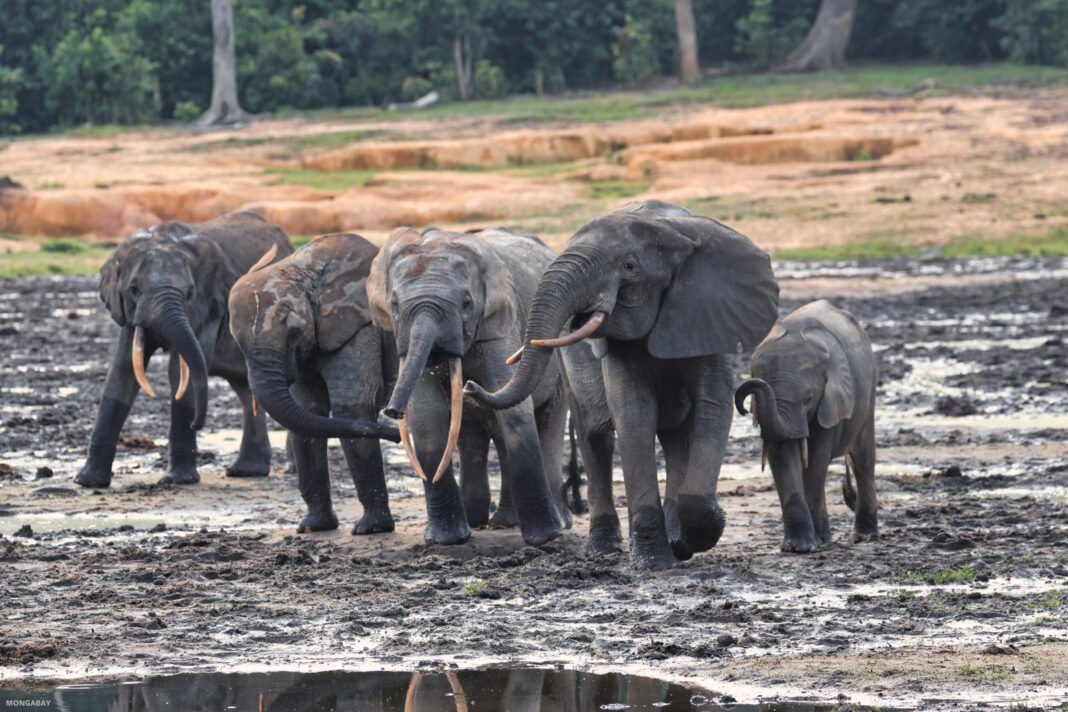
Banner image: Elephants in the Dzanga Bai forest clearing, Central African Republic. Image by Rhett A. Butler/Mongabay.
Source:
news.mongabay.com