



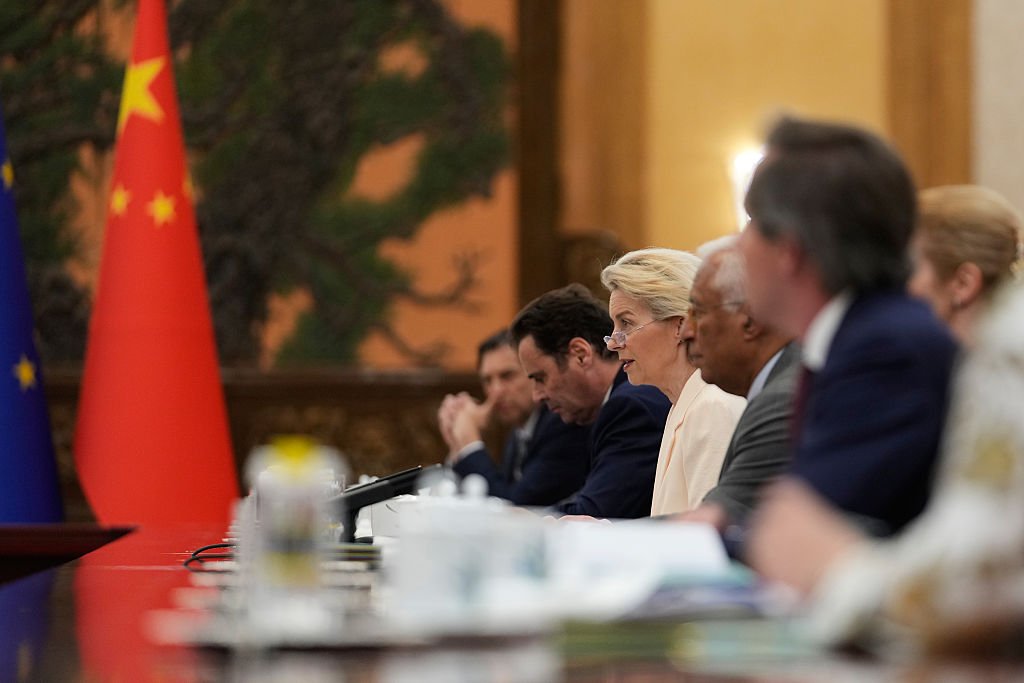
European leaders will discuss the EU’s increasingly fraught relationship with China when they gather in Brussels on Thursday, but there is little sign the debate will alleviate tensions with Beijing.
For years, China’s ballooning trade surplus, dominance of critical supply chains and deepening ties with Russia have strained Europe’s relationship with the world’s second-largest economy.
Recent events have sharpened those tensions. In March, the European Commission enraged Beijing by proposing a ‘Made in Europe’ law designed to curb China’s role in strategic industrial sectors.
Earlier this month, the Commission also backed a French-led push to strengthen the bloc’s trade defence tools against economic coercion. On Monday, Brussels said it had verified reports that Chinese nationals were being trained by Russia to fight in Ukraine – allegations Beijing has denied.
“This week’s European Council is likely to mark one of the most important moments in Europe’s China debate in years,” said Andrew Small, director of the Asia programme at the European Council on Foreign Relations.
“The issue is no longer whether China poses a systemic challenge – EU leaders now broadly accept that – but whether Europe is prepared to act at the scale and speed required,” he added.
There are signs that even Germany, traditionally among Europe’s more China-friendly capitals, is reassessing its position as its export-oriented industries face intensifying competition from Chinese manufacturers.
“We cannot and will not stand idly by when others fail to observe shared rules,” Friedrich Merz, Germany’s chancellor, said last week, adding that the EU should protect itself from “distortions … caused by the trade practices of other states.”
Others have gone further. Bart De Wever, Belgium’s premier, recently accused China of behaving like an “imperial overlord” and criticised fellow EU leaders for being “afraid” to challenge Beijing’s efforts to create “systemic dependencies” through its supply chains.
EU officials and analysts warn that China’s vast trade surplus, which reached a record $1.2 trillion (€1.04 trillion) last year, has compounded pressures facing European industry, particularly in the chemicals, automotive and machinery sectors.
“There is a growing perception that the trade imbalances that all member states have with China are unsustainable,” said a senior EU official. The “overarching goal” of Thursday’s discussion, the official added, is for national capitals to provide guidance to the Commission on “how to deal with this challenge.”
James Green, a research fellow at the Centre for European Reform, said China’s export-led growth model had amplified Europe’s wider economic difficulties, including high energy costs and US President Donald Trump’s sweeping tariffs on EU exports to the US.
“If Chinese industry is a shark, then it is currently taking big bites out of European industry,” he said.
Backlash by Beijing?
Yet many remain sceptical that Europe is prepared to translate tougher rhetoric into action.
Alicia García Herrero, a senior fellow at Brussels-based think-tank Bruegel, said divisions among EU states and fears of Chinese retaliation mean that leaders are unlikely to agree on any concrete measures on Thursday.
Spain, which has cultivated closer ties with Beijing in recent years, recently distanced itself from French calls for tougher trade measures despite initially supporting them.
“Unless you have very strong support from member states, which we do not have … [leaders will not] come up with any approved way forward,” García Herrero said, adding that the summit would most likely produce little more than “stronger words.”
Concerns about retaliation are not unfounded.
China’s export controls on rare earths last year, covering materials used in a broad range of civilian and military technologies, triggered alarm in European capitals and forced some manufacturers to delay or suspend production. The restrictions also contributed to an uneasy truce between Beijing and Washington after Trump imposed tariffs of up to 145% on Chinese imports.
Emboldened by its victory over the US, Beijing has explicitly threatened retaliation against tougher trade measures from Brussels.
“Isn’t ‘diversification’ in this case just another version of protectionism?” a Chinese foreign ministry spokesperson said earlier this month after the Commission endorsed a dedicated instrument aimed at reducing European dependence on China.
“As an old Chinese saying goes, do not do unto others what you would not have others do unto you,” the spokesperson added.
Analysts also caution that additional trade measures would do little to address the deeper source of tension: China’s reliance on export-led manufacturing. China now accounts for roughly a third of global industrial output – around three times that of the US and nine times that of Germany.
“China has a strategic interest in continuing this export-led model, in part, because it means that the EU, the US and third countries all over the world are reliant on its products, giving China leverage,” Green said.
Whether Europe’s tougher mood translates into policy, however, remains uncertain.
Green also said it remained unclear what the outcome of Thursday’s debate will be.
“I do think that we’re seeing a shift in mindset towards a tougher line against Beijing,” Green said. “But how that tougher line translates into actual action remains to be seen.”
(bw, cz)
For deeper context on how Brussels and Beijing shape each other’s decisions, sign up to Red Thread, Euractiv’s weekly EU-China briefing.
Source:
www.euractiv.com
