



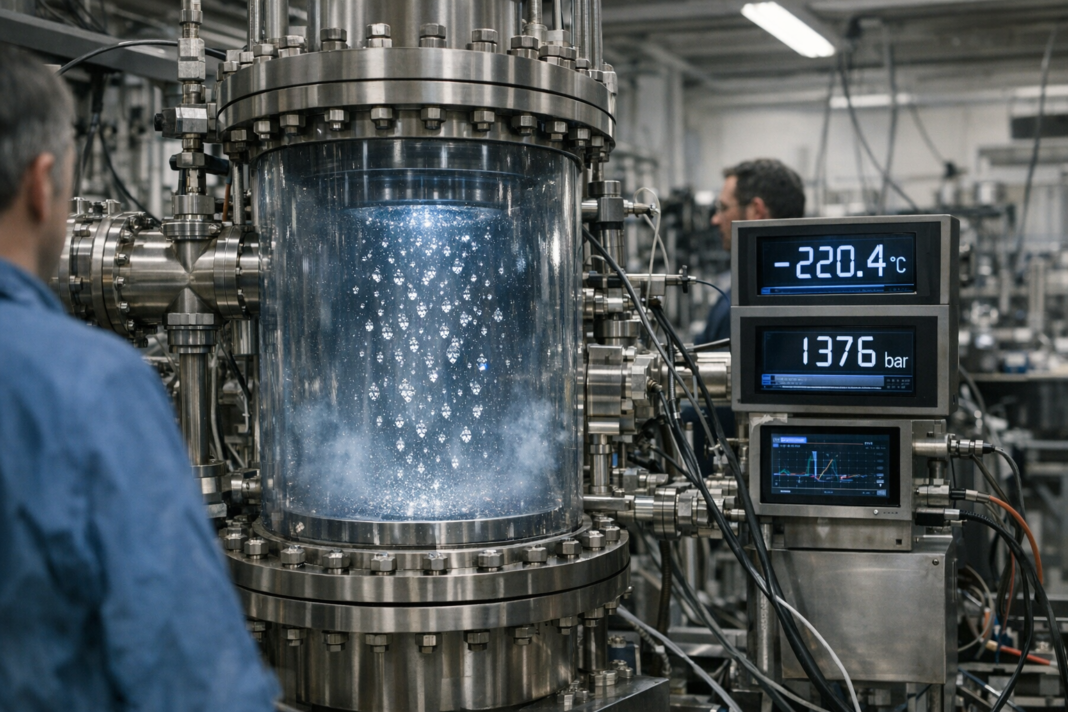
Laboratory teams have for the first time reproduced in controlled experiments a process long hypothesized to occur deep inside ice giants: the formation of solid carbon structures under extreme conditions that could sink toward planetary cores. The work addresses a persistent question in planetary science—how materials behave under pressures and temperatures far beyond Earth’s surface—and provides new experimental evidence for a mechanism often summarized in popular accounts as “diamond rain.” The result narrows the gap between theoretical models and laboratory physics for these distant worlds.
The researchers recreated the intense environments believed to exist in the mantles of planets composed largely of volatiles and ices, then observed carbon-rich material transform in ways consistent with solidification and downward transport. While descriptions in media commonly speak of glittering showers, the experiment focuses on phase changes and material flows at conditions that are challenging to produce and diagnose in the laboratory. This milestone is notable because it directly tests processes that had previously been inferred only from calculations and indirect planetary data.
Beyond the striking image of falling diamonds, the findings have practical implications for how scientists model the internal structure, thermal evolution and magnetic behavior of planets such as Neptune and Uranus. Changes in composition and the movement of dense carbon phases can alter heat transport and influence dynamo action in a planet’s interior, with consequences for observable properties like intrinsic heat flux and magnetic field geometry. The experiment therefore supplies a piece of the physical puzzle needed to interpret current and future observations of ice giants in our solar system and around other stars.
Next steps will include independent replication of the experimental conditions, refinement of the measurements, and integration of the findings into planetary interior models. Comparisons with data from spacecraft missions and telescopic observations will be important to assess how laboratory-scale processes scale up to whole-planet behavior. As exploration of the outer solar system and exoplanetary systems advances, experimental benchmarks like this one will help bridge theory and observation in the study of complex planetary interiors.