



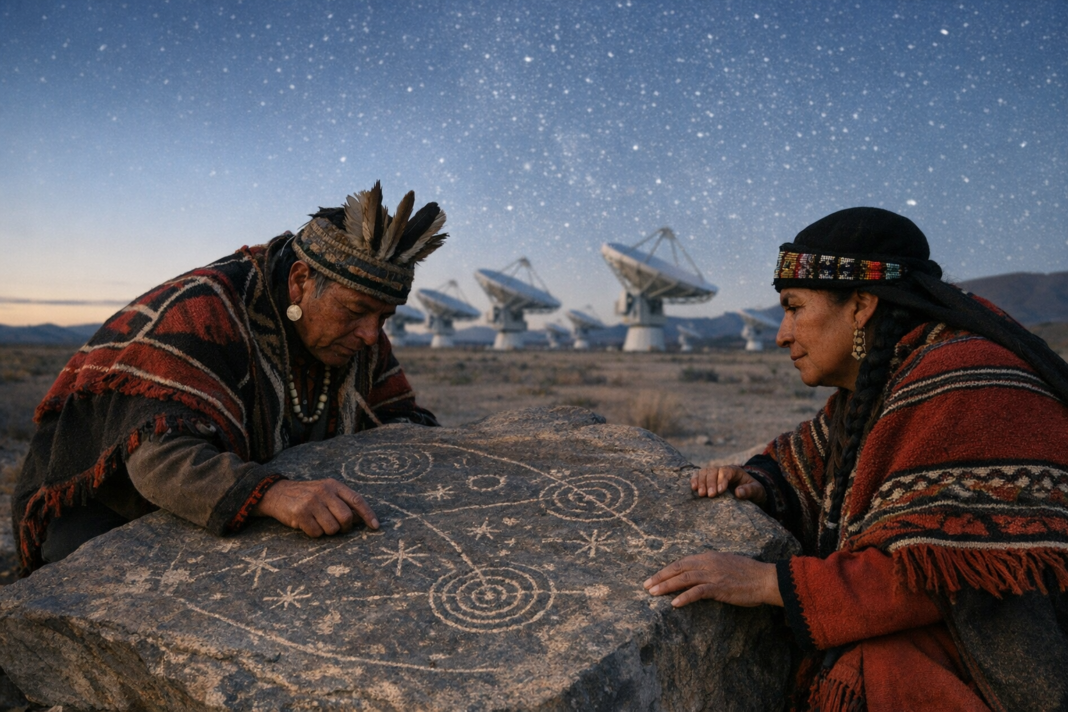
Ancient sky observation shaped practical human activities for millennia: people tracked the sun, moon and stars to mark hours, seasons and agricultural cycles. Those practices produced a variety of records — from written logs and engraved stones to oral traditions — that document how communities interpreted celestial phenomena. What modern researchers call cosmology and astrophysics represent a recent stage in a long, evolving relationship between societies and the sky. This continuity places historical materials at the intersection of cultural heritage and scientific inquiry, and it reframes how contemporary projects engage with local knowledge.
The international effort known as SKA Observatory aims to build next‑generation radio telescopes with sites in Australia and South Africa. As a large‑scale scientific infrastructure, the project highlights the need to consider both technical requirements and the cultural contexts of hosting territories. Engineers, astronomers, archivists and community representatives face shared questions about preserving archival material, documenting local memories of the sky and ensuring that scientific development proceeds in dialogue with custodians of heritage.
Historical astronomical archives and living traditions can contribute practical context for contemporary observations. Old records sometimes contain positional observations, timing practices or descriptive accounts that help place new data within longer temporal frameworks. At the same time, attention to local memory supports cultural continuity and may affect site stewardship and public access to heritage resources. Integrating these sources requires cataloguing, respectful collaboration and methods that make archives usable for both researchers and community members without compromising their integrity.
Addressing the overlap between heritage and radio astronomy calls for multidisciplinary work across fields such as astronomy, conservation and community engagement. The SKA’s scale underscores the broader relevance of combining technical ambition with attention to historical and cultural dimensions, and it points to opportunities for education, shared stewardship and expanded research horizons. Maintaining transparent, respectful partnerships will be central to ensuring that scientific advances and the preservation of sky‑related memory proceed in parallel.