



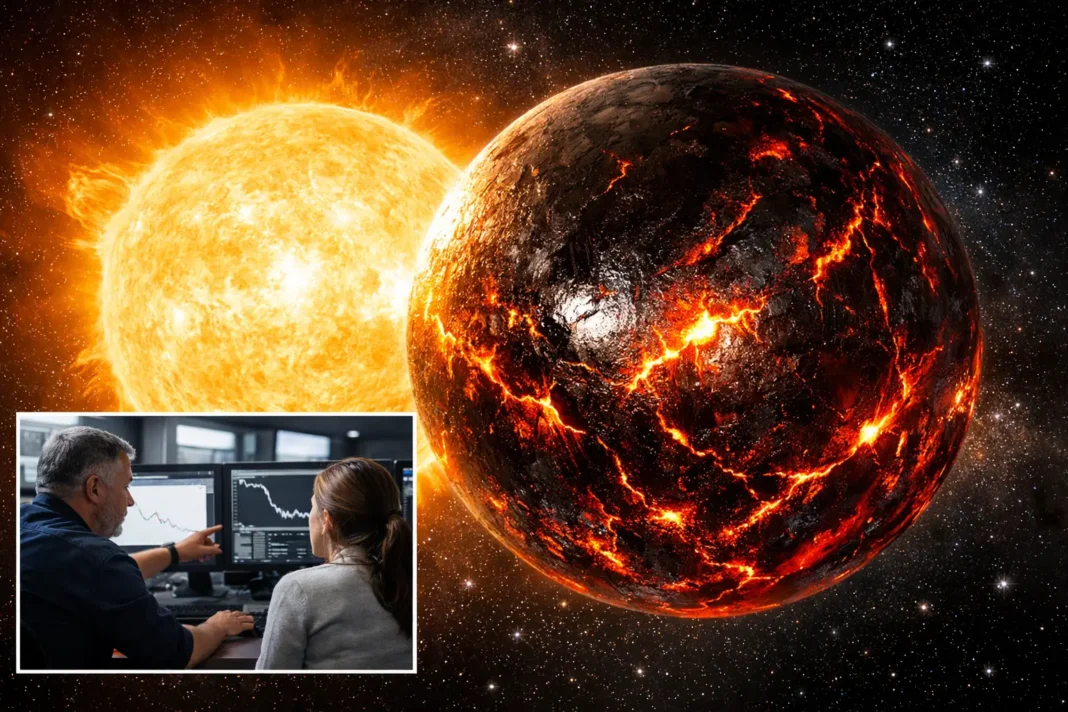
A strange reflective world covered by lava is drawing attention to one of the most extreme families of planets known beyond the solar system: ultra-short-period worlds. These objects, identified among the discoveries made by NASA Kepler and TESS, orbit their stars in less than 24 hours. Their speed alone places them far outside the familiar architecture of our planetary neighborhood and makes them a demanding test for current models of exoplanets.
The contrast with Mercury shows how unusual these systems are. For ancient observers, Mercury appeared so swift across the sky that it was associated with the Roman messenger god. Yet the planet takes 88 days to complete one orbit around the Sun. Ultra-short-period planets compress that journey into a single Earth day or less, implying an orbit extremely close to the host star. In such environments, the boundary between planetary geology, atmosphere and stellar radiation becomes difficult to separate.
The reflective lava world under study is especially challenging because it combines characteristics that do not sit comfortably with simple expectations. A lava-dominated surface suggests intense heating, while strong reflectivity raises questions about what material or process allows so much light to be returned rather than absorbed. For astronomers, that combination matters: reflected light is one of the clues used to infer the nature of distant planets that cannot be visited or directly resolved in detail.
Kepler and TESS transformed this field by detecting planetary transits, the tiny dips in starlight that occur when a planet crosses in front of its star from Earth’s point of view. That method is particularly effective for worlds on very short orbits because they pass in front of their stars frequently. The repeated signals help confirm their existence, but confirmation is only the starting point. Understanding what these planets are made of, how they formed and why some behave unexpectedly remains far more complicated.
Ultra-short-period planets have become a valuable laboratory for space science because they expose planetary systems to conditions not seen in the solar system. Their study helps refine ideas about orbital evolution, planetary surfaces and the effects of intense stellar radiation. The reflective lava world now under scrutiny underlines a broader lesson from the exoplanet era: the more planets astronomers find, the less likely it becomes that any single model can capture the variety of worlds in the galaxy.