




See All Key Ideas
In July 2025, the Indigenous Shuar people celebrated the end of a decade-long struggle when they received official titles for three communities — the Shuar Tunants, Kampan and Tsuntsuim –- within the Kutukú Shaimi Protected Forest, in the south of the Ecuadorean Amazon.
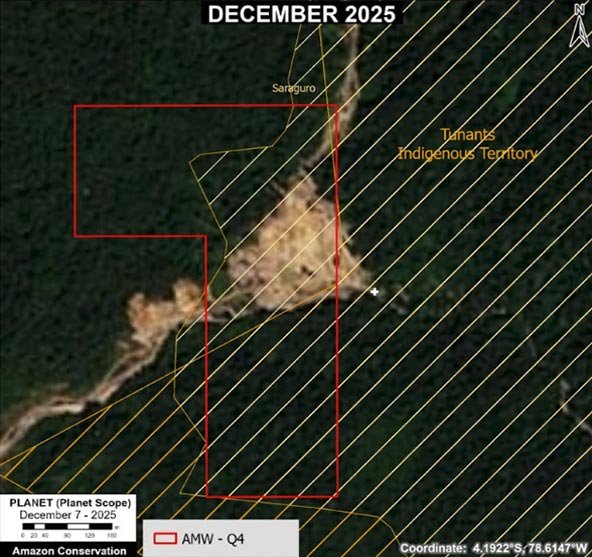
But in one of those communities, satellite imagery shows that between August and December 2025, a gaping hole appeared in the forest around a riverbend — a mining scar. Despite the Tunants territory’s newly formalized status, deforestation due to gold mining nearly tripled, reaching 2 hectares (5 acres) in size in the last three months of 2025, according to Amazon Mining Watch Panorama, a new quarterly report.
The report shows that deforestation due to illegal gold mining continues to grow across the Amazon, threatening protected parts of the rainforest. In total, 6,000 hectares (more than 14,800 acres) — about seven times the size of Central Park in New York City — of new mining scars appeared across protected areas and Indigenous territories over the last three months of 2025. This mining is presumed to be illegal, as most Amazonian countries have legislation prohibiting mining in Indigenous territories and protected areas, with experts warning that greater law enforcement is needed.
Most of the deforestation caused by mining during that period took place in Brazil, with roughly 2,000 hectares (about 5,000 acres) of forest being cleared. This was followed by Peru with 1,700 hectares (4,200 acres), and Guyana with 900 hectares (about 2,200 acres). New mining scars were also recorded in the six other countries that make up the Amazon: Venezuela, Suriname, Bolivia, French Guiana, Colombia and Ecuador.
Overall, 496,000 hectares (1.2 million acres) of Indigenous territories and protected areas were affected by mining between 2018 and 2025, according to Amazon Mining Watch, a public platform on which the Panorama report is based. The southeastern Brazilian Amazon, southern Peru and the Guyana Shield are the most affected regions.
In Guyana’s Kamarang Keng Indigenous territory, mining has caused environmental pollution, forest degradation, disruption to subsistence farming, and social problems “like drugs coming into our territory,” said Alma Marshall, the toshao, or Indigenous leader, of Kamarang/Warawatta village in the Upper Mazaruni district of Guyana.
After a lull earlier last year, mining scars grew by 10 hectares (25 acres) in Kamarang Keng between October and December, bringing the total affected area to 340 hectares (840 acres). Artisanal mining has been a source of livelihood for the local Indigenous community for decades, Marshall told Mongabay by phone, but outsiders now come without prior consent, claiming to have mining permits that Marshall said are outdated. “Whenever these people come, they should consult with us [first],” she said.
Gold prices drive new, renewed and ongoing mining
The Panorama report highlights 10 Indigenous territories or protected areas where new mining scars appeared. In one case, the Charip Indigenous territory near Ecuador’s border with Colombia, no mining had previously been detected since the data series began in 2018. But deforestation was detected in the last three months of 2025. This is a region with a strong presence of illegal armed groups that are responsible for mining, according to Jorge Villa, coordinator of the Monitoring of the Andes Amazon Program (MAAP) at Ecuador’s EcoCiencia Foundation.


In five other areas, mining had abated in the previous months or even years, but returned at the end of 2025. This was the case at Tunants in Ecuador and Kamarang Keng in Guyana.
Another four territories in Venezuela, Brazil and Peru saw an acceleration of mining incursions during the quarter. In Peru, more than 200 hectares (about 500 acres) of new mining were added to the Tambopata Protected Area in the Madre de Dios region, bringing the total forest loss there to 16,700 hectares (about 41,300 acres). This February, an operation by Peruvian authorities destroyed dozens of pieces of mining equipment there.
“It’s no secret that high prices of gold are driving this illegal activity,” Andrés Santana, senior manager for halting illegal deforestation at Amazon Conservation, told Mongabay in a video interview. The price of gold rose by more than 50% last year, hitting a then-record $4,549 per ounce (prices have since crossed the $5,000 mark.)
This “makes the illegal business increasingly viable,” said Luiz Jardim, coordinator of Brazil’s Observatory for Mining Conflicts and a professor in the geography department at Fluminense Federal University in Brazil.
Varying degrees of mining incursions reflect different realities on the ground. Factors like the absence of the state — and by extension the presence of criminal organizations — the proximity of existing roads, and the ease of transporting heavy machinery can explain larger areas of illegal gold mining, Santana said.
Colombia only recorded 10 hectares of new mining scars in the period analyzed. That’s because mining in the Colombian Amazon tends to be in rivers, which doesn’t directly cause deforestation and isn’t currently picked up by Amazon Mining Watch’s system, Santana said. “That doesn’t mean that there are fewer impacts,” he added.
In Ecuador, which recorded 240 hectares (nearly 600 acres) of new mining scars, illegal gold mining is relatively new. “This process started recently in Ecuador, but as we’ve seen in countries like Brazil and Peru, we understand that this can have a tendency to expand very quickly and strongly if we don’t start developing control and monitoring actions,” Villa said.
The Tunants, Charip and Arajuni Chicico Rumi Indigenous territories saw new mining incursions after receiving formal recognition last year, raising questions about the robustness of these protections.
“We don’t have much information about the context,” said Blaise Bodin, director of strategy and policy at Amazon Conservation. “The Panorama’s objective is to detect new mining invasions early and make this public so that other actors, such as local organizations, can use this data and investigate.”
A tool to combat cross-border illegal mining
Launched last year, Amazon Mining Watch trains artificial intelligence algorithms to recognize mining scars in satellite images. It’s being constantly improved, fed information from partners on the ground, Santana said.
“The platform’s unique aspect is that it has a unified methodology for the whole Amazon and will provide complete analysis every quarter,” Bodin said. “It may not be as detailed as some local monitoring systems, but it gives the possibility of detecting new [mining] areas where local organizations aren’t monitoring.”
Bodin and Santana say the platform is particularly useful for fighting illegal mining across borders, as Brazil and Colombia did last year with two joint operations against illegal gold miners on the Puré River.
“Part of the solution is not only in the application of the law and enforcement efforts, but also in generating a convergence of regulations, so that there can be a joint response,” Santana said.

A tool integrated into the platform estimates the socioenvironmental cost of mining in U.S. dollars, putting a price on deforestation, mercury pollution, river erosion and silting, as well as the cost of the extracted gold. “It’s information that can be used by communities to file a lawsuit, or by prosecutors to better estimate impacts and sanctions,” Santana said.
Amazon Conservation will soon be launching a Mining Policy Scoreboard as part of Amazon Mining Watch, keeping track of each country’s mining-related policies, such as mercury sales regulations. Examples of good practice include the Geocatmin mining registry in Peru and a national registry of mining machinery in Colombia that includes GPS data, Santana said.
Jardim, who isn’t involved in Amazon Mining Watch, said the platform is vital to exposing the scale of the environmental damage caused by illegal gold mining in the Amazon. “It doesn’t directly reduce mining, but it contributes to raising the awareness of civil society, consumers, about the damage of their consumption and trade,” he said.
Bodin said tackling the gold supply chain with traceability measures will be key to effectively addressing illegal mining and the damage it wreaks in the Amazon.
“With the price of gold we have at the moment,” he said, “repression alone is not going to work.”
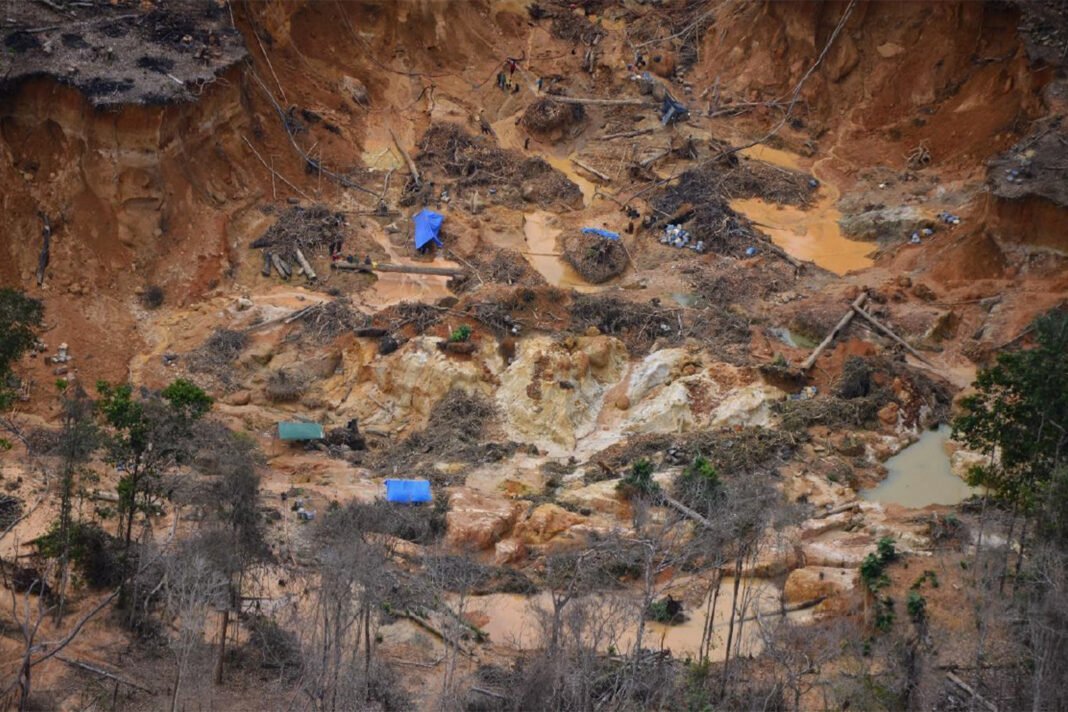
Banner image: An overflight view over illegal gold mining camps in the Yanomami Indigenous Reserve. Image courtesy of Instituto Socioambiental (ISA).
FEEDBACK: Use this form to send a message to the author of this post. If you want to post a public comment, you can do that at the bottom of the page.

Source:
news.mongabay.com