



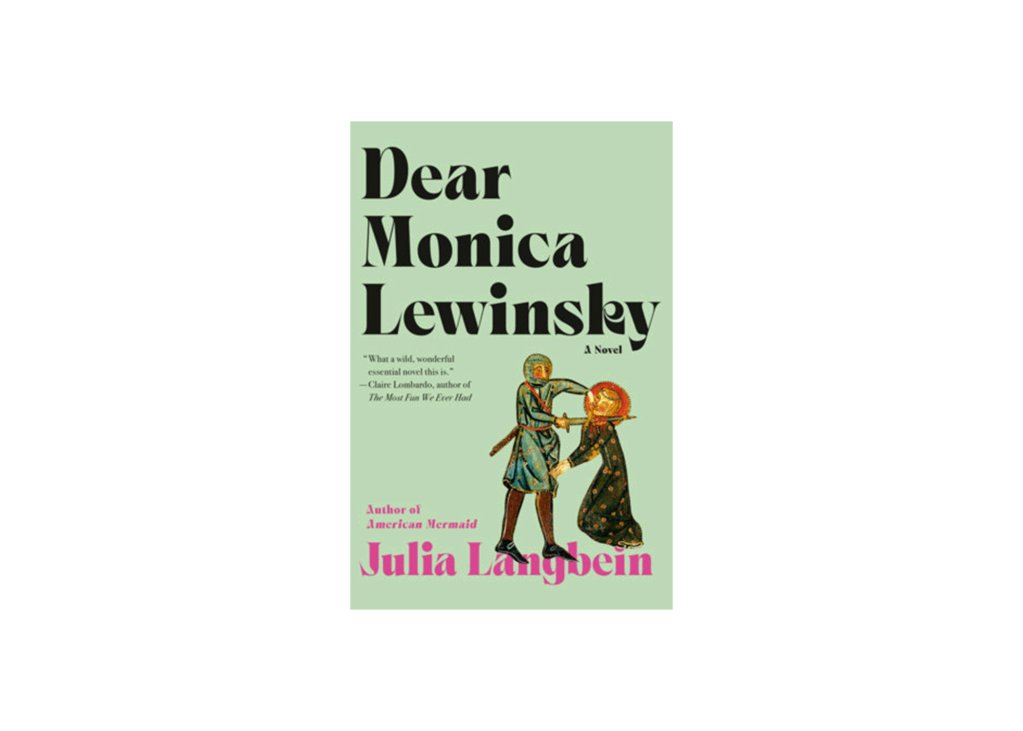

If you turned on cable news in the summer of 1998, you were all but guaranteed to see the face of then 24-year-old Monica Lewinsky. Earlier that year, in January, news of her relationship with President Bill Clinton broke, and for the months following, Lewinsky endured a shame-spinning spectacle of puritanism, contempt, and blame—much of it hurled at her first by Ken Starr in a hotel room at the Ritz Carlton in Pentagon City, where she was questioned for twelve hours, then later by members of the federal grand jury, who demanded she retrace her encounters with the President of the United States in painful detail. This says nothing of her greatest abuser of all: the general public.
Related Articles
Monica’s mortification that summer of ’98 forms the backbone of Julia Langbein’s latest novel Dear Monica Lewinsky, out this month from Doubleday. But Langbein’s narrative begins two decades later, in 2019, as forty-year old Jean Dornan, a translator stuck in an ever-present malaise, finds herself on the brink of crisis. David, a professor with whom she shared an inappropriate relationship in her youth—as it happens, that same summer Lewinsky’s face was plastered everywhere—invites her to attend a party celebrating his retirement from the intercollegiate institute of Medieval Art where they first met. In the years preceding his invitation, their relationship—and the hurt and humiliation it caused—had proved impassable. Jean found herself stuck and haunted by a sense of doom.
As the invitation stirs up memories, middle-aged Jean revisits her diary from the time of her relationship with David. There, she discovers her own teenage mistreatment of Monica Lewinsky. “Clinton admitted on TV to an affair in the White House with a skanky intern,” she had spewed.
Reading her words from years past, Jean comes to notice the parallels between President and professor. There, in her guest bedroom, she begins to pray: “Dear Monica Lewinsky, please help me.”
And help she does. The next day, a haloed Monica Lewinsky appears and guides her through memories of her time with David: the summer she spent cataloging hundreds of Romanesque churches at the institute in Plaisy, France before her junior year of college. Interspersed with tales of martyred women drawn from The Golden Legend, the 13th-century collection of over 150 women’s stories compiled by the Dominican Friar Jacobus de Voragine, Langbein’s novel manages to enlist both medieval art Monica Lewinsky to plumb the depths of self-estrangement.
Langbein is no stranger to medieval art: she holds a PhD in art history from the University of Chicago and is also the author of the American Mermaid as well as Laugh Lines: Caricaturing Painting in Nineteenth-Century France. Art in America spoke with Langbein about Dear Monica Lewinsky; her time researching the novel in Bourges, France; and the limitations of art history when it comes to capturing a work’s emotional power.
When did you know this was the novel that you wanted to write?
In 2019, I found an old diary from 1998 in which I was cruel about Monica Lewinsky. I must have been 16 or 17 that year. I clasped my hands, dropped the diary, and I went, “I’m so sorry. I’m so sorry.” I’m not a religious person at all, but I just felt that this gesture was available to me, of praying to Monica Lewinsky.
My background as an art historian pushed me to consider that there might be an understanding of a collective experience in that idiosyncratic gesture I’d made. I had studied a lot of medieval art, especially as an undergrad, and you become familiar with these sources, like [Jacobus de Voragine’s] “Golden Legend.” You read a Saint’s Vita [a hagiographic account of a holy figure’s life], and you understand that it’s a literary genre. Once I understood her life as a martyr’s Vita, the rest just fell into place.
How did you connect that almost religious experience around Monica Lewinsky to medieval art?
There were a few pieces that needed to come together. During the year of Monica Lewinsky, I lived in France. My dad was a professor, and he was in the UK for that year; I chose to do a study abroad program. That meant I experienced that whole political media moment through the filter of a foreign country.
The main character of the book is a fictional woman who’s had this really damaging affair and is trying to get her life back. Thinking about Monica Lewinsky, I realized that if framed as a saint, she could wear so much history. I could play around with the iconography, because everyone is familiar with both “Monica” iconography and with the iconography of Western saints, as well as with the church’s language of saints and sinners, judgment and virtue.
People connected to Christ because of his suffering, and he became the model for the martyrs. [His story is] not the typical 19th century novel about emotional connection, but it is an almost pre-novelistic, kind of archaic form. “Compunction instead of catharsis” is how one medieval scholar put it—that’s the relationship that people have to saints. We are made to feel their suffering.
Can you talk about the research you did for this novel?
In Bourges, I went to churches; I went and touched these places and looked at them. And I did it through a 19-year-old’s eyes. God, I really looked at the Portal of Bourges [Cathedral]. Jean really woke up in me.
Nancy Thebaut is [an Associate Professor in the Department of History of Art] at Oxford now, but we went to grad school together, and we walked through the Musée de Cluny. We really took on a kind of student-teacher relationship: I would give her reactions, and she would gently send me toward scholarship. I deliberately went and read a lot of scholarship from the ’90s, like [art historians] Jeffrey Hamburger and Caroline Walker Bynum. And I tried to steep myself in some of what Jean would have been reading.
The novel really touches on this idea of memory as a tool to recontextualize objects and history. How did you find a way to emphasize the emotion and sensitivity in art that we associate more with punishment and pain?
Something that has become really clear to me, as somebody who did a PhD in art history and then became an art historian, is that I wasn’t using so many aspects of my emotional responses to art in academic, which is so analytical. Here, I got to use metaphors that aren’t proper in academia, but that bring the work to life. There were so many instances where I looked at an object anew, through Jean’s eyes, in a way that I couldn’t as an academic.
Jean says at one point that she’s attracted to medieval art because it’s the “teenager of art history.” It’s awkward and it doesn’t understand itself. There’s a kind of imperfection and emotional rawness, but also these moments of incredible refinement, ugliness, and exquisiteness. Those are the things about medieval art that Jean’s really drawn to, and it’s an interest that is actually properly intellectual.
Something that really drove me nuts in art history was encountering people who felt like what their job was to exercise taste. Jean gives herself over to [the art]’ and she’s not saying, “What am I supposed to think? What’s the right answer?” She’s just really responding to it in a full-bodied way.
Do you find that looking at artwork through an emotional lens changes your relationship to the works?
I always said to students: you should look at something, and you should react. Then, you should think about your reaction. But don’t go and read what somebody thinks. Because students were so quick to assume that what they needed to do to download some smarter person’s thoughts or apply someone else’s idea or some or historical knowledge or whatever. And it’s like, no! React! And then bring all the analytical sharpness and the rigor and the learning to the reaction.
How do you see your writing practice evolving from your study of art history?I lived in this book—Cynthia Hahn’s Portrayed on the Heart—about the lives of the saints and their manifestations in medieval art. And as I was reading it, I would hear the voices. I would hear the voices of the characters. It’s amazing how productive reading scholarship can be for me as a fiction writer. I don’t know how I ever got through grad school. I imagine this [envisioning of characters and their voices] must have been happening the whole time. I probably had to use some really powerful internal repression machine. My art historical education gave me this frame—this trellis—and I’m so grateful for the time I got to spend living among it again, to spend looking at art again with purpose.
Source:
www.artnews.com