



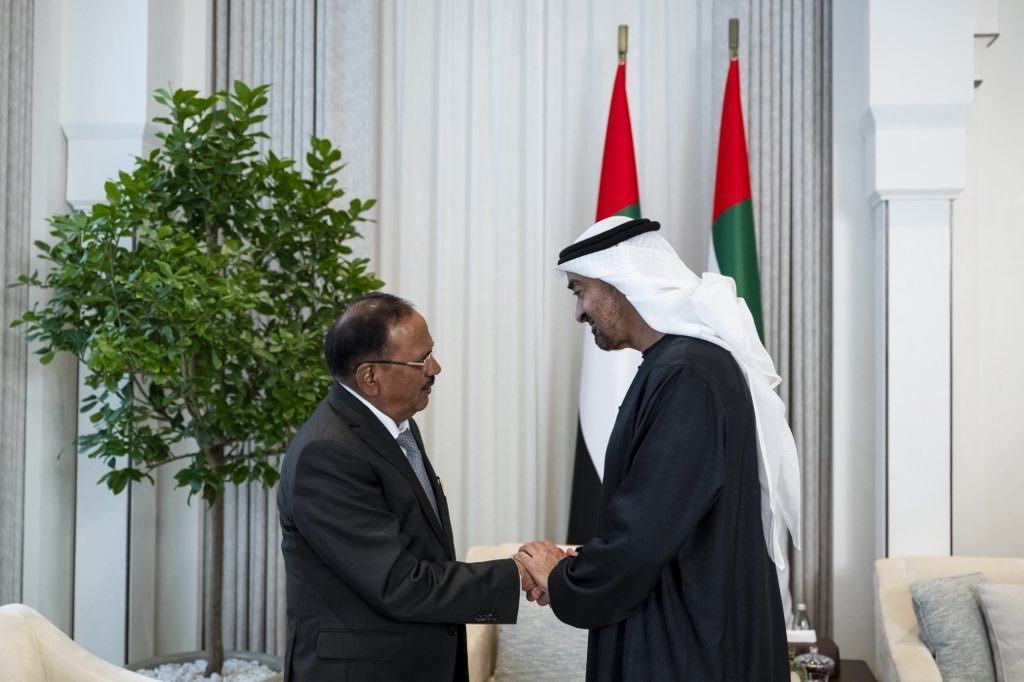


On April 26, 2026, within the solemn setting of the Presidential Palace in Abu Dhabi, Mohamed bin Zayed Al Nahyan received India’s National Security Advisor, Ajit Doval, in a meeting that far exceeds simple diplomatic protocol to align with a comprehensive strategic vision where stability, influence, and crisis anticipation converge with remarkable coherence. In an international context marked by tensions, conflicts, and geopolitical reconfigurations, this meeting powerfully illustrates the ability of the United Arab Emirates to maintain an active, structured, and resolutely forward-looking diplomacy, without yielding to the pressure of regional turbulence.
The welcome extended to the Indian emissary was worthy of the exceptional relationship that binds Abu Dhabi and New Delhi, imbued with respect, mutual consideration, and a political closeness that continues to strengthen over the years. By personally receiving Ajit Doval, Mohamed bin Zayed sends a clear signal — that of an engaged leadership placing strategic partnerships at the heart of its action, while consolidating a security architecture founded on cooperation, dialogue, and collective intelligence. This diplomatic moment, seemingly conventional, reveals in reality a much deeper dynamic: that of an UAE-India axis gradually asserting itself as a pillar of stability in a fragmented international environment.

What stands out in this sequence is consistency. While many regions of the world are paralyzed by conflicts or weakened by persistent tensions, the United Arab Emirates pursue their trajectory with undiminished determination, refusing any form of strategic withdrawal. On the contrary, Abu Dhabi multiplies initiatives, strengthens alliances, and consolidates its presence on the international stage with remarkable lucidity. This meeting thus fits into a logic of continuity where each diplomatic engagement reinforces a global positioning founded on stability, security, and development.
The relationship with India, in this context, takes on particular importance. An unavoidable emerging power, a major actor in Asian balances, and a top-tier economic partner, India constitutes for the Emirates a strategic ally that is both complementary and essential. The discussions between Mohamed bin Zayed and Ajit Doval naturally focused on regional security issues, Middle East developments and their international repercussions, but they also reflect a convergence of views on the great contemporary challenges, whether in combating transnational threats, cybersecurity, or crisis management in an increasingly uncertain environment.
This diplomatic rendezvous also sheds light on a fundamental reality: that of an Emirati model built on anticipation and resilience. Where other actors endure events, the United Arab Emirates seek to understand them, frame them, and, as far as possible, influence them. This capacity for adaptation, combined with a clear strategic vision, enables Mohamed bin Zayed to maintain a stable course despite turbulence, while strengthening his country’s international credibility. The pursuit of high-level diplomatic activities, even in times of crisis, is not merely a sign of institutional normality, but rather the expression of a strong political will to never let uncertainties dictate the national agenda.
In the background, this meeting also reveals the evolution of global power dynamics. The intensification of relations between the Emirates and India testifies to the emergence of new strategic axes, where Global South powers play an increasingly structuring role in international governance. This repositioning, skillfully orchestrated by Mohamed bin Zayed, allows Abu Dhabi to sit at the intersection of major contemporary dynamics — between the West, Asia, and the Middle East — while preserving precious strategic autonomy in a world marked by rivalries between great powers.
Thus, the meeting of April 26, 2026, cannot be reduced to a simple diplomatic audience. It embodies a vision: that of a State which refuses immobilism, which believes in the power of dialogue, and which bets on cooperation to build its security and influence. It also illustrates the ability of a leadership to transform constraints into opportunities, to maintain a course in the storm, and to make stability an active political project rather than a passive state. In a world seeking bearings, the United Arab Emirates appear more than ever as a reliable, determined, and deeply committed actor in the construction of a more balanced international order.—Tu peux copier tout ça et le coller directement dans l’éditeur WordPress en mode “Paragraphe” (visuel) — chaque bloc de texte est bien séparé, le titre est seul en haut. WordPress créera automatiquement les balises `<p>` pour chaque paragraphe.