



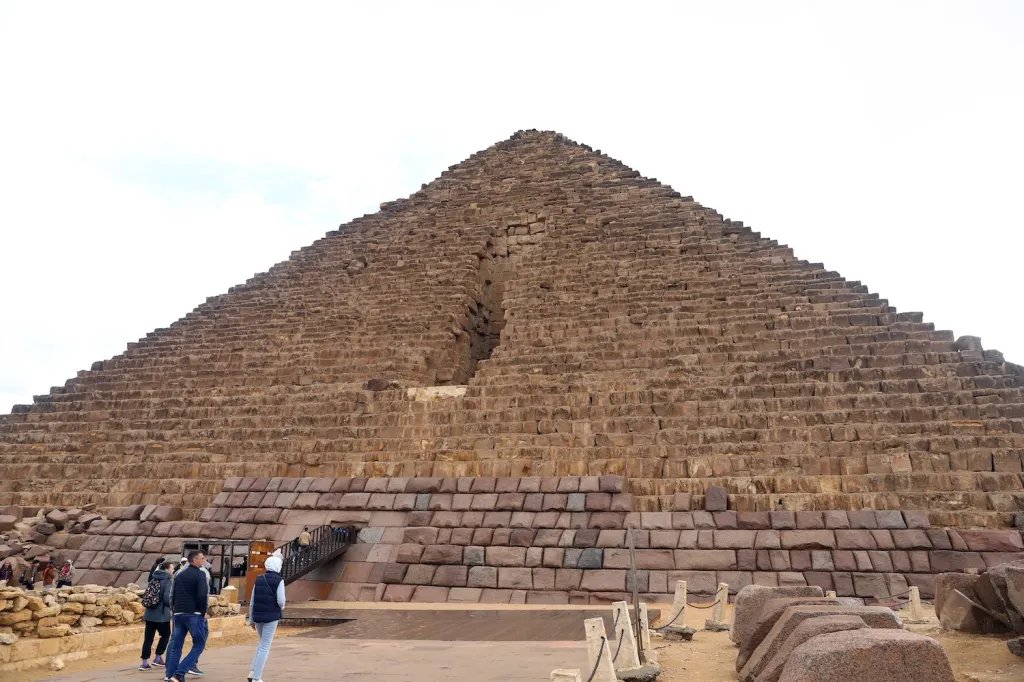

Using non-invasive technologies, researchers from Cairo University and the Technical University of Munich (TUM) have located two air-filled spaces within Giza’s Menkaure pyramid that hint at a possible secret entrance. Their findings were published in the academic journal NDT & E International.
The Menkaure pyramid is the smallest of the three main pyramids on Cairo’s Giza plateau. Built for the Fourth Dynasty ruler Menkaure, it was completed in the 26th century BC. It was excavated between 1906 to 1910, but has not been fully explored since then.
Related Articles
The structure is distinguished from its two larger neighbors by having been partially clad in red granite blocks, rather than white limestone. An unusually smooth area on its eastern facade has long intrigued researchers, due to its resemblance to a similarly polished section surrounding its north-facing main entrance.
Working within the ScanPyramids project, the research team used ground-penetrating radar, ultrasound, and electrical resistivity tomography (ERT) to confirm the presence of voids behind this area. Their discovery supports the theory, suggested by researcher Stijn van den Hoven in 2019, that a second entrance might exist at that location.
Since 2015, ScanPyramids has used the latest technologies to explore pyramids. In 2023 it found a previously undiscovered corridor at the Great Pyramid of Giza using advanced scanning techniques.
“The testing methodology we developed allows very precise conclusions to be drawn about the nature of the pyramid’s interior without damaging the valuable structure,” Christian Grosse, a non-destructive testing specialist at TUM, said in a statement. “The hypothesis of another entrance is very plausible, and our results take us a big step closer to confirming it.”
Source:
www.artnews.com