



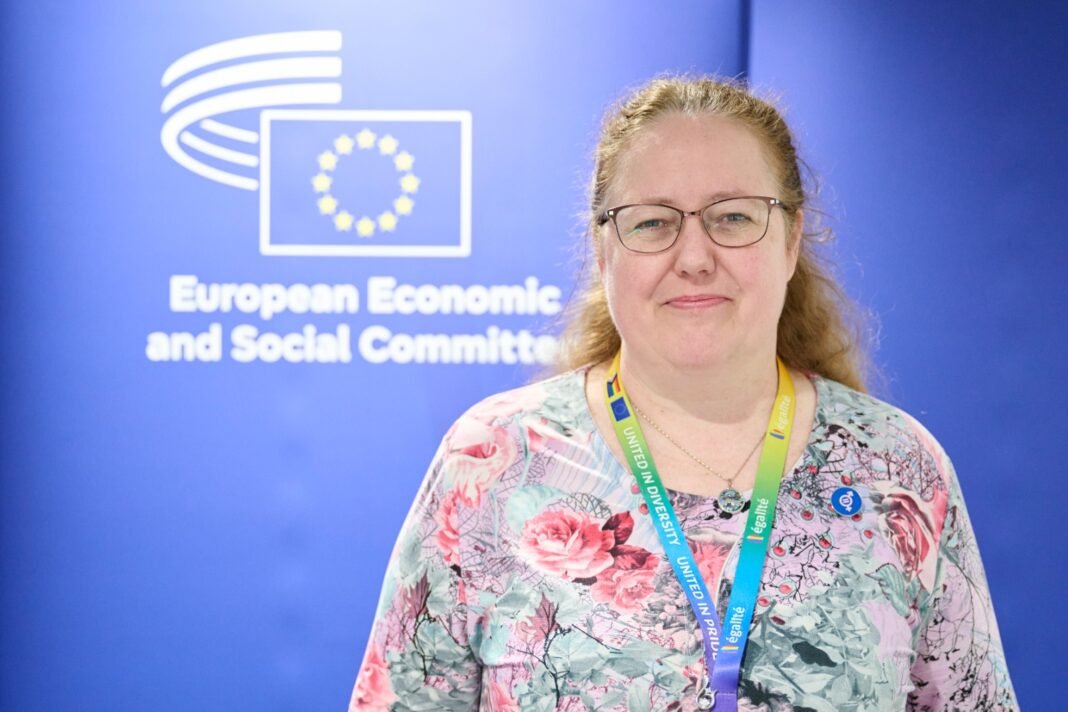
More than a third of LGBTIQ+ people in the EU report discrimination, and over half face harassment, yet political backlash and budget cuts are threatening to reverse a decade of progress. Juliane Marie Neiiendam, vice-president of the European Economic and Social Committee, tells Euractiv why the bloc’s next equality strategy must move from ambition to enforcement.
The statistics, assembled by the EU’s Fundamental Rights Agency, are striking in their consistency. In its most recent survey, 36 per cent of LGBTIQ+ people in the European Union reported experiencing discrimination in the previous year; 55 per cent reported harassment; physical and sexual attacks had risen to 14 per cent, with transgender and intersex people disproportionately affected. In schools, 67 per cent of LGBTIQ+ students reported bullying.
Against that backdrop, the European Economic and Social Committee – the EU’s formal advisory body for civil society – used its April plenary to adopt two opinions pressing the European Commission to move beyond aspiration. One addressed the forthcoming LGBTIQ Equality Strategy for 2026 to 2030; the other called for an EU-wide ban on conversion practices, framing them as violations of human dignity equivalent to hate crimes.
Juliane Marie Neiiendam, the EESC’s Vice-President for Equality and the rapporteur of the strategy opinion, is careful to acknowledge progress where it exists. But she is equally direct about what she believes the EU’s record has so far failed to deliver: not legislation on paper, but change in daily life. “The key challenge,” she says, “is making sure commitments actually reach people and become lived realities.”
The strategy and its stakes
The EESC’s opinion arrives at a moment of political turbulence for LGBTIQ+ rights across the continent. Several member states have moved to restrict gender recognition, limit adoption rights, or curtail the activities of civil society organisations working in this space. The committee’s intervention is, in part, a defensive one: an attempt to lock in legal and institutional protections before the political weather worsens further.
Neiiendam is frank about the unevenness of the current landscape. Marriage equality, she notes, remains unavailable in a significant number of EU member states. Rural areas across the bloc suffer particular shortfalls – in healthcare provision, in legal awareness, in the basic infrastructure of civil society – that metropolitan statistics tend to obscure. “Many people are still not aware of their rights,” she says. “While we have the ambition that everyone is equal, that is not always the lived experience, particularly outside metropolitan areas.”
The EESC’s eight principal recommendations cover legal gender recognition based on self-determination, strengthened monitoring and enforcement mechanisms, access to inclusive healthcare and education, workplace inclusion, and sustained support for civil society organisations.
On gender recognition, the committee’s position is unambiguous: the principle should be self-determination, not administrative or medical gatekeeping. “That is really a core principle for us,” Neiiendam says. “Self-determination, not somebody else telling you what you are.”
Enforcement Over Ambition
The committee’s central argument is that the EU’s equality architecture suffers less from a deficit of stated intent than from a failure of implementation. Successive strategies have articulated the same principles; successive assessments have found the same gaps. What the EESC is pressing for in the 2026–2030 cycle is a harder-edged approach: clearer benchmarks, more rigorous monitoring, and a stronger role for European courts, which Neiiendam credits with doing significant work to translate equality principles into binding legal obligations for member states.
She is also attentive to the limits of single-axis policy thinking. Many of the people most acutely affected by LGBTIQ+ discrimination do not experience it in isolation: they are also disabled, or members of ethnic minority groups, or living in poverty. “Many policies tend to address one issue at a time,” she says.
“But in reality, people often face multiple forms of discrimination simultaneously. When discrimination overlaps, its impact compounds.” The committee’s opinion calls for intersectionality to be built into equality policy as a structural principle rather than an addendum.
Civil society under pressure
Perhaps the most urgent concern Neiiendam raises is the funding environment for civil society organisations. Negotiations over the EU’s next multiannual financial framework are already raising the prospect of cuts to the programmes that sustain much of the practical equality infrastructure across the bloc – the organisations that provide legal advice, psychological support, and safe spaces for people who have nowhere else to turn.
“Civic space requires resources,” she says, “even something as basic as having a place where people can meet.” For Neiiendam, the social partners – trade unions and employer organisations – have a particular role to play in workplace inclusion, not only through social dialogue but through collective bargaining that makes equality commitments contractually real rather than merely aspirational.
The broader argument she is making is fundamentally a social and economic one as much as a rights-based one.
A Europe in which significant numbers of people are afraid to participate fully in public and professional life is, she argues, a less innovative and less productive one. “We cannot have individuals who are afraid to participate because of who they are,” she says. “Everyone should be able to take part – that is how we become stronger, more innovative and better prepared as a society.”
The question the EESC is putting to the Commission, and implicitly to member states, is a pointed one: what kind of Europe does the bloc actually want to be? Neiiendam’s answer is clear enough. “A Europe where people feel safe, respected and free to be themselves” – and, she would add, one prepared to do the institutional and financial work to make that more than a slogan.
This interview has been abbreviated.
[BM]
Source:
www.euractiv.com