



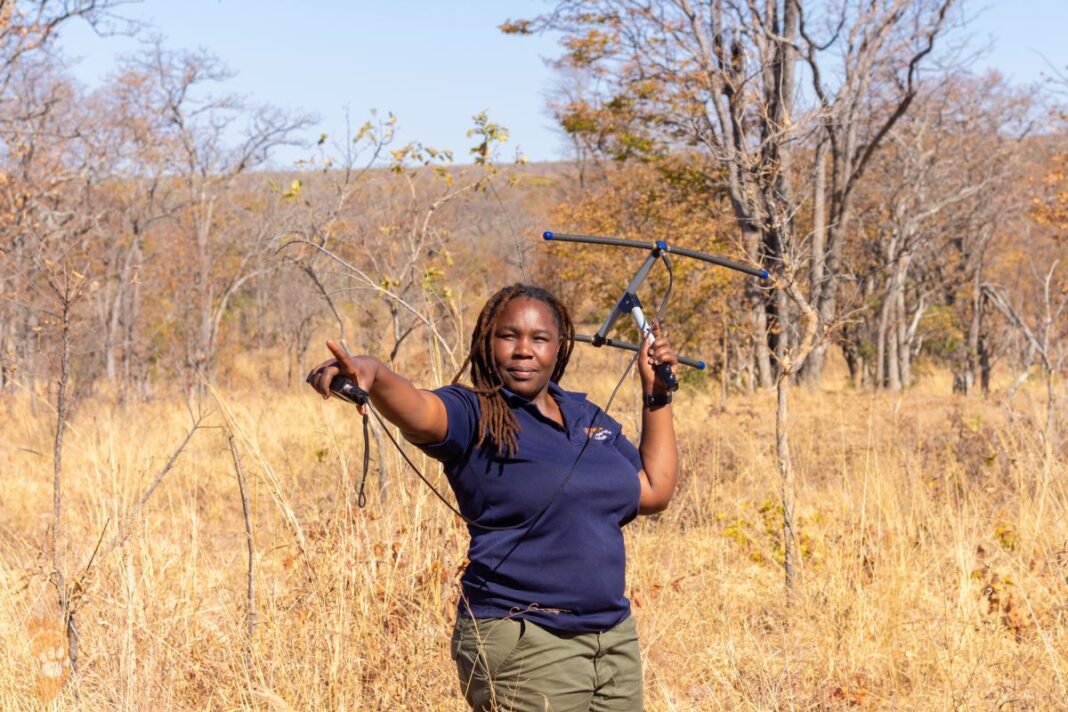

Community guardians employed by WCA warn farmers when lions enter their farming areas; promote the use of secure animal enclosures for cattle, goats and sheep, and oversee the installation of solar-powered flashing lights to deter nocturnal raids by lions.
These interventions have reduced conflict by up to 98% in at least two rural wards, but habitat loss through the expansion of farms into wildlife migration corridors worries Mbizah and her team.
See All Key Ideas
Lion conservationist Moreangels Mbizah and her colleagues chose the name “Batabilili” for the community guardians they’re training in northern Zimbabwe. The word means “protectors” in the local language, Tonga, and its meaning cuts both ways: the guardians protect people and their livestock from lions, and lions from people.
Both jobs are essential in this part of the Southern African country. When cattle are killed by lions, the economic losses suffered by families are considerable; when farmers retaliate by killing lions, it worsens the plight of an emblematic species, Panthera leo, now vulnerable to extinction across the continent.
“In some cases these lions are female lions and at times some of them would have cubs, so when the females die [at the hands of people] the cubs would probably die [also],” says Mbizah, who is the winner of one of this year’s Whitley Awards, prestigious international conservation prizes given out annually by the U.K.’s Whitley Fund for Nature.
The 50,000-pound ($67,500) prize money will go toward supporting the work by Mbizah’s NGO, Wildlife Conservation Action, in three additional rural wards — small administrative areas comprising clusters of villages and around 4,800 people — that are prone to human-carnivore conflict. This will include the recruitment of six new Batabilili.
The protectors head out early each morning to look for tracks or droppings and warn farmers about the presence of predators or elephants (Loxodonta africana) so that they can avoid herding their livestock in that direction. They also encourage farmers to strengthen their cattle kraals, or enclosures, to protect them from lions or other nocturnal predators like hyenas (Crocuta crocuta); identify farmers most at risk of animal attacks and encourage them to take other steps to protect their livestock, and their crops from raids by elephants.
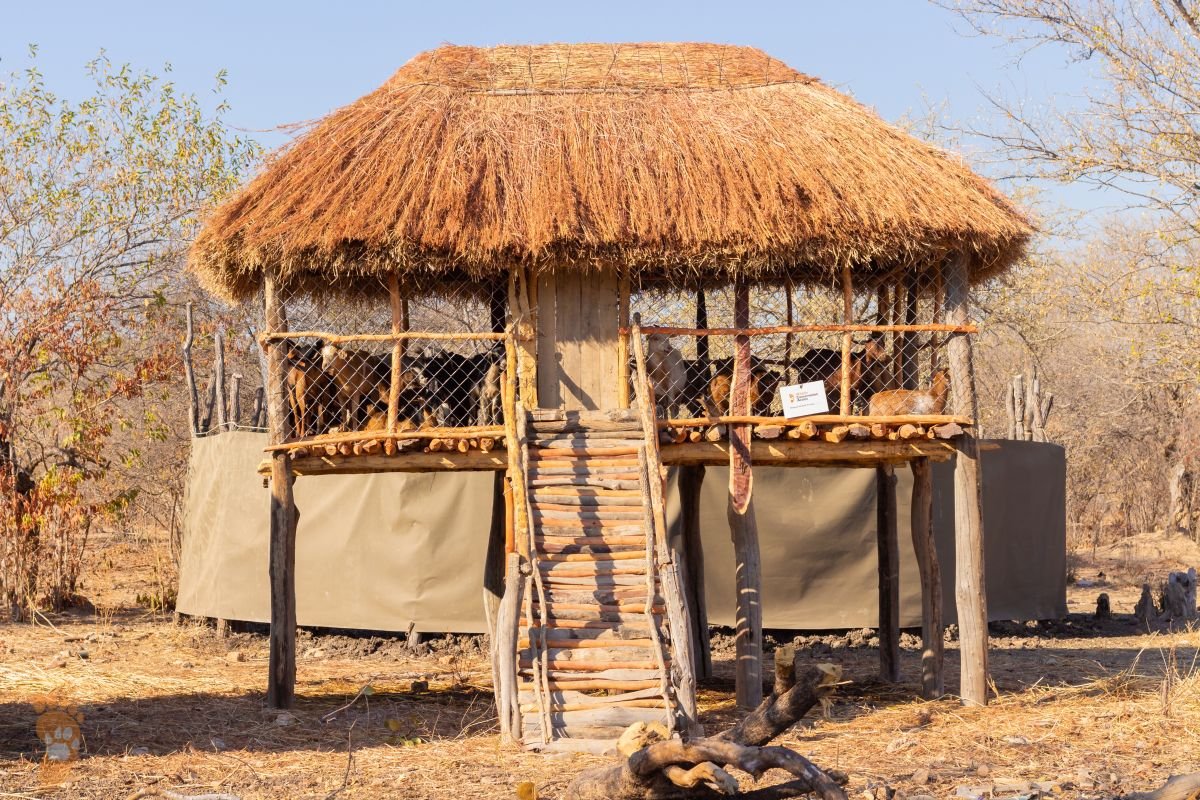
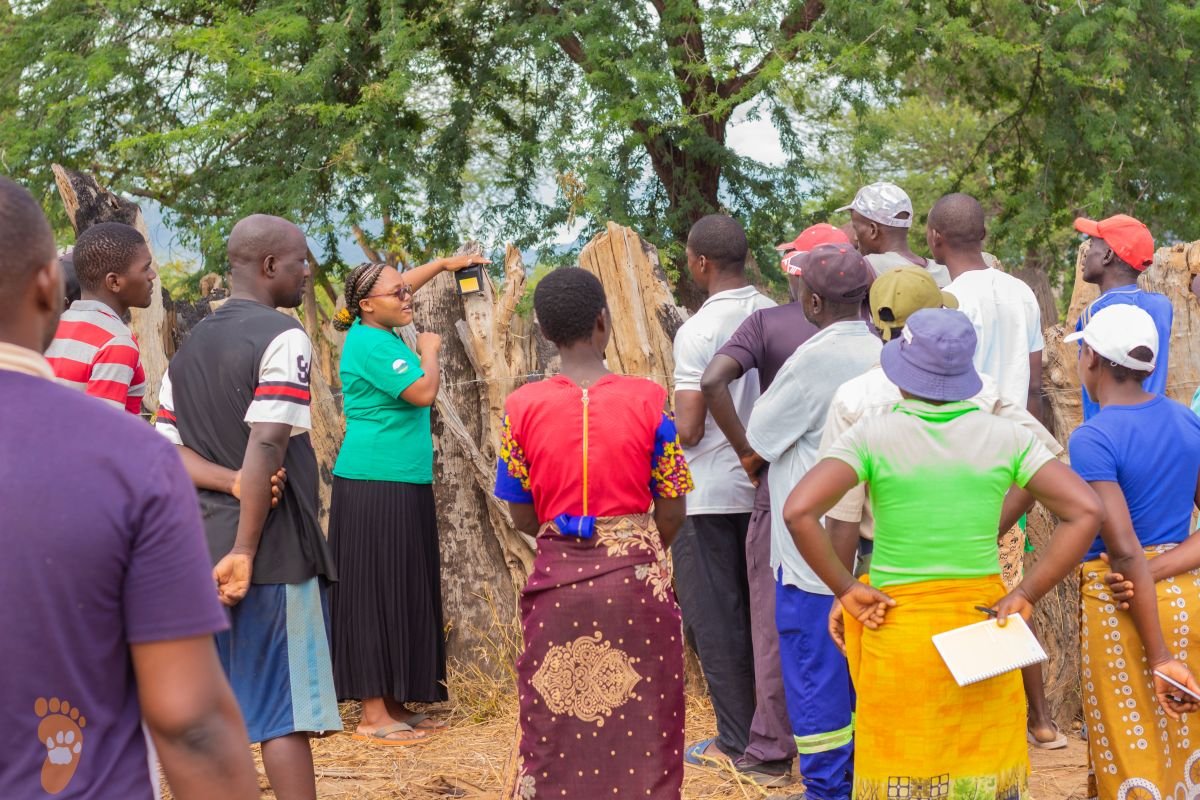
WCA’s work to reduce lion attacks includes the installation of solar-powered flashing lights, four per kraal, to frighten off the predators. It also distributes mobile cattle enclosures, or bomas, to farmers who might not have secure animal pens. One innovation, inspired by the traditional Tonga practice of building houses on stilts to keep them cool, is the construction of raised kraals for small livestock like goats and sheep.
The raised pens, which are thatched and encircled by wire, sit around 1.5 meters (5 feet) off the ground, with a movable ramp to allow the animals in and out. WCA provides the expertise and materials to build these kraals, though other farmers who’ve witnessed how effective they are at deterring predator attacks have improvised versions on their own.
It’s a good sign, Mbizah says. “When they see that it’s working for somebody else who has benefited, they now start to use their own money to buy those things — so, it’s what we want to see in terms of sustainability [of the project] in the long term.”
The various interventions have, over the past five years, halved incidents of human-carnivore conflict across three districts where WCA works, Mbizah says. In at least two wards, conflict has been eradicated almost entirely. This year, her organization started working in a fourth conflict-prone district, Hurungwe, whose northern end juts into the Zambezi Valley.
Mbizah says that women are proving themselves especially effective as community guardians.
“You have to be that kind of person who really cares about people, who really cares about the communities, and you are constantly interacting with people,” she says. “Even when they give the advice to the farmers, [women] give it in a way that the farmers would understand.”
As the demand for land to grow crops and provide grazing for livestock grows throughout Zimbabwe’s side of the mid-Zambezi Valley, people have encroached on the edges of protected areas and settled in wildlife corridors.
This increases interactions with wildlife. The farmers and herders in these areas had little in the way of external support, and so Mbizah, a zoologist by training, acted to change this.
There are currently no reliable figures for this region’s lion population, though it’s thought to be well below what it should be. Over the next few years, Mbizah and her team are hoping their work will boost lion numbers to more than 600 individuals.
It will be a delicate balancing act, requiring a lot of work both inside protected areas and outside, in the farming lands.
“As long as lions can find weaker and easy-to-kill prey outside of the protected areas, even if there’s enough [wild prey] inside [the protected areas], they must still go out and hunt within the communities because they don’t have to use much energy to hunt the livestock,” she says.
One of the four districts where WCA works to ease this conflict is Mbire, which lies within the planned ZIMOZA Transfrontier Conservation Area (TFCA) that will encompass nearly 40,000 square kilometers (15,400 square miles) of farms, safari areas and national parks in Zimbabwe, Mozambique and Zambia.
The Whitley Award will allow WCA to expand its work into eight wards in Mbire, from five currently. The district is tucked into a corner of northern Zimbabwe, and its woodlands and forests are being rapidly converted to farmland.
Frédéric Baudron, an agronomist who has conducted research in Mbire for more than two decades, says WCA’s work to reduce human-wildlife conflict there is crucial, given the heavy toll it has on people, their crops and their livestock each year. But he warns that current livestock production systems in Mbire are unsustainable.
Baudron’s research found that between 2007 and 2020, a shift from cotton farming to livestock rearing changed residents’ impact on the landscape. Farmers increasingly cut down dominant trees like mupumbu (Faidherbia albida) and mubvee (Kigelia africana) to provide livestock with leaf forage when grazing was scarce, and cleared the land to create grassy fallows.
“Protecting livestock from predation is key for people and large carnivores to coexist,” Baudron says, “but it may also stimulate livestock production and habitat conversion further if not accompanied by measures that reduce the demand for land.”
Throughout the mid-Zambezi Valley, reframing perspectives on wildlife and conservation may help to shift communities toward a more ecologically sustainable future, and it starts with the youngest generation, Mbizah says.
While her first experience with wildlife was relatively late, at the age of 25 while carrying out her master’s degree research on African wild dogs (Lycaon pictus) in the southeast of the country, that positive experience shaped her purpose and passion as a conservationist. In the places where WCA works, however, children encounter wild animals from a much younger age — and those experiences are often negative.
An integral part of WCA’s work now is to promote environmental education through conservation clubs at schools, Mbizah says.
“For some schools we have also been able to take them into the protected area [closest to their district], so that they can see wildlife in a different way, in a positive way, where there is no conflict happening,” she says. “There is hope for those kids, and even hope that many of them will end up contributing to the protection of their natural resources.”
Banner image: A young lion at rest. Image courtesy of the Whitley Foundation.
Local communities are conservation’s most undervalued asset (commentary)
Silvery lining for Java’s endangered gibbon as Rahayu Oktaviani wins Whitley prize
Citation:
Baudron, F., Guerrini, L., Chimimba, E., Chimusimbe, E., & Giller, K. E. (2022). Commodity crops in biodiversity-rich production landscapes: Friends or foes? The example of cotton in the Mid Zambezi Valley, Zimbabwe. Biological Conservation, 267, 109496. doi:10.1016/j.biocon.2022.109496
Feedback: Use this form to send a message to the author of this post. If you want to post a public comment, you can do that at the bottom of the page.

Source:
news.mongabay.com