




Forester and scientist Suzanne Simard is well known for her landmark 1997 paper, which demonstrated that two distinct species of trees could share resources. At the time, it turned traditional Western forestry thinking on its head. Instead of the Darwinian view of trees as being in competition with each other, it introduced the idea that these trees may actually help each other, and that industrial logging practices may be missing the forest for the trees.
In recent years, Simard has been advocating for Indigenous knowledge as the only way to save the Earth and its forests. Environmental reporter Erica Gies spent some time in the field with Simard and her colleagues, looking into her latest project, The Mother Tree Project, which seeks to find the most sustainable form of forestry for both people and ecosystems.
Gies joins the Mongabay Newscast to explain what she learned from Simard and why she advocates Indigenous knowledge and systems, which are governed by rules of reciprocity. A shift in her thinking occurred when she read the dissertation of fisheries ecologist Teresa Sm’hayetsk Ryan, who now works with Simard.
“She realized that, you know, the people were also a very important part of the complex forest relationships,” Gies says. “Which is much more of a reciprocity kind of mentality. If you take, you also give back. There is a responsibility to care for the system. Because if you don’t, and if you overexploit it, it would be really easy to starve, right?”
Simard has the permission and participation of Indigenous nations across nine sites in the Canadian province of British Columbia to carry out this project, which is intended to last at least 100 years, or ideally 500 (the lifespan of many trees in this region). Gies says the initial findings suggest leaving the majority of forest cover intact is the sweet spot for sustainability.
“So far, the results show that 60% coverage really does maintain a lot of the complexity of the forest and those forest relationships and a healthy hydrology, keeping the land from drying … in some ecosystems it seems like 30% might be enough, but definitely clear-cutting seems to not be sustainable.”
Mike DiGirolamo is the host & producer for the Mongabay Newscast based in Sydney. Find him on LinkedIn and Bluesky.
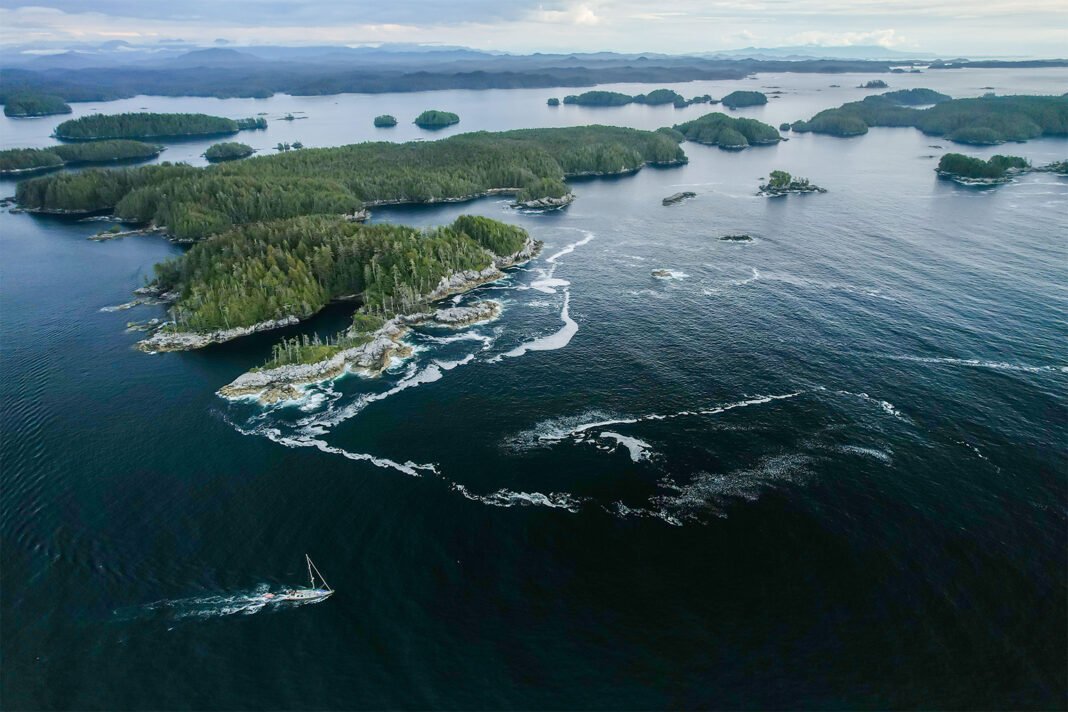
Banner image: Goose Island Archipelago is a cluster of tree-covered islands with wild, rocky beaches located off the central coast of British Columbia. Image courtesy of Alex Harris.
Simard, S. W., Perry, D. A., Jones, M. D., Myrold, D. D., Durall, D. M., & Molina, R. (1997). Net transfer of carbon between ectomycorrhizal tree species in the field. Nature, 388(6642), 579-582. doi:10.1038/41557
Notice: Transcripts are machine and human generated and lightly edited for accuracy. They may contain errors.
Erica Gies: If you take, you also give back. There is a responsibility to care for the system, because if you don’t, and if you overexploit it, it would be really easy to starve, right? And so these rules regulating how they manage the trees, the salmon, et cetera, become a fundamental part of practice and culture. The goal is to maintain the system, whereas the goal of the logging industry is to make as much money right now as possible, and maybe some money in the future. And so Simard realized that her goals in that are wrong.
Mike DiGirolamo: Welcome to the Mongabay Newscast. I’m your host, Mike DiGirolamo, bringing you weekly conversations with experts, authors, scientists, and activists working on the front lines of conservation, shining a light on some of the most pressing issues facing our planet, and holding people in power to account. This podcast is edited on Gadigal Land today. On the newscast, we speak with Erica Gies, author and environmental reporter. Gies recently published a piece in the online magazine Psyche regarding the work of forestry scientist Suzanne Simard. Her work rose to prominence in 1997 when she published research in the journal Nature, showing that trees can share resources with each other, specifically between birch trees and Douglas fir. Gies spent some time with Simard and her colleagues in the field, interviewing them and digging into her latest work, the Mother Tree Project. Gies explains how and why Simard now argues that Indigenous knowledge is the primary means of saving the Earth and its forests. She explains how the Mother Tree Project, with the support of Indigenous nations and communities, tests different logging methods to find a forestry approach that works with the complexity of human relationships with the Earth and the trees. Initial findings indicate that retaining around 60% of the largest trees protects the forests. But perhaps the biggest takeaway from this conversation is that Gies emphasizes Simard’s shift in seeing forests differently. Rather than seeing trees as resource units to exploit, she advocates viewing them as complex living systems with which humans are in relationship, and that this may be the only way to save them. Hi Erica, thanks for joining us. It’s great to have you back on the show.
Erica: Yeah, I’m so glad to be here. Thanks for inviting me.
Mike: So I’m really excited to talk about this profile that you did on Suzanne Simard. But can you explain what drew you to this story and why you decided to dig into this?
Erica: Yeah. I think I had interviewed Suzanne for an earlier story that I actually wrote for Mongabay about an Indigenous group in central BC called Wetʼsuwetʼen, and they were trying to conserve an old-growth watershed. And that story was focused on the links between industrial logging and increased fire, increased forest fire. And that’s not the main thrust of Simard’s work, but a lot of it does deal with complex forest systems and how they function. And my background is focused on hydrology and water from my reporting for my book Water Always Wins and other stories I’ve done surrounding that. So I was asking her questions that were related to how clear-cut logging, which is common in British Columbia, where I live part-time, has altered the hydrology and amped up forest fires. Because of that connection, I was connected with an Indigenous group that she is a co-founder of called the Awi’nakola Project. And it is a partnership of Indigenous knowledge keepers, Western scientists, and artists. And it’s specifically focused on sharing knowledge about how nature and land work, and also helping Indigenous people, particularly the Ma’amtagila Nation, reconnect with their land.
Mike: So let’s go ahead and start then with the thrust of her work. What is the central principle behind her research and her work?
Erica: Sure. Yeah. So she became well known in scientific circles in the late nineties when part of her PhD landed her a cover on Nature magazine, which is a prestigious scientific journal, and it was titled “The Wood Wide Web,” which is perhaps a misnomer. But basically, scientists have known for a long time that plants partner with fungi underground and that fungi help plants to live by supplying them with water and nitrogen and phosphorus. And there’s a pretty well accepted theory that we would not have plants on land if fungi hadn’t helped them colonize the land. But people didn’t really know that plants might send resources to each other via these fungal networks. There was one study out of the UK by a scientist named David Read, and he had studied in a laboratory that pine seedlings sent resources to another pine. But before Simard did the study, nobody had studied it out in the forest, and nobody had studied it between species. And so her kind of landmark paper showed that indeed Douglas fir and paper birch trees were sending each other resources.
Mike: And can you explain to our audience how Simard was able to determine that?
Erica: You can imagine that these types of studies are really difficult, because you’re trying to track something that happens underground where you can’t really see it. But what she did was she planted seeds of birch and fir and also cedar. And the cedar was a control. And the reason for that is there are a few different kinds of fungi that partner with plants, but the two in question here are called ectomycorrhizal and arbuscular mycorrhizal. And the cedar is with the arbuscular, and the other two are with the ectomycorrhizal. And so the cedar was the control because it shouldn’t be tapping into the same network. So she shaded the fir trees because, in the actual forest, the birch grow really fast and shade out the fir seedlings. And then maybe they’re struggling during that time. And she also enclosed each seedling in a plastic bag. And the reason for that was so that she could control the air that it breathes, basically the type of carbon that it was taking in. And then she administered carbon to the different seedlings. And there are different tracers that you can use for carbon, and one of them has radioactivity to it, and so that one is easy to see. And that’s how then she was able to see. So she gave that one to the birch, and then later she was able to see that it was in fact present in the fir. And then later she dug up the seedlings and the mycorrhizae and ground them up and tested them to verify that the transfer had happened. In subsequent work, she found that when the birch drop their leaves and are less able to get their own resources through photosynthesis, the fir support them in turn.
Mike: And so why is this such a big deal? Why was this such a kind of a striking study?
Erica: Yeah. In the mainstream culture, where we tend to see landscapes as resources and we want to extract as much as possible to make as much money as possible, people had viewed the trees as resource units and also had this Darwinian view that competition was the main thing driving tree growth. And so with that in mind, the trees they were most interested in were conifers, the money trees like the Douglas fir, and trees like birch and other understory native plants were viewed as competing with these trees for resources. And so the result of that was a practice where they would try to remove these other plants either by cutting them or by poisoning them with herbicides. And so the idea that plants might instead be cooperating and sharing resources with each other is very much at odds with this view. And in fact, there were some root diseases that people were seeing in these replanted plantations of one or two commercial species. In other cases, they just weren’t thriving and they weren’t growing very well. And so it did seem to Simard that there was a problem with business as usual, that it wasn’t working out the way that they thought it would from eliminating the competition. And so that observation is what prompted her to go searching for another way of understanding the forest that might explain why removing the birches actually led the firs to suffer.
Mike: This is the really interesting part that drew me to this piece that she wrote, because I think we should spend some time discussing Simard’s background. She is a forester, and so from that viewpoint it seems like the incentive there would be for that extractive model, but she was actually finding confirmation of the opposite.
Erica: Yeah. So interestingly, Simard’s family came to Western Canada from eastern Canada about a hundred years ago, and they were what she calls horse loggers. That means they would take one tree over several days and sell the wood to support the family. And before coming to Canada, her family was from France, and she actually said that they had been foresters for a hundred generations. I don’t know if that’s hyperbole, but a long time. So it was like the culture of her family. But when she was growing up in rural interior BC, it was still this very kind of human-scale logging where they would just take one tree at a time. And her grandfather taught her, “When you leave the forest, there’s still a forest.” And there was this idea that the forest would naturally regenerate at this level of extraction, and in fact it seemed to be doing so. But over the course of the 20th century, I think around the world, but definitely in British Columbia, the forestry industry moved to really large-scale machines that would clear-cut many acres in a single day and just remove absolutely everything. And so this is a very different way of interacting with the forest. And anyway, she and I talked about it in some depth, and she does think that her childhood experiences with her grandfather and her uncles and just being on the land in the forest and observing mycelium when she would dig in the dirt, and really just loving the land, helped her to not just accept what she was being taught and to question and to explore what else might be going on. And also to have a visceral reaction to these clear cuts, which, if you see them, they’re really extreme and they’re pretty horrible. You’ll see an entire landscape just gone, and then there’s a line of trees where they haven’t cut yet, and big piles of slash, which is just little pieces of wood and stuff that weren’t marketable. I’ve seen bears who are wandering around looking lost, like, what happened here? And then, as you travel around BC, there’s only like 3% of old forests left. And so you see these clear cuts absolutely everywhere, even up really steep mountains. And where they’ve replanted, it’s uneven haircuts of different heights. And so anyway, I think she had a very human reaction to seeing this really dramatic modification of the landscape, and that pushed her to ask questions.
Mike: And so then maybe we’re stating the obvious here, but what is she instead advocating for, instead of this clear cutting or getting rid of the birch trees, so to speak?
Erica: So she, about 10 years ago, founded something called the Mother Tree Project, and it’s basically a massive scientific experiment. They have done some work in nine sites across the province, and for each site, different ecosystems, different climate, different Indigenous group whose land it is, they have done five different applications. And her goal is to try to understand, like, okay, we need wood. Is there a way that we can still harvest wood while maintaining the health of a forest, while maintaining its ability to hold water and not burn and not cause landslides, and maintaining Indigenous people’s connection with the land, and storing carbon in the trees and in the soil? So the five models are clear-cut, retaining 10%—that’s a seed tree model—retaining 30% in clumps, and then retaining 60%, which leaves the canopy intact and harvests from within that, and then a control where nothing is done to the land. And so she has invited scientists, with the permission of the First Nations whose land it is, to do various experiments. And in partnering with the First Nations, she’s also hoping that will create a good bit of longevity. She wants this project to be at least 100 years, if not 500 years, which is the lifespan of some of the trees and some of the ecosystems. And the goal is to understand, is there a better way than clear cutting? Is there a way we can get wood without doing such devastation? So far, the results show that 60% coverage really does maintain a lot of the complexity of the forest and those forest relationships, and a healthy hydrology, keeping the land from drying. And then in some ecosystems it seems like 30% might be enough, but definitely clear cutting seems to not be sustainable in all these various ways.
Mike: Hello listeners, and thank you for tuning in. As I always like to mention, Mongabay is a nonprofit news organization. If you want to support us, head to patreon.com/mongabay to become a monthly sponsor of this show, or you can go to mongabay.com and donate directly to the organization. There you can find a link in the show notes to my previous conversation with Erica Gies about her book Water Always Wins, as well as her reporting for Psyche on Suzanne Simard. That’s all for now. Back to the conversation with Erica Gies.
You wrote that somewhere, I think about roughly 12 years ago, she started working with a scientist named Theresa Ryan, and this really impacted her. Can you talk about the working relationship between the two?
Erica: Sure. Yeah. Theresa Ryan is a fisheries scientist and also a member of the Stz’uminus Nation, which is from further north in British Columbia. And her—yeah, Simard read her dissertation, which was about her own nation and several others and their relationship with fish and forests. And for people who aren’t familiar with the Pacific Northwest forest, salmon actually fertilize the trees and help the trees become so giant, and that happens in a variety of ways. The salmon come back upstream to spawn, and then they die. And as they’re dying, bears, especially grizzly bears, come and feast on them to fatten up for winter, and wolves do in some places as well. And then they often will carry them a little ways away from the river, and so then when the fish break down, they’re fertilizing trees within a wider area. And so there have been really interesting studies that show that ocean-based nitrogen is fertilizing these trees. And then the Indigenous peoples of the Pacific Northwest, many of them are salmon people. Salmon is a very important part of their diet and their culture, and they had a practice of harvesting under certain restrictions that allowed the strongest, healthiest fish to procreate and keep the populations large. They returned fish bones to the stream to help the water and the soil in the stream have the right calcium that would help future fish be strong. And so for Ryan, the trees are intimately tied in with salmon and with the First Nations people. And so Simard, when she read this, was just really blown away because she had been focused on the plants and the soil organisms and the fungi and how they were in relationship, but she realized that the people were also a very important part of the complex forest relationships. And also she was very struck by the worldview of Ryan and her people, which is much more of a reciprocity kind of mentality. If you take, you also give back. There is a responsibility to care for the system, because if you don’t, and if you overexploit it, it would be really easy to starve, right? And so these rules regulating how they manage the trees, the salmon, et cetera, become a fundamental part of practice and culture. And anyway, the goal is to maintain the system, whereas the goal of the logging industry is to make as much money right now as possible, and maybe some money in the future. And so Simard realized that her goals in that are wrong. She had been trying to convince them to leave some biodiversity, to not take all the trees, as sort of stopgap measures, but they were still focused on extraction. In fact, there was something called—basically they had a law up until just a couple of years ago that said you can’t protect nature if it will unduly harm the timber harvest, if it will unduly restrict how many logs we can take.
Mike: This is called the Forest and Range Practices Act, FRPA. In 2024, a part of the provision was amended to remove the following statement: “without unduly reducing the supply of timber from British Columbia’s forests.”
Erica: And so she said in reading Ryan’s dissertation, she just realized our goals are wrong, and we need to move more toward this reciprocity and care kind of value. And so she now works with Ryan in all of her projects, and Ryan is the Indigenous liaison for all of these Mother Tree research sites, where they go in and they follow protocol with the nations of the area, which means asking for their permission, asking how their knowledge might be used.
Mike: This is—yeah—and I ask about this because this is a theme that keeps coming up on this podcast. You are certainly not the first person to echo these sentiments and also talk about the evidence that shows their efficacy. I’ve had on Keli Yon, I’ve had on Tyson Yunkaporta, and I’ve had people from all over the world discuss how the idea of reciprocity isn’t just like a thing that’s nice to have, but essential for survival. And it’s really quite striking to see a scientist, a forester no less, publish research that shows that to be the case. What has struck you the most about this story and in your work as an environmental journalist? Where else do you see this principle coming up?
Erica: Everywhere. And maybe, like you, I tend to seek out those stories. But one that really grabbed me was—there’s a physical scientist in Arizona named Laura Norman. She works for the USGS, and she spent a lot of time studying another Indigenous technique, which is to slow water in drylands. She calls it natural infrastructure in dryland streams. But what she has been able to measure is that, in the mainstream culture, we tend to have a real scarcity mindset. We’ve got to take all the resources for ourselves, and we can’t leave any for whoever else or for nature, because that’s money left on the table. And so similarly with water in the Southwest—we’re seeing this now at the Colorado River, right? Oh, there’s not enough, and who’s going to have to cut? Somebody has to suffer so other people continue to get what they want. And so in Arizona, when somebody blocks a stream, there’s a very knee-jerk response of, they’re taking our water from people downstream. But what Laura Norman was able to show was that these interventions actually created 28% more water in the stream that she studied. And it’s because when you’re slowing the water, you’re giving it time to seep underground, and when it’s underground, it’s not evaporating, and then it flows up again into the stream over a longer period of time. And so there’s this—it’s a—I love that example because it shows that when you give back, when you care for the stream system, when you care for the forest, oftentimes we actually get more. And it’s not just that we get more in the future—in a lot of cases we get more in the near term, because a system that is healthy and is working in synchronicity, it has backup. Like when it suffers a stress, there are other ways for it to adjust and to get what it needs and to adapt. But when we push these systems to the breaking point, then they do break, and then oftentimes they’re destroyed. And I think in the story I go into sort of the difference between Western science and Indigenous science or Indigenous knowledge. And Western science has been formulated to be reductionist, right? You want to eliminate all the variables so you can prove that one thing, or you can measure that one thing. But it’s really hard to understand complex systems of interlocking biodiversity and hydrology and climate when you’re breaking everything down. The sum is greater than the sum of its parts, right? Even when you’re putting them back together, you’re still not seeing the big picture. Whereas Indigenous knowledge is intimate knowledge of the many beings who they share the land with and how they work together, and it is targeted toward having enough now and later. And it’s just a fundamentally different worldview and science as well. And so Western science has often been used in support of extractive industry. And so I think Simard has come around to a true cultural shift within herself, and therefore she’s become an advocate for that to the wider world, and I think sees herself as maybe a waypoint between these two worlds.
Mike: So there have been some critiques of her, specifically her paper that was in Nature. What can you tell us about those critiques?
Erica: Yeah, the critiques actually began in 2021 after the publication of her memoir, which is called Finding the Mother Tree. Her original paper was published in 1997. For a long time it stood, and other scientists did related work and also showed different aspects of this system. But yeah, there was an opinion piece published in Nature Ecology and Evolution, and it alleged a few things, not just in Simard’s work but in other scientists who were looking at how trees may share resources through mycorrhizal networks, mushroom networks. And basically one of the allegations was positive bias—that’s a tendency to notice, highlight, or publish supportive results while downplaying conflicting findings. They alleged that the findings were overstated. So for example, there’s this idea that all around the world plants are sharing resources through mycorrhizal networks, and so what these critics are saying is we don’t actually know that. There have only been studies in a handful of ecosystems, including this one that I wrote about in British Columbia. We can’t make those overgeneralizations. And I did a pretty deep dive into this critique and also the science of Simard’s work and others, and I think a lot of the criticism comes down to the limits of what’s been measured. The type of study that Simard did is really difficult and expensive and hard to do in real forests, so as a result some has been done in labs. You can imagine if you’re trying to measure something underground, it’s difficult. And so I think too some of Simard’s students have gone on to study things like big trees supporting younger trees, and there have been a lot of studies about plants warning each other through chemical signaling, like if they’re getting attacked by insects. But I believe one of Simard’s students looked at whether mature trees could warn their offspring via these networks, so that was something else that the critics took issue with. I think in talking with Simard about this, I think she feels like they have not disproven her peer-reviewed research. I think she feels like they’re coming after her more for the way in which she tries to communicate science to the general public, using words like “mother tree,” which a lot of scientists are uncomfortable with because they feel like that’s anthropomorphizing. And I don’t know—it is—there are interesting questions that remain. Like one question is: are the trees directing this? Do they have agency? Does the fir say, “Oh hey, I notice that the birch needs something, I’m going to send something to the birch”? Or are the fungi the ones who are orchestrating this? They rely on the plants for carbon—that’s why they partner with plant roots—so they have an interest in making sure their plant partners remain healthy, and so maybe they’re guiding things to the plants. And I think Simard is open to that argument. I think she’s come to the conclusion that organisms can have selfish reasons for sharing. It’s a little bit of a hybrid of that competition versus cooperation argument, and fungi may have a selfish motivation for keeping their trees healthy. Trees may have a selfish reason for keeping others in the forest healthy through other partnerships too, like there are bacteria that protect against root fungi that might be fostered by one tree species but end up helping another. They’re very complex systems.
Mike: Is there anything else about this story that really struck you that you want listeners to know or think about?
Erica: Yeah. I guess another thing that really attracted me to this story, going back to one of your earlier questions, was the Indigenous group, the Ma’amtagila Nation, that hosted us on their traditional territory for the week that I was reporting on this. They have an initiative that’s called the Fungal Relations Campaign, and basically they are acknowledging that the forests that we know and love rely on the fungi as important partners. But fungi typically haven’t been protected by governments. We have endangered species protections in some places for plants or animals, but fungi are really overlooked, because they’re out of sight, out of mind. And so the Fungal Relations Campaign was geared toward getting the provincial government, the national government of Canada, to protect fungi on par with plants and animals. And the idea is that it would be an Indigenous-led initiative that would, by necessity—if you want to keep all of these diverse species of fungi happy—you have to keep their diverse species of plants happy as well. And anyway, it was just a different way of thinking about conservation that intrigued me. And Rande Cook, who is a chief of the Ma’amtagila and partnered with Simard with the Awi’nakola Project and spearheaded this Tree of Life celebration that happens every year on their land, he actually created a dance of the Fungi Kingdom, which is—their dances are a form of governance when they do them on their land, and they’re also a form of conveying their knowledge to people today and down through the generations. So he’s hoping that this dance will continue to be danced to let generations to come understand the importance of fungi in the forest relationship and to prioritize making sure that we also devote our reciprocity to maintaining their populations.
Mike: Erica, some of our audience may know you from your book Water Always Wins. Is there anything else you’re working on that you want to give people a preview for or to keep an eye out for?
Erica: Yeah, I’ve just gotten a book deal for my next book, which is called Roots to Sky: How Life and Water Can Help Cool the Climate, and it’s going to be a journey underground up through the surface and into the sky. And we’re going to follow the water cycle, and in each phase, water is partnering with life, and so it really shows how biodiversity, water accessibility, and climate are all intrinsically linked. And the good news is that it presents us with another climate solution, which is restoring ecosystems and caring for landscapes. If we make space for biodiversity, we heal the water cycle, which in turn helps to stabilize the climate. And that’s something that has been overlooked in the wider climate conversation. It’s really been oversimplified to, it’s all about carbon dioxide and we need to get off fossil fuels, which we absolutely do, but we also need to protect ecosystems and balance the water cycle.
Mike: Erica Gies, thank you so much for joining me today. It’s always a pleasure speaking with you.
Erica: Thanks so much for having me.
Mike: If you want to read Erica Gies’s reporting on Suzanne Simard’s work on forestry, you can find the links in the show notes at the end of this episode. If you’re enjoying the Mongabay Newscast or our podcasts, please spread the word by telling a friend and leaving a review. Word of mouth helps us grow, and you can also support us by becoming a monthly sponsor via our Patreon page at patreon.com/mongabay. Even pledging a dollar per month makes a big difference, so visit patreon.com/mongabay to learn more and support the Mongabay Newscast. Stay informed and inspired. Visit mongabay.com for news from nature’s frontline. Connect with us on LinkedIn at Mongabay News and on Instagram, Threads, Bluesky, Mastodon, Facebook, and TikTok, where our handle is @mongabay, or on YouTube at Mongabay TV. Thank you, as always, for listening.
Source:
news.mongabay.com