



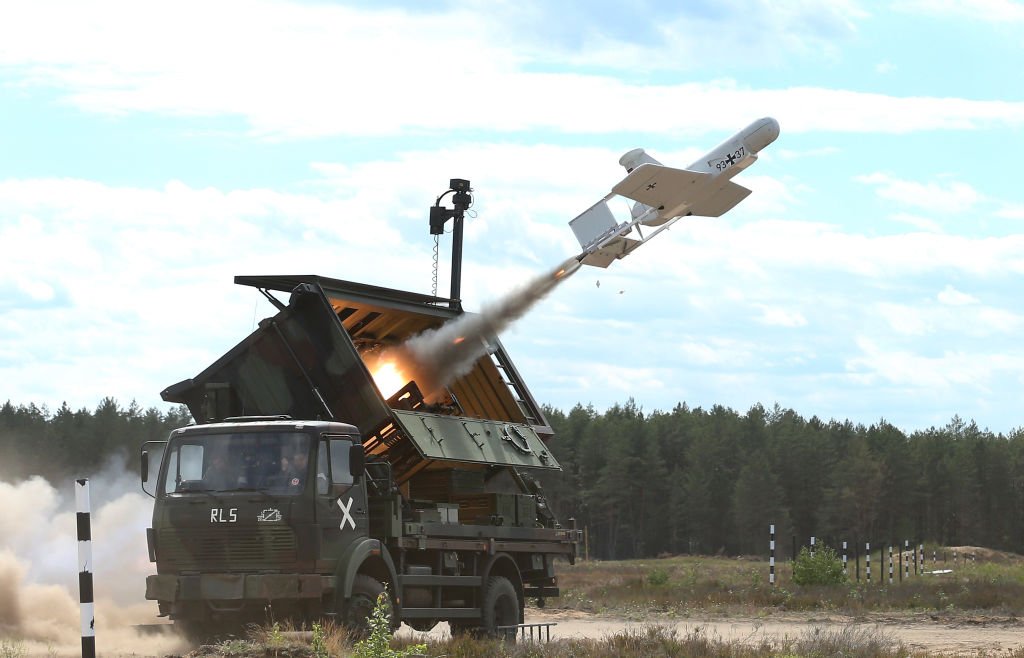
The wars in Ukraine and the Persian Gulf have shown that long-range strikes do not deliver a decisive blow but work best when applied continuously against an adversary’s critical logistics, communications, and infrastructure. Europe collectively lacks the capacity to sustain deep strikes of this kind, and that gap is now a strategic liability.
Europe’s response, embodied in the European Long-range Strike Approach (ELSA), reflects a recognition that this dimension of defence can no longer be outsourced. Yet ELSA remains platform-centric, risking a focus on acquisition without the system-level integration required to build a credible deterrent.
Europe’s vulnerabilities are rooted in post-Cold War choices. NATO developed deep strike concepts during the Cold War, but the operational burden shifted to the United States. European allies came to rely on American intelligence, surveillance, and reconnaissance (ISR), strike assets, and stockpiles.
Russia’s invasion of Ukraine has forced a reassessment. NATO has identified deep precision strike as a priority, recognising that defence alone cannot neutralise sustained strike campaigns. Europe must also contend with uncertainty about US enablers, meaning that its deep strike capability must function even when American support is delayed, partial, or absent.
A missile is only as effective as the system behind it. A functioning deep strike chain requires sensors, intelligence fusion, decision-making, and delivery mechanisms working together. Europe’s primary weakness is not only the absence of individual capabilities but the lack of a coherent system connecting them. Effectiveness in modern warfare derives not from the sophistication of any single munition, but from the coherence of the chain connecting sensor to target, and factories to the front.
To put adversary command nodes, logistics, and force concentrations at risk, European deep strike must extend beyond its current 500-kilometre range to at least 2,000 kilometres. A disciplined approach begins with high-value fixed targets such as command nodes, logistics hubs, and critical enablers before expanding toward broader preplanned targeting and, ultimately, dynamic targeting at scale.
A sharp sword but a shaky hand: Europe’s struggle to match capability and will
The EU’s recent hesitation over a reparations-backed loan for Ukraine reveals something deeper and more…
4 minutes
Ukraine’s use of the Flamingo cruise missile, with ranges exceeding 1,400 kilometres, illustrates this dynamic. Their strikes on Russia’s Baltic export in Ust-Luga and Primorsk have crippled the core of Moscow’s oil export system.
ISR also remains a central challenge. Europe possesses significant space-based imaging and radar capabilities, but their constraints are mostly institutional. ISR at scale requires shared standards, rapid data fusion, and intelligence that flows among allies without delay. In other words, Europe can see the battlefield but struggles to act on what it sees at the speed of relevance.
Industrial depth is the other half of the equation. The conflicts in Ukraine and Iran have shown that modern conflict consumes munitions at rates far exceeding peacetime expectations. A European deep strike capability without robust supply chains – including critical inputs such as tungsten – will only sustain a short-lived surge. Industrial strategy must therefore be a core component with predictable demand signals, coordinated procurement, and supply chain resilience.
ELSA is a beginning, not a destination. It provides a joint development framework and signals political intent but lacks a clear operational design. It does not define how Europe will integrate ISR, targeting, and strike delivery into a coherent system. Building beyond ELSA means linking it to NATO’s Defence Planning Process, connecting it to EU industrial instruments, and integrating it with European ISR efforts.
The UK-Germany deep precision strike programme is a step toward the necessary range requirement, but it remains disconnected from any broader European strike system. Without that integration, bilateral initiatives risk reinforcing fragmentation. European deep strike is perhaps best conceived as a coalition-of-the-willing capability, inclusive of the UK and Norway, available to NATO but under European control.
Deep strike is not only a technical challenge but political one. It raises questions of escalation and control that only political leaders can resolve, and it does not exist in isolation from nuclear deterrence. France’s nuclear deterrent carries a European dimension, and as conventional deep strike matures Europe will face harder questions about how the two relate. A European deep strike strategy must therefore be accompanied by a clear narrative that emphasises defence, deterrence, and integration.
ELSA has generated momentum, but the path forward demands a shift in perspective. Deep strike must be understood as a system connecting missiles, ISR, decision-making, and industrial capacity, governed by structures that enable Europe-wide integration.
The alternative is a familiar one. Europe acquires platforms and announces capabilities yet remains dependent on external enablers. In that scenario, deterrence becomes conditional and strategic autonomy remains an aspiration. Europe can either build the means to act on its own decisions or accept that in a crisis, those decisions may not be its own.
Europe was raised in a hothouse. Now comes the cold
For most of its life, the European Union grew in unusually benign conditions. Security was…
4 minutes

Source:
www.euractiv.com

