


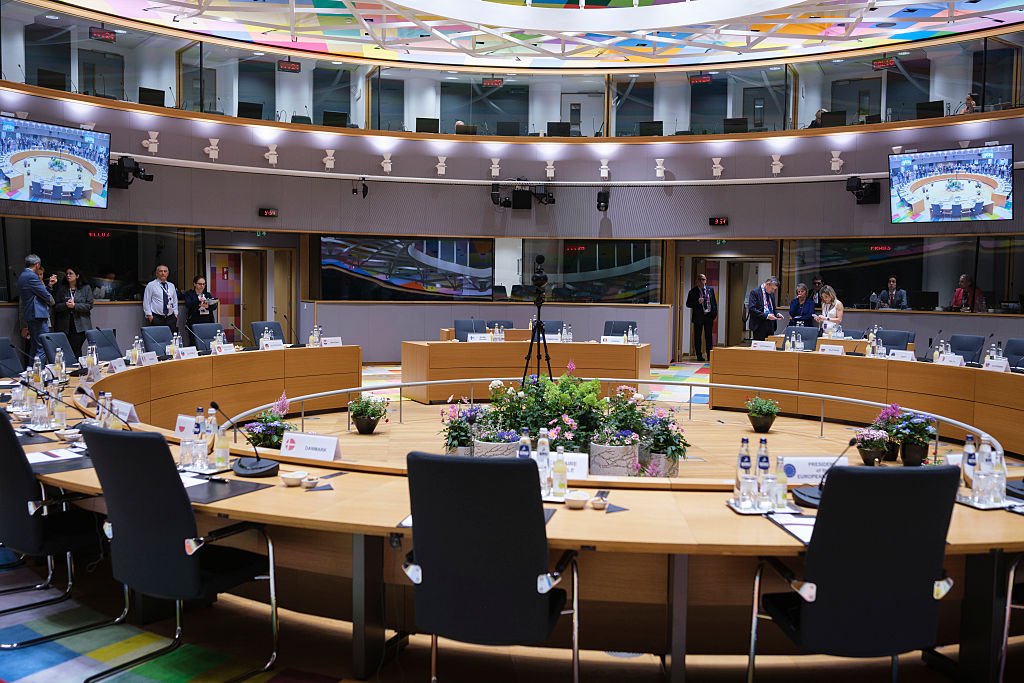

Leaders of Britain, France, Italy and Poland will be hosted by Friedrich Merz in Berlin on Wednesday in what will serve as a trial run for the best format to represent Europe – rather than the EU.
The so-called E5 summit is regarded as a critical moment ahead of a NATO summit with Donald Trump in Turkey next month and amid expectations that, according to diplomats and officials, Ukraine ceasefire talks with Russia could begin within weeks.
The group of European allies will also announce steps to strengthen Ukraine’s air defences, including Patriot PAC-2 interceptors and efforts to paper over cracks between Warsaw and Kyiv.
Good news came from Emmanuel Macron, the French president, at a summit in Brussels last week, as he told EU leaders there is new momentum for Ukraine peace talks and that Europe will be at the table.
His optimism quickly gave way to bickering. After intense talks chaired by Macron with Donald Trump at a G7 summit in France there were reports that António Costa, the European Council president, had opened a communications back channel with the Kremlin, generating criticism from some of his fellow EU leaders.
Despite there not yet being a negotiating table – as Russia remains adamant about continuing its war of aggression against Ukraine – European heads of state and government were only interested in one question: would the seat be taken by the E3, E5 or the EU?
According to the accounts of diplomats and officials, Macron stressed that first in the queue were those countries involved in providing future security guarantees, including military commitments for Ukraine, notably through the “Coalition of the Willing”, which France leads alongside Britain.
The British, he noted drily, are not members of the EU but would have a seat at the table as talks in London chaired by British Prime Minister Keir Starmer earlier this month had already demonstrated.
Merz chipped in to note that the “E3” format – Britain, France and Germany – was Ukraine’s favoured grouping and would naturally play a leading role as the basis of a ceasefire and settlement are negotiated.
Sensitive to history, both recent and wartime, Merz stressed that he would keep eastern European countries – particularly Poland and the Baltic states – informed.
Donald Tusk, Poland’s combative leader, appeared unimpressed with the “rather lengthy discussion” at the summit. Poland has bitter memories of the Normandy Format, under which France, Germany, Russia and Ukraine signed the Minsk agreements, which failed to prevent Russia’s full-scale invasion in 2022.
“There is the E3, and soon there will be an E5 with Poland and Italy joining France, Germany, and the United Kingdom. Fine – we will meet and discuss what we can do together,” Tusk said. “Poland will not respect – let me repeat this – any arrangements made without its participation.”
He added: “From the expressions and reactions of my colleagues, I could see that some were perhaps not entirely pleased, but everyone understood what I meant, and I do not expect any unpleasant surprises.”
Tusk’s comments, backed “unequivocally” by Italy’s Giorgia Meloni, have pushed for the E5 format to represent the European position in any future talks.
Not to be left out, Costa and European Commission President Ursula von der Leyen also pressed for EU involvement, illustrating the bureaucratic turf wars that are never far from the surface in Brussels.
At some point the EU will have to be represented, Macron acknowledged, with Costa perhaps tasked with issues such as sanctions on Russia or decisions concerning frozen Russian assets.
Complicating matters are Tusk’s relations with Volodymyr Zelenskyy, Ukraine’s president, which have hit a low in an ugly dispute over wartime atrocities carried out by Ukrainian nationalists. Zelenskyy has insisted that Ukraine will have the final say on Europe’s role in any negotiations with Russia.
“Europe will consider the format and propose several options, but Ukraine will decide who represents Europe in the negotiations,” he said. “That is fair.”
A senior EU diplomat noted that the E3 would be the natural lead group, as most European and EU allies acknowledge.
“When it comes to core security interests, the relevant actors are the states capable of providing those guarantees. The E3 has more capabilities than others,” said the diplomat in a reference to military capabilities, including the British and French nuclear deterrence.
“Intelligence, long-range strike capabilities: not everyone can provide these. Italy and Poland are right to say that this should not happen over their heads. Hence the idea of an E5 format to ensure broader reassurance and security.”
(cs, ow)
Source:
www.euractiv.com