



Introduction & Market Context
Alcoa Corporation () presented its second quarter 2026 earnings on July 16, revealing a complex picture of record-setting performance in operations alongside challenges in its alumina business and a transformative $4.7 billion acquisition announcement. While the company achieved its highest quarterly revenue in nearly a decade at $3.97 billion, results fell short of analyst expectations, with adjusted earnings per share of $2.12 missing the consensus estimate of $2.32.
The presentation highlighted strong operational execution, with CEO William Oplinger emphasizing safety improvements, production records at multiple facilities, and successful labor agreement ratifications across the company’s global footprint. However, disruptions at the Pinjarra refinery in Australia and elevated production costs weighed on alumina segment performance, leading to a reduction in full-year guidance.
Quarterly Performance Highlights
As shown in the following quarterly income statement summary, Alcoa delivered substantial sequential revenue growth driven by higher aluminum prices and increased shipment volumes.
Revenue increased 24% sequentially to $3.97 billion, with adjusted EBITDA climbing to $901 million from $595 million in the first quarter. The company’s adjusted earnings per share of $2.12 represented a 51% improvement from the prior quarter’s $1.40, though falling short of Wall Street’s $2.32 forecast.
The following waterfall chart illustrates the key drivers behind the $306 million sequential increase in adjusted EBITDA, with metal prices contributing $331 million and volume adding $64 million.
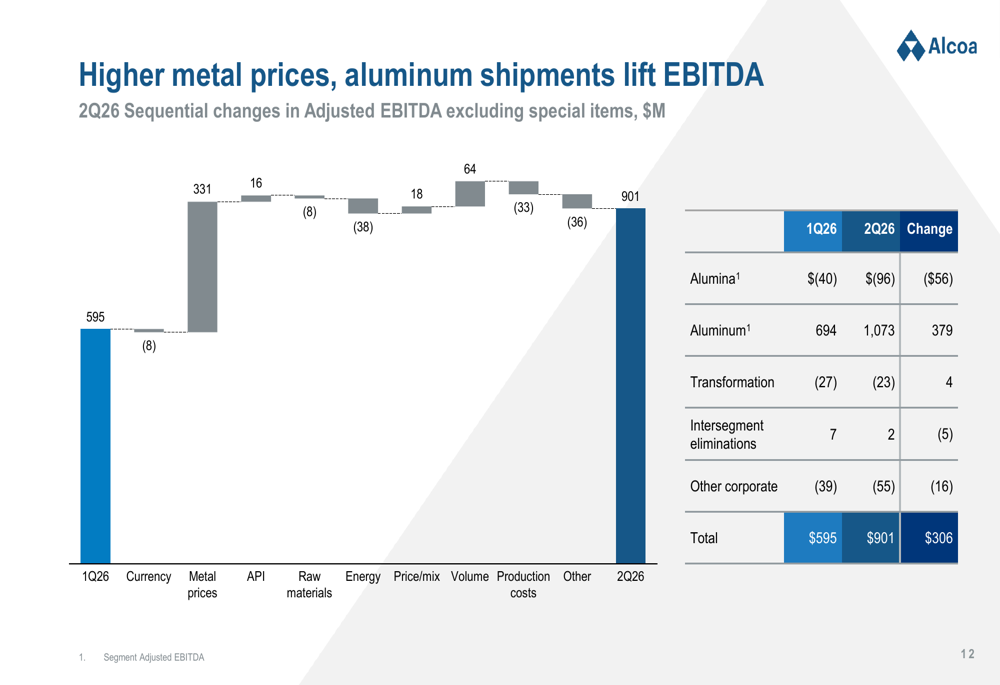
The aluminum segment delivered record-breaking performance with adjusted EBITDA of $1.073 billion and a 32.3% margin, benefiting from higher LME prices and strong regional premiums. In contrast, the alumina segment posted a negative adjusted EBITDA of $96 million, deteriorating from negative $40 million in the first quarter due to production challenges at Pinjarra and higher energy costs.
Strategic Acquisition of South32 Assets
The centerpiece of Alcoa’s second quarter presentation was the announcement of a strategic acquisition of ’s upstream aluminum value chain assets, representing what management characterized as “a natural strategic fit” and “compelling transaction for long-term value.”
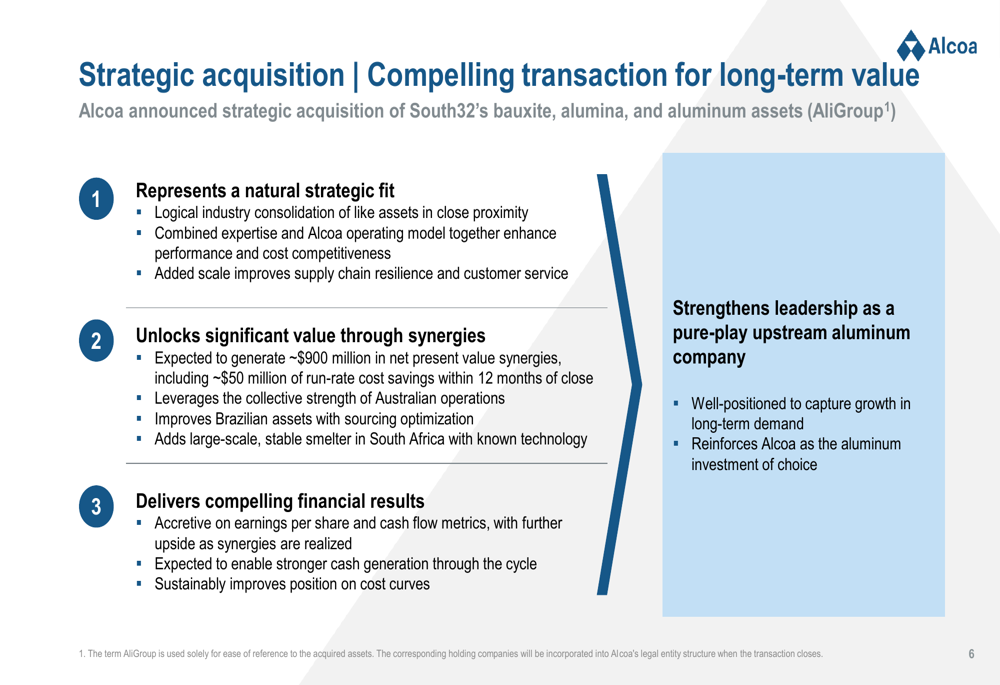
The acquisition encompasses bauxite mining, alumina refining, and aluminum smelting operations, with Alcoa expecting to generate approximately $900 million in net present value synergies. Management highlighted the transaction’s potential to enhance performance through combined expertise, improve supply chain resilience, and strengthen the company’s position on industry cost curves.
The financial terms reflect an implied enterprise value of $4.7 billion, structured to maintain financial flexibility while positioning Alcoa for long-term growth.

The transaction includes $3.1 billion in upfront cash consideration, $1.0 billion in Alcoa stock (approximately 17.0 million shares), and $0.6 billion in assumed net debt. Post-closing leverage is expected to remain at approximately 2.0x, with both S&P and Moody’s affirming Alcoa’s current credit ratings. The deal is targeted to close in the first half of 2027, subject to South32 shareholder approval and regulatory clearances.
The transaction structure incorporates innovative financial mechanisms designed to align interests and share upside potential.
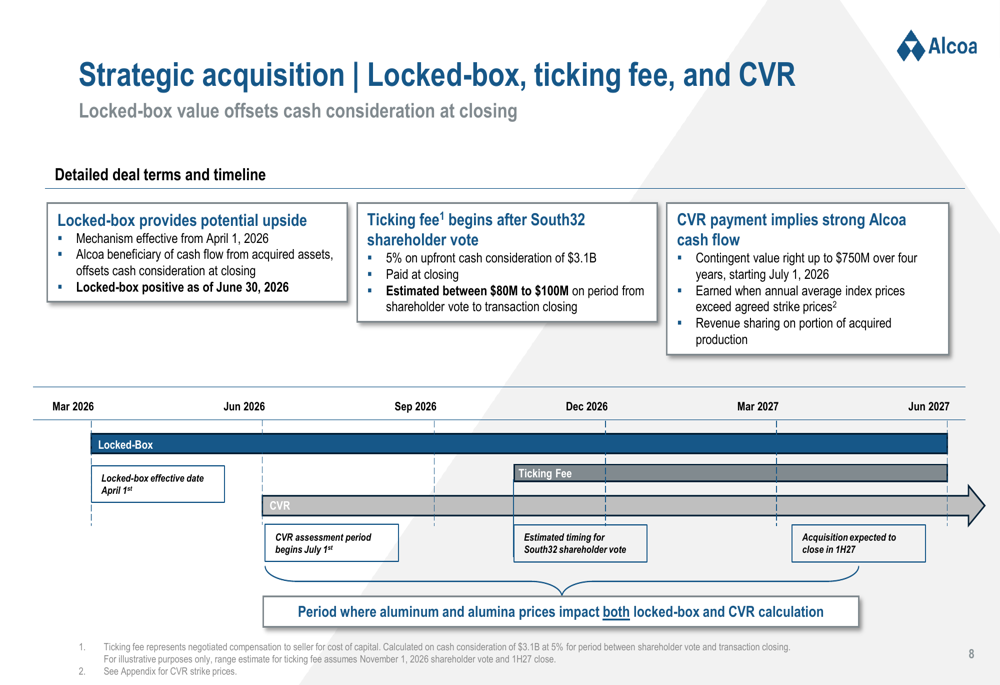
A locked-box mechanism effective from April 1, 2026, allows Alcoa to benefit from cash flows generated by the acquired assets, offsetting cash consideration at closing. The agreement also includes a ticking fee of 5% on the $3.1 billion cash consideration, estimated at $80-100 million, and a contingent value right (CVR) of up to $750 million over four years tied to aluminum and alumina price performance.
Market Growth and Capacity Expansion
Alcoa’s presentation emphasized favorable long-term fundamentals supporting the strategic rationale for the South32 acquisition, with demand growth expected to outpace supply in key markets outside China.

The company projects primary aluminum consumption in markets outside China to grow from 29 million metric tons in 2026 to 36 million metric tons by 2036, representing 24% growth. Alumina consumption is expected to increase even more dramatically, from 56 million metric tons to 74 million metric tons over the same period, a 32% expansion. Critically, the acquisition enables capacity expansion at significantly lower capital intensity than greenfield development, with expansion costs of approximately $1,850 per metric ton for smelting and $600 per metric ton for refining—well below alternatives in North America, Europe, and the Middle East.
Cash Flow and Financial Position
Despite operational challenges in the alumina segment, Alcoa demonstrated robust cash generation capabilities during the quarter.
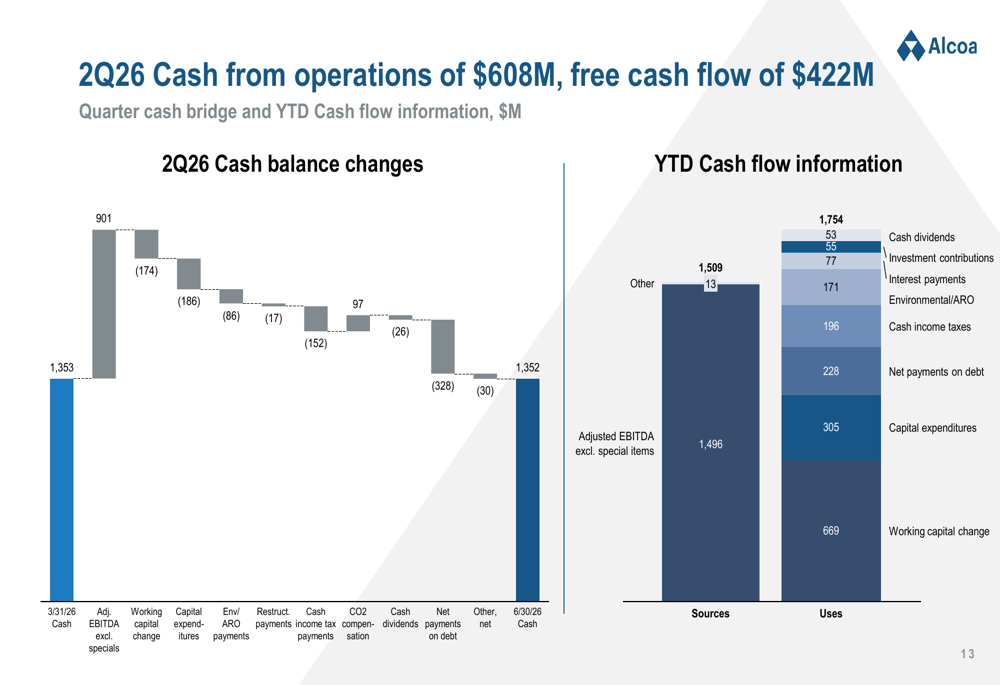
The company generated $608 million in cash from operations and $422 million in free cash flow during the second quarter. Working capital changes consumed $174 million, while capital expenditures totaled $186 million. The company also made net debt payments of $328 million, strengthening its balance sheet position.
Alcoa ended the quarter with a cash balance of $1.35 billion and adjusted net debt of $1.4 billion, positioning the company at the top of its target net debt range. Year-to-date return on equity reached 26.4%, the highest level since 2022, while days working capital improved to 46 days from 48 days in the prior quarter.
Aluminum Market Dynamics
The presentation provided detailed analysis of favorable market conditions supporting aluminum pricing and regional premiums throughout 2026.

LME aluminum prices recovered to $3,156 per metric ton by July 2026, returning to pre-Middle East conflict levels after a macro-led correction. Regional premiums remained elevated, with Midwest duty-paid premiums reaching approximately $2,500-3,000 per metric ton. Management attributed price support to underlying fundamentals including low inventory levels and production curtailments totaling approximately 3.5 million metric tons annually in the Middle East.
Alcoa highlighted strong demand resilience despite macroeconomic headwinds, with the global aluminum market expected to remain in deficit for 2026. The company leveraged its regional presence to capture higher value-added product volumes, with the full-year order book strengthening across all regions and major products.
Alumina Segment Challenges
While aluminum operations thrived, the alumina business faced headwinds that impacted both quarterly results and full-year guidance.
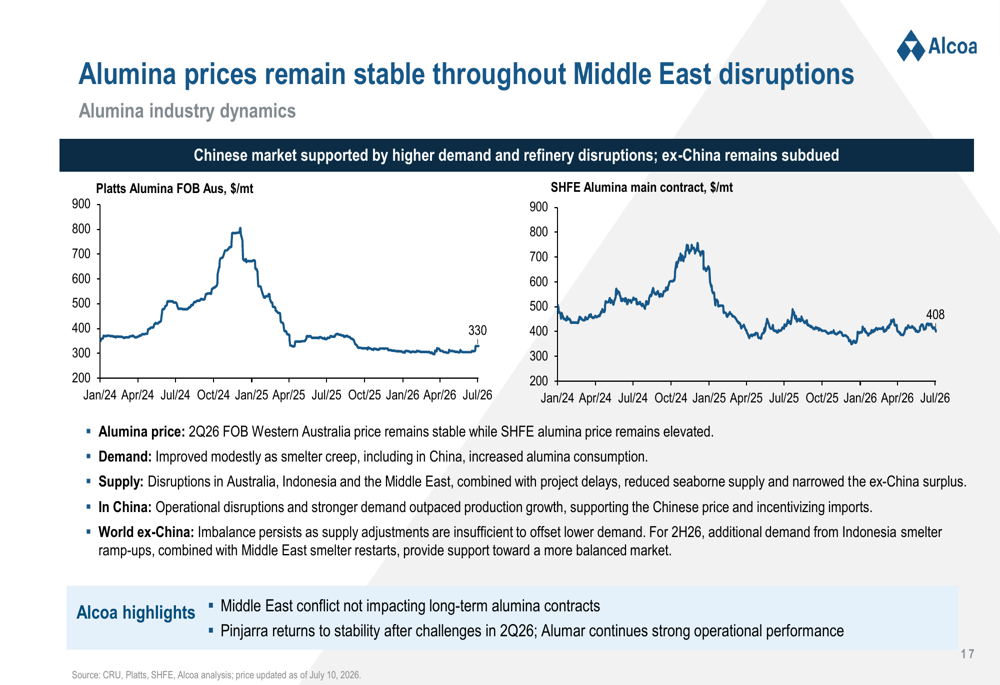
Alumina prices remained relatively stable, with Platts FOB Australia pricing at $330 per metric ton in July 2026. However, operational disruptions at the Pinjarra refinery in Western Australia—including an oxalate outbreak and natural gas supply interruption from Cyclone Laurence—reduced production volumes and increased costs. Management noted that Pinjarra returned to stable operations in June, but the company does not expect to fully recover lost second-quarter volumes.
Full-year alumina production guidance was reduced to 9.5-9.6 million metric tons, with shipment guidance lowered to 11.5-11.6 million metric tons. Despite these challenges, the Alumar refinery in Brazil continued strong operational performance, partially offsetting Pinjarra’s difficulties.
Forward-Looking Guidance and Outlook
Alcoa provided detailed expectations for the third quarter and updated full-year metrics, balancing near-term challenges with longer-term strategic opportunities.
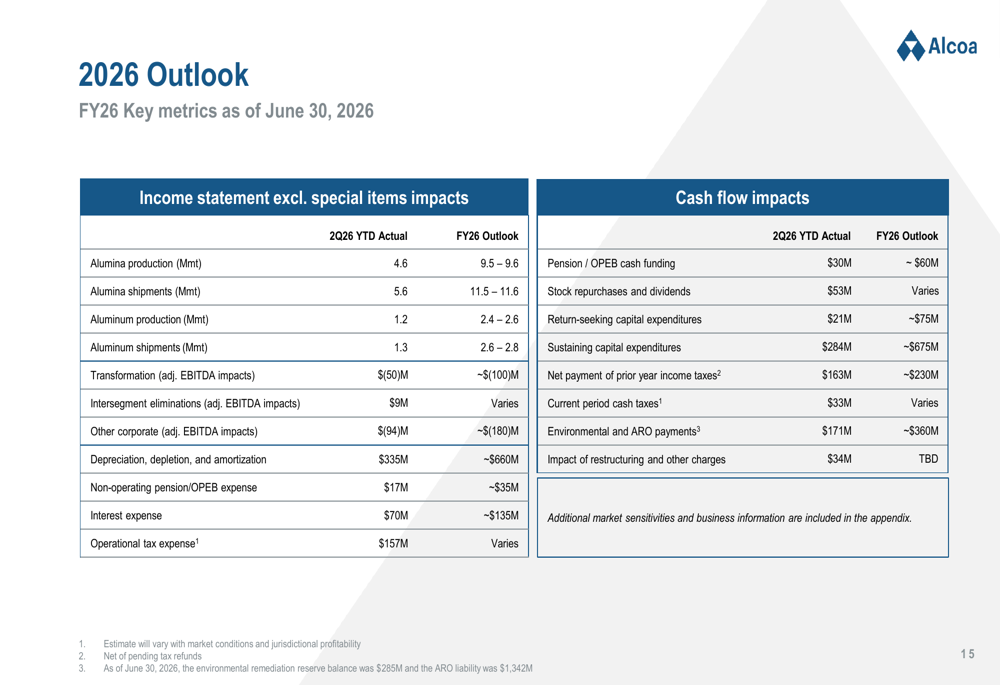
For the third quarter of 2026, management expects alumina segment performance to improve by approximately $10 million sequentially, driven by Pinjarra’s recovery and lower diesel and fuel oil prices, partially offset by planned maintenance at Alumar and the Juruti mine. The aluminum segment is expected to deliver flat sequential performance as productivity gains and operating efficiencies offset higher carbon prices and seasonally lower third-party energy sales in Brazil.
Full-year depreciation guidance increased to approximately $660 million, while other corporate expenses are expected to reach approximately $180 million. The company also anticipates operational tax expense of $80-90 million in the third quarter based on recent pricing.
Strategic Priorities and Execution
Looking beyond the immediate quarterly results, Alcoa outlined key focus areas for the second half of 2026 and into 2027.
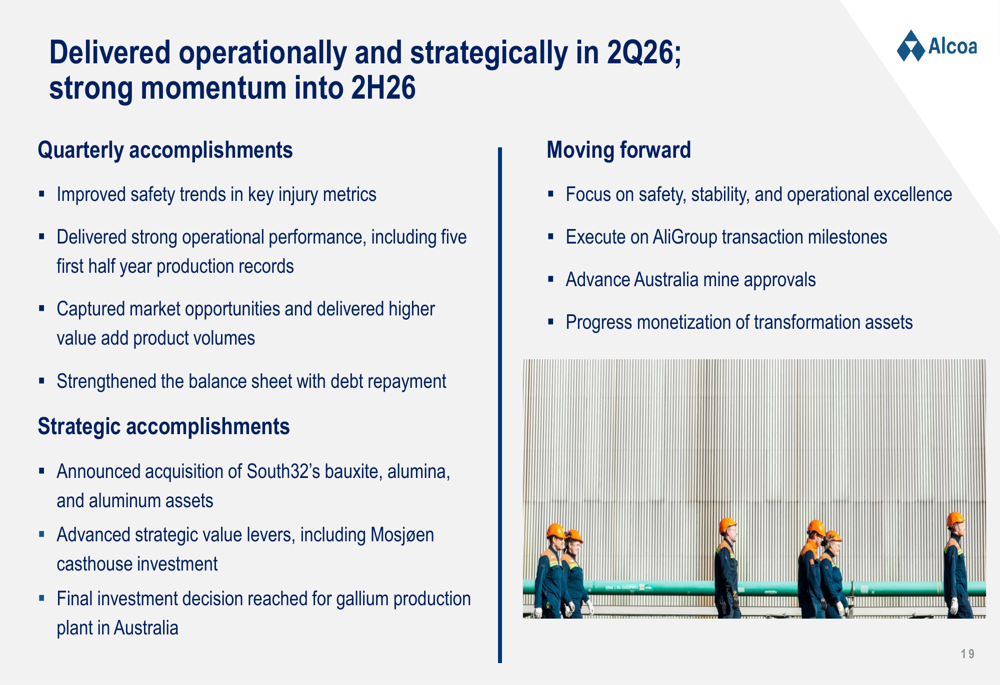
Management emphasized continued focus on safety, stability, and operational excellence, with improving trends in key injury metrics. Strategic priorities include executing on South32 transaction milestones, advancing Australia mine approvals, and progressing monetization of transformation assets. The company also highlighted the final investment decision for a gallium production plant in Australia and ongoing investment in the Mosjøen casthouse, demonstrating commitment to value-creating growth initiatives.
Market Reaction and Investor Considerations
Despite the presentation’s emphasis on record revenue and strategic progress, the market response reflected investor focus on the earnings miss and reduced alumina guidance. Alcoa’s stock declined 3.56% during regular trading to $46.85, followed by an additional 2.4% drop in after-hours trading to $45.73. The stock remains well below its 52-week high of $84.38, though above the low of $28.11.
The mixed reception underscores the challenge commodity producers face in balancing operational achievements with analyst expectations and guidance revisions. While the aluminum segment’s record profitability and the strategic South32 acquisition represent significant positives, near-term execution risks in alumina and the substantial capital commitment required for the acquisition weighed on investor sentiment.
With a price-to-earnings ratio of 12.01 and beta of 1.63, Alcoa continues to reflect both the cyclical nature of the aluminum industry and investor uncertainty about the timing and magnitude of the South32 transaction’s benefits. The company’s ability to integrate the acquired assets, realize projected synergies, and navigate ongoing alumina operational challenges will be critical factors for performance in the coming quarters.
Full presentation:
This article was generated with the support of AI and reviewed by an editor. For more information see our T&C.
Source:
www.investing.com