



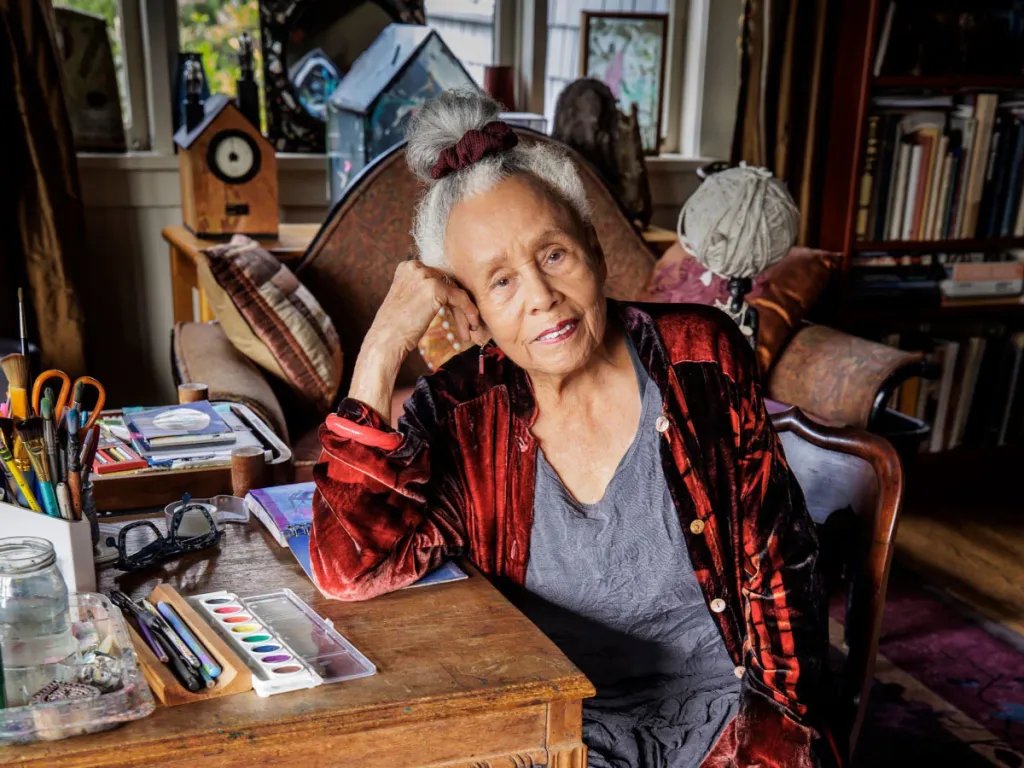

Betye Saar, the Los Angeles–based artist whose assemblages powerfully tackled the brutality of racism and anti-Blackness and the stereotypes they engender, died in her sleep in the early hours of Sunday, July 26, her gallery Robert Projects announced. She was 99 years old, and just four days shy of turning 100 on July 30.
Across seven decades, Saar created a body of work that used a wide variety of materials—often found objects like furniture, statuettes, feathers, and more—and arranged them in such a way that helped give them new meaning, all the while elucidating the pervasiveness of racism in the US.
Related Articles
Her most famous work is arguably The Liberation of Aunt Jemima (1972). At the center of the work is a racist “mammy” statuette who holds a broom. She stands on a bed of cotton, and embedded in her torso is a painting of a similar mammy figure holding a white child over which Saar has painted a Black power fist. Most shockingly, though, Saar has given this figure, a trope of a Black woman, a rifle and a pistol. She is going to liberate herself at all costs, Saar suggests.
The background features tiled images of Aunt Jemima, who once graced the boxes of pancake mix and syrup bottles before Quaker Oats changed the name of the brand in 2020 after the murder of George Floyd and the ensuing Black Lives Matter protests that roiled the world. Saar made the work for the 1972 exhibition “Black Heroes” at the Rainbow Sign Cultural Center, Berkeley, California, which was organized as a response to the assassination of Martin Luther King, Jr.
““My artistic practice has always been the lens through which I have seen and moved through the world around me. It continues to be an arena and medium for political protest and social activism,” Saar told ARTnews in 2020, reflecting on the Quaker Oats announcement. “This work allowed me to channel my righteous anger at not only the great loss of MLK Jr., but at the lack of representation of black artists, especially black women artists. I transformed the derogatory image of Aunt Jemima into a female warrior figure, fighting for Black liberation and women’s rights. Fifty years later she has finally been liberated herself. And, yet more work still needs to be done.”
This is a developing story. Please check back for the full obituary.
Source:
www.artnews.com