




See All Key Ideas
NEW ORLEANS, U.S. — On a cold Saturday in late January, a parade floats rolls down Royal Street painted with the image of the Louisiana coastline, eroding away. The next float displays Lady Liberty gagged and locked behind a chain-link fence.
This is Krewe du Vieux, the raunchy, mule-drawn satirical parade that has rolled through New Orleans’ French Quarter for 40 years, making political jokes few others dare to make in public. Its 2026 theme is “Save the Wet Glands,” a play on “save the wetlands.”
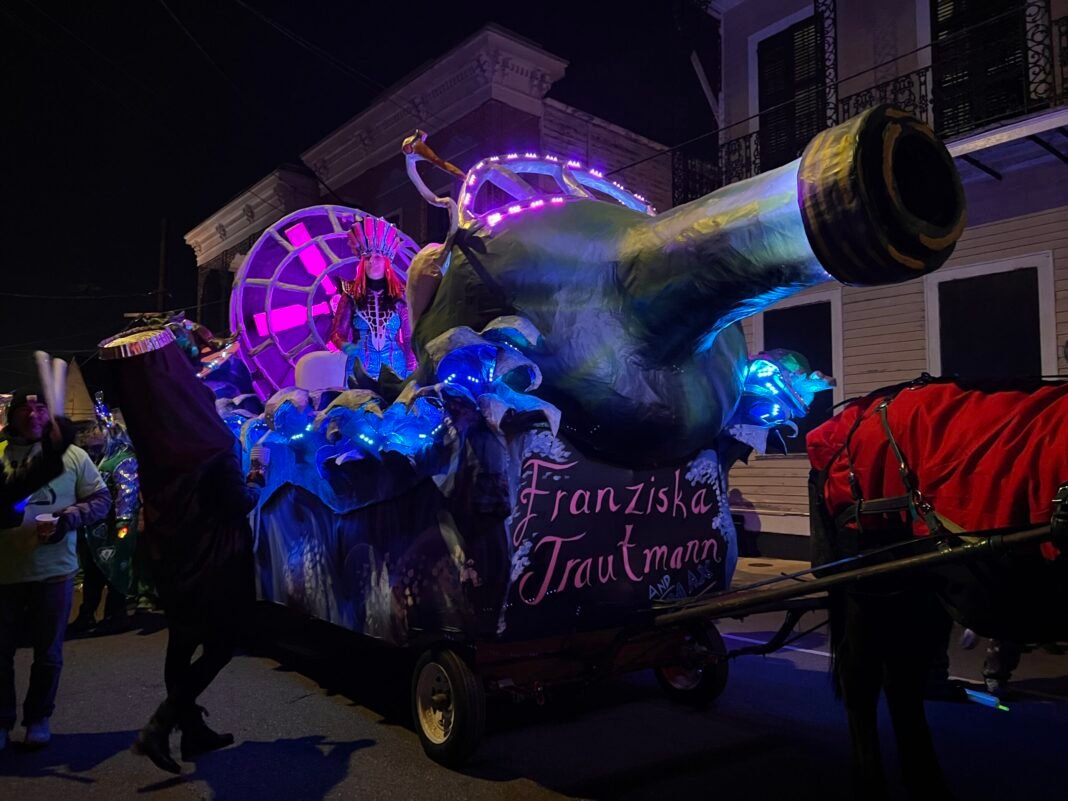
This year’s Krewe du Vieux Queen is Franziska Trautmann, the pink-haired co-founder and CEO of Glass Half Full, a nonprofit that takes the city’s glass bottles and turns them into sand used to rebuild Louisiana’s dwindling coast.
Growing up here, the coastal erosion crisis is “like the boogeyman,” Trautmann told me outside the Glass Half Full facility in Arabi, Louisiana. “It’s this overwhelming thing looming in the distance.”

Most locals have heard the statistics: roughly a football field of Louisiana is lost to the sea every hour. Large areas of grassy marshes and tree-laden swamps that once knit the coast together have succumbed to erosion after more than a century of being sliced apart by roads, oil pipelines, and canals. Reduced sediment flow from the Mississippi River brings less would-be land down south. Also, the land is sinking, and the sea is rising.
But in New Orleans, where tragedy and joy are often held in the same cup, Krewe du Vieux is parading about it.
On the parade route, a reveler with a bushy black mustache peers through the face-hole of a big yellow star costume. The star raises its Miller High Life bottle and shouts “Woo!” as a brass band thumps by. Later, it tosses the bottle in a plastic bin outside Anna’s bar.
By Tuesday morning, the glass bottle is in a box truck headed just a few kilometers east to Arabi, home to the Glass Half Full recycling plant.

Where the glass goes
Glass Half Full started in 2020 in a backyard near Tulane University, when Trautmann and her classmate Max Steitz couldn’t figure out where to recycle their wine bottles. The 20-somethings’ pipe dreams are now a full-scale operation atop a 3-acre (1.2-hectare) plant just outside New Orleans.
GHF’s partner, GlassRoots, runs about 40 locations citywide where people can drop off their household glass. Additionally, dozens of restaurants and bars in town have dedicated glass bins with multiple weekly pickups.
“In 2024 alone we went through half a million pounds of glass [about 227 metric tons], which is quite a bit,” Brice Abadie, general manager of the famed Carousel Bar at the Hotel Monteleone in New Orleans, told Business Insider. The bar is one of GHF’s largest glass suppliers. “I don’t think anybody truly comprehends the amount of garbage and glassware and other things that end up in landfills until, you know, you start separating it and seeing it for yourself.”

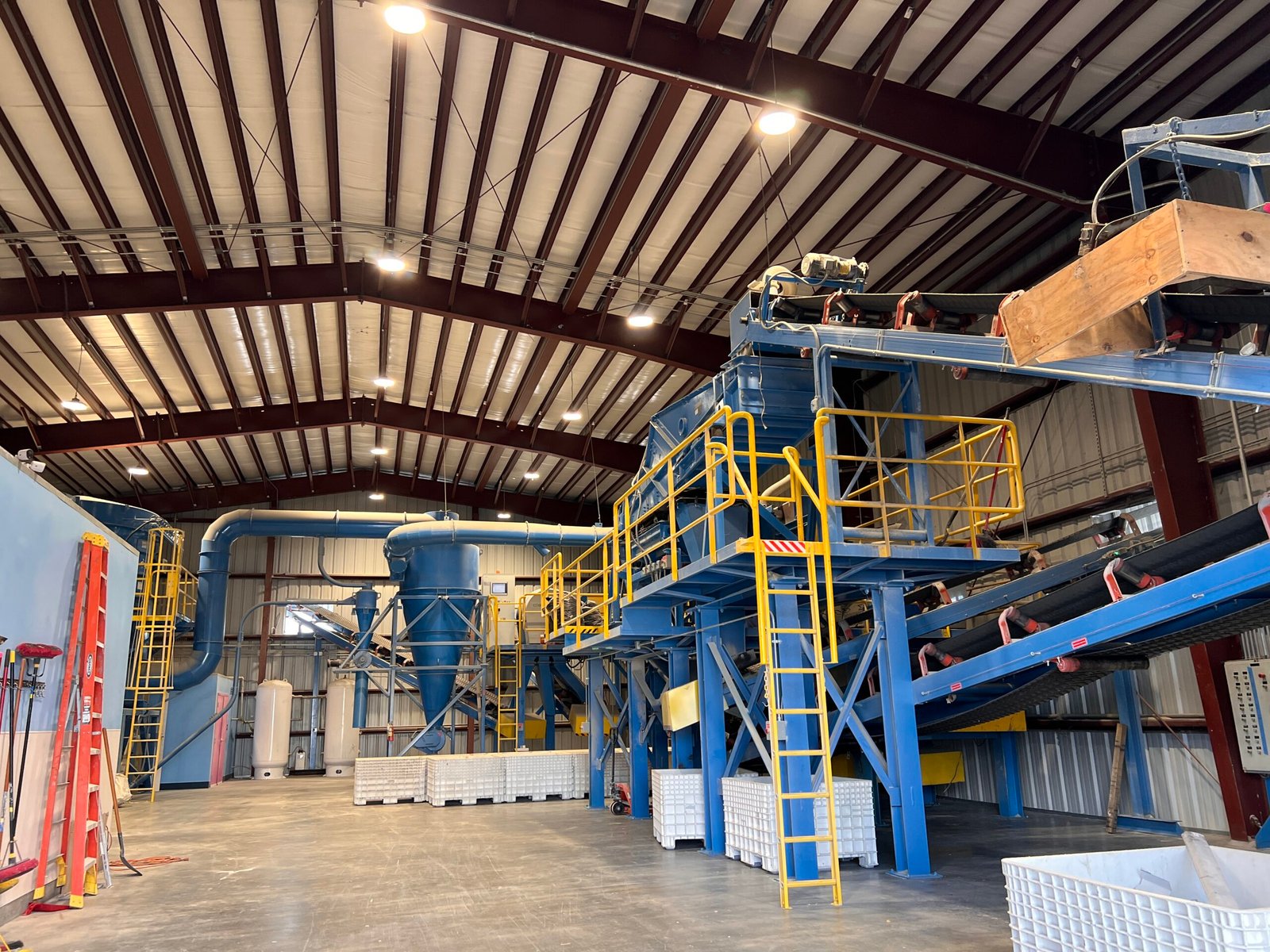
Once the glass reaches the Arabi facility, it’s stored in piles until process days, which occur about three times a week. Heavy machinery moves large scoops of glass into a hopper, which crushes the glass and moves it down a conveyor belt. Workers pull out anything that isn’t glass.
Past the human inspection, optical sorters separate the glass shards by color and pluck out contaminants such as labels.
Larger pieces, called cullet, are collected in a railcar. When the railcar is full (about once a month), it’s hauled by a train to Anchor Glass Container in Oklahoma and melted down into recycled glass bottles.
Glass shards too small to be cullet go through a pulverizer that grinds them into a fine, 100% silica sand, soft enough to rub against skin without cutting.

Since its inception, GHF has recycled 14 million lbs (6,350 metric tons) of glass, including more than 2 million lbs (907 metric tons) this year, Trautmann said in a call in July.
The plant receives nine trucks a day bringing glass from up to 225 kilometers (140 miles) away in Louisiana, Mississippi and Alabama. GHF has the capacity to process more glass, but collection is the bottleneck.
“We need more glass!” Trautmann says to a crew of volunteers gathered at the GHF facility on a sunny Saturday in March, her back to a small mountain of sand glass.
The group has gathered to plant native species (bald cypress and water tupelo trees, giant bulrush, bulltongue and irises) on two small islands built with glass — some of the newest land on the planet.
How to build an island
The Arabi facility sits on the edge of Bayou Bienvenue, atop a former illegal dumping ground. The area used to host a lush swamp, until a shipping channel was cut and the area became flooded with seawater in the 1960s.
Just offshore, a few meters down a boardwalk, are four small islands; each is 25 feet (7.6 meters) across. These baby islands are a grand experiment. And “they’re doing really well!” Kat Fogg, project manager for ReCoast, Glass Half Full’s restoration arm, tells me.


The first two islands, closer to the shore, were built in 2024. One is made of pure Mississippi River dredge — sediment pulled from the bottom of the river. The other is a mix of half dredge and half GHF’s recycled glass sand.
To build the first islands, Fogg and her team trudged out in waders with stakes and tape to mark the perimeter. Next, they hauled biodegradable coir logs made from coconut husks to erect holding containers for the sand and sludge. Large machines pumped the sand and/or sludge into the container. They let the land settle for a few weeks and then planted plants whose roots would eventually hold it in place.
The second set of islands, built in 2025, were made with containers of metal fencing wrapped in burlap instead of coir logs which, Fogg says, “were quite unwieldy.”

All four islands are now solid ground, the older two covered in thick vegetation and the newer islands freshly planted. Wildlife is already making use of the islands. Camera traps placed on the islands in 2025 have logged birds, alligators, marsh rabbits, and a river otter that used the new land as a toilet.
Fogg says they’re building two new islands in the next few months and will experiment with different holding container designs. “We’re going to keep making land,” she says.

Glass Half Full and ReCoast have worked with academic collaborators to study the properties of the glass sand and its suitability for restoration.
The resulting peer-reviewed publications report that the glass sand material is mostly silica, chemically inert, free of harmful leaching, and behaves like natural sand. Native estuarine fish, crabs, oysters and barnacles survive in it; wetland plants, dune plants and black mangroves have grown comparably in glass sand and natural sediment in greenhouse and field trials.
There is “great evidence that we can use recycled glass as a resource for coastal restoration,” Hank Bart, a professor at Tulane University and co-author of research examining the effects of the recycled glass sand on animals, told Mongabay in a phone call. “If we can just crush and recycle enough.”

Reviving the coast
So far, ReCoast has used recycled glass in four major restoration projects. The first went in at Big Branch Marsh on the north shore of Lake Pontchartrain. In June 2023, Glass Half Full partnered with the Coalition to Restore Coastal Louisiana (CRCL) and the Louisiana Department of Wildlife and Fisheries to build a 300-ft (91-m) berm across a shoreline breach opened by Hurricane Ida in 2021. The blowout was letting saltwater from Lake Pontchartrain flow into freshwater marsh, killing vegetation and speeding sediment loss.
Over two days, roughly 100 volunteers filled discarded burlap coffee sacks with 45 metric tons of recycled glass sand and stacked them into a barrier. The berm was designed to ease wave energy and allow bulrush planted behind it to take root and rebuild the marsh.
ReCoast marked a line, or transect, through the site and returned every month for a year to photograph conditions and measure change along the line. According to the group’s monitoring data, vegetation coverage rose by 60% over 12 months, and the site gained 1.25 inches (3.2 centimeters) of sediment.
“We’re seeing all kinds of species now and massive amount of [vegetation] spread,” Fogg says. “It’s so lush.”

Another project, at Bucktown Harbor in nearby Jefferson parish, fortified a 15-acre (6-hectare) peninsula built by the local government to prevent erosion. Working with the Pontchartrain Conservancy and the state’s Coastal Protection and Restoration Authority, ReCoast staff and volunteers wedged burlap bags of recycled sand into the crevices between the rip-rap, the large pieces of concrete used to build the peninsula.

When Fogg returned to the site early this year to monitor progress, she didn’t recognize where she was standing. “I started walking the shoreline, and I realized I’m walking on what was rip-rap,” she says. “It’s just turned into land.”
Ken Krauss, associate director at the Louisiana Universities Marine Consortium and unaffiliated with Glass Half Full, praised their work. “We need substrate to build land,” he told Mongabay. “Adding sand is sort of like adding chicory to the coffee. If it works, it works.”
Restoration at the end of the road
South of New Orleans, the road runs out. Past that is water. This is Pointe-au-Chien, where Pete LeBouf grew up, and where the Pointe-au-Chien Indian Tribe has run its own restoration program for years. ReCoast’s last project brought the two together.
“Whenever they talk about coastal erosion, it’s not just a story,” LeBouf, who is a member of the Pointe-au-Chien Indian Tribe, tells Mongabay in a call. “It’s something that I’ve had to deal with and seen just in my lifetime.”

LeBouf once served on the tribal council, but had to move north to Slidell. The hurricanes hit too hard, he said, the insurance got too high, and “there is no land left to slow the storms down.” He now works as an environmental scientist for a contractor monitoring the coast.
In his lifetime, an island called Timbalier, where his grandparents kept a houseboat and where he chased nutria as a child, has disappeared. A two-story camp house there now lies upside down in the water.
“I’ve watched places that I wanted to bring my kids disappear,” LeBouf says. “They don’t exist.”
He helped identify a potential restoration site while out crabbing one afternoon, on a sliver of tribal marshland. The site sits outside the floodgates of a heavily trafficked canal. Here, boat wakes and wave action had eaten a stretch of Pointe-au-Chien tribal land down to a thin land bridge between the tribe’s property and the canal. Lose that bridge, Fogg says, and everything downstream goes with it.

Here, ReCoast, along with tribal members, tribal boat captains, and dozens of volunteers, built a berm of recycled glass sand in burlap bags. Crews also planted mangroves and shrubs along the existing shoreline to reinforce it.
Because of the high salinity in the area, vegetation has been slow to come in, Fogg and LeBouf say, but the wave action has calmed, the water is shallower, and sediment is starting to stick.
“The berm’s still holding up,” LeBouf says. “I’m really kind of impressed and proud of what they’ve done with that.”
Trautmann says they hope to do more work down there, and elsewhere, but funding is limited.

Meet me at the party

To get the bottles to the marsh, Glass Half Full meets the city where it is, and during Carnival, that’s largely on St. Charles Ave.
I join a fleet of volunteers in bright-green vests manning recycling stations and brandishing collection bags as we weave through the crowds at the Saturday Uptown parades. The scene is part block party, part triage. The streets are littered with a wreckage of plastic: beads, cups, stuffed animals, and light-up trinkets rain down from large parade floats. Most of these prizes will be in a landfill by Ash Wednesday.
But from where I stand, I also hear the undercurrent of a steady, satisfying clink: glass bottles meeting other glass bottles in the bins. A sequin-clad merrymaker places a bottle in my bag. “Y’all’re awesome y’all,” they say with slurred speech.
“Everyone is looking for that little dopamine hit,” Stevie Frazier, a Glass Half Full volunteer, yells over the cacophony of a marching band. “And this feels like you can save the world a little bit at a time.”

Banner image: Glass Half Full CEO Franziska Trautmann riding on a glass bottle float in the Krewe du Vieux parade. By Liz Kimbrough for Mongabay.
Liz Kimbrough is a staff writer for Mongabay and holds a Ph.D. in ecology and evolutionary biology from Tulane University, where she studied the microbiomes of trees. View more of her reporting here.
15 years after the BP oil spill disaster, how is the Gulf of Mexico faring?
Citations:
Twilley, R. R., Bentley, S. J., Chen, Q., Edmonds, D. A., Hagen, S. C., Lam, N. S.-N., … McCall, A. (2016). Co-evolution of wetland landscapes, flooding, and human settlement in the Mississippi River Delta Plain. Sustainability Science, 11(4), 711-731. doi:10.1007/s11625-016-0374-4
Dokka, R. K. (2011). The role of deep processes in late 20th century subsidence of New Orleans and coastal areas of southern Louisiana and Mississippi. Journal of Geophysical Research, 116(B6). doi:10.1029/2010jb008008
Ahmad, S., Vanegas, J. P., Borne, N., Butler, N., Mendels, T., Michaeloff, L. A., … Albert, J. N. (2025). Physical and chemical characterization of recycled glass sand for environmental restoration. Restoration Ecology. doi:10.1111/rec.70095
Campbell, D. C., Gleason, G., Cruz, S., & Bart, H. L. (2026). Gaining ground: Survival of native estuarine fauna exposed to recycled glass sand, a potential material for coastal restoration. Restoration Ecology. doi:10.1111/rec.70407
MacDougal, E. H., Markel, B. X., Farrer, E. C., Ahmad, S., Albert, J. N., & Van Bael, S. A. (2025). Wetland plant growth in recycled glass sand versus dredged river sand: Evaluating a new resource for coastal restoration. Restoration Ecology. doi:10.1111/rec.70020
Editor’s Note: Liz Kimbrough’s former lab group at Tulane University participated in research testing the suitability of glass sand for plant growth after Liz’s graduation. Liz was not involved in this research.
FEEDBACK: Use this form to send a message directly to the author of this post. If you want to post a public comment, you can do that at the bottom of the page.
Cite this article
Liz Kimbrough (2026). From Mardi Gras to marsh: Glass Half Full turns party glass into Louisiana coastline. Mongabay Conservation news. DOI: https://doi.org/10.66709/news-323746

Source:
news.mongabay.com