



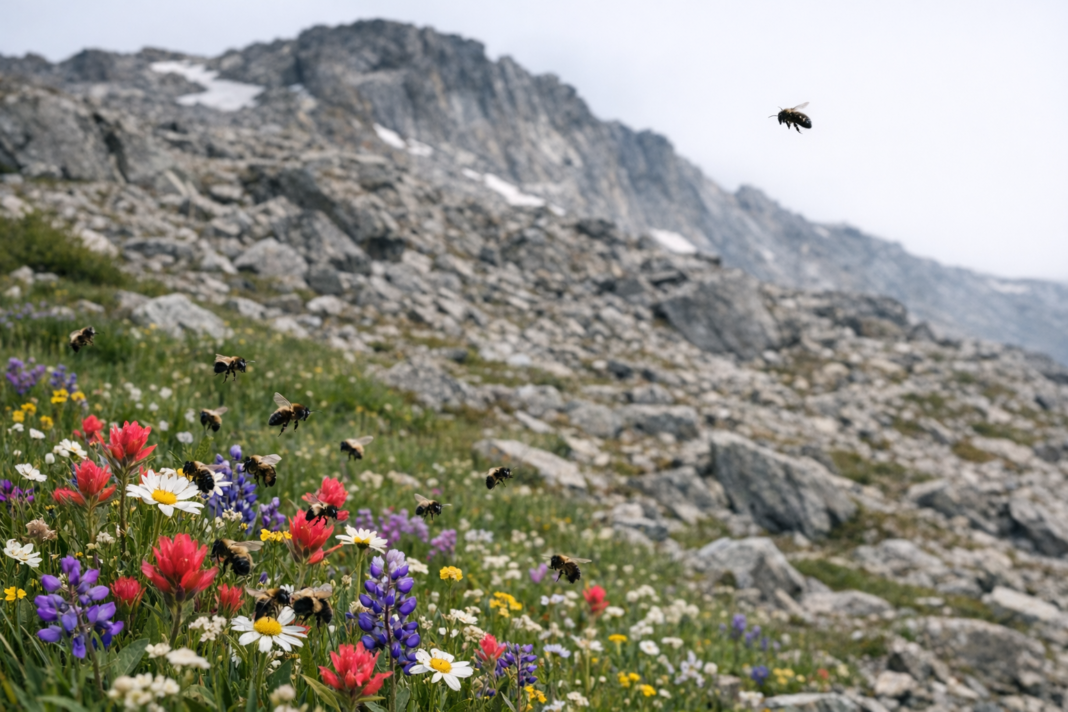
Reduced oxygen levels and lower atmospheric pressure at higher elevations may limit the ability of many insects to move upslope as temperatures rise, a new review in Functional Ecology finds. The paper synthesizes existing studies to highlight physiological and aerodynamic constraints that could prevent some species from tracking shifting climate envelopes by climbing to cooler, higher terrain.
The review examines how thinner air affects two interconnected systems for flying and active insects: oxygen delivery to tissues and the aerodynamic forces required for flight. Both processes depend on air density and oxygen partial pressure, which decline with elevation. Where temperature-driven range shifts require ascents of hundreds of metres, these environmental changes may create a barrier, reducing dispersal success and fitness for species that otherwise rely on upslope movement to escape warming.
Impacts could extend beyond individual species. Pollination, pest regulation and other insect-mediated ecosystem services are tied to insect abundance and distribution. If some pollinators or natural enemies cannot establish populations at higher elevations, plant reproduction and crop yields in montane and adjacent lowland areas could be affected. Mountain ecosystems, already facing habitat compression and fragmentation under climate change, may therefore experience compounded pressures from both warming and atmospheric constraints on mobile organisms.
The authors identify gaps in empirical data and call for targeted physiological and field studies to quantify species- and life-stage-specific limits across elevation gradients. For conservation planners and agricultural stakeholders, the review suggests that anticipating future service losses will require integrating physiological barriers into models of range shifts and designing strategies that do not assume universal upslope movement. Improved monitoring of insect populations along elevation gradients will be essential to track emerging mismatches between species’ climatic niches and the physical limits of the atmosphere.