



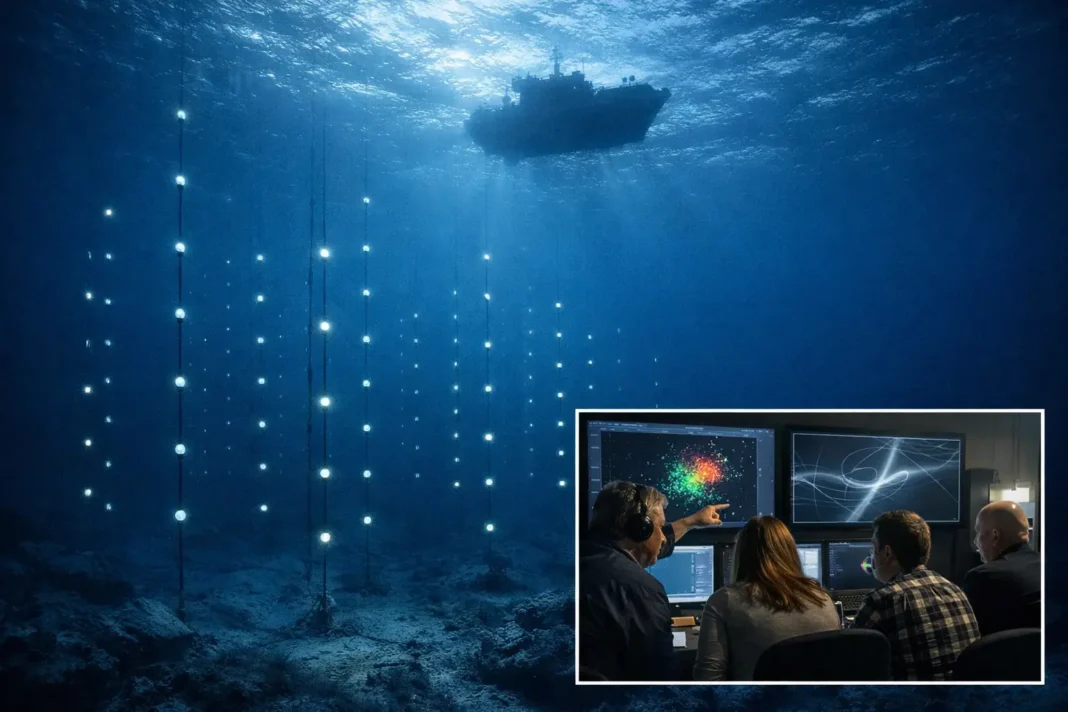
Deep beneath the Mediterranean, researchers are using ghostlike particles to examine one of the foundations of modern physics. The international KM3NeT collaboration has analyzed 5,828 atmospheric neutrino candidate events recorded by KM3NeT/ORCA, a detector installed on the seabed, to probe Lorentz invariance, the principle that the laws of physics should remain the same for all observers moving at constant speed.
That principle is central to Albert Einstein’s theory of relativity and underpins much of contemporary science, from particle physics to cosmology. Yet it remains an active target for experimental scrutiny because some theoretical attempts to bring gravity and quantum mechanics into a single framework allow for the possibility that Lorentz invariance may not be exact under all conditions. Testing it is therefore not a philosophical exercise, but a way to search for signs of physics beyond established theory.
The events examined by KM3NeT/ORCA involve atmospheric neutrinos, particles created when cosmic rays interact with molecules in Earth’s atmosphere. Neutrinos are exceptionally difficult to detect because they rarely interact with matter, but that same property makes them valuable messengers. They can travel long distances, pass through the planet and reach instruments hidden far from surface noise, preserving information that can be used to test subtle effects in their propagation.
ORCA, the low-energy branch of the KM3NeT infrastructure, is designed to study neutrinos by observing the faint light produced when secondary particles move through seawater after a neutrino interaction. Its location deep in the Mediterranean shields the detector from many backgrounds that would overwhelm similar measurements at the surface. By studying a large sample of candidate events, the collaboration can look for patterns that would be difficult to access in conventional laboratory settings.
The work highlights the growing role of undersea observatories in fundamental science. Instead of relying only on accelerators or space telescopes, researchers are turning natural particle sources and extreme environments into precision tools. For Lorentz invariance, each new test narrows the room available for deviations from relativity or helps define where future searches should look. From the bottom of the sea, the question remains one of the largest in science: whether the rules described by Einstein are truly universal.