



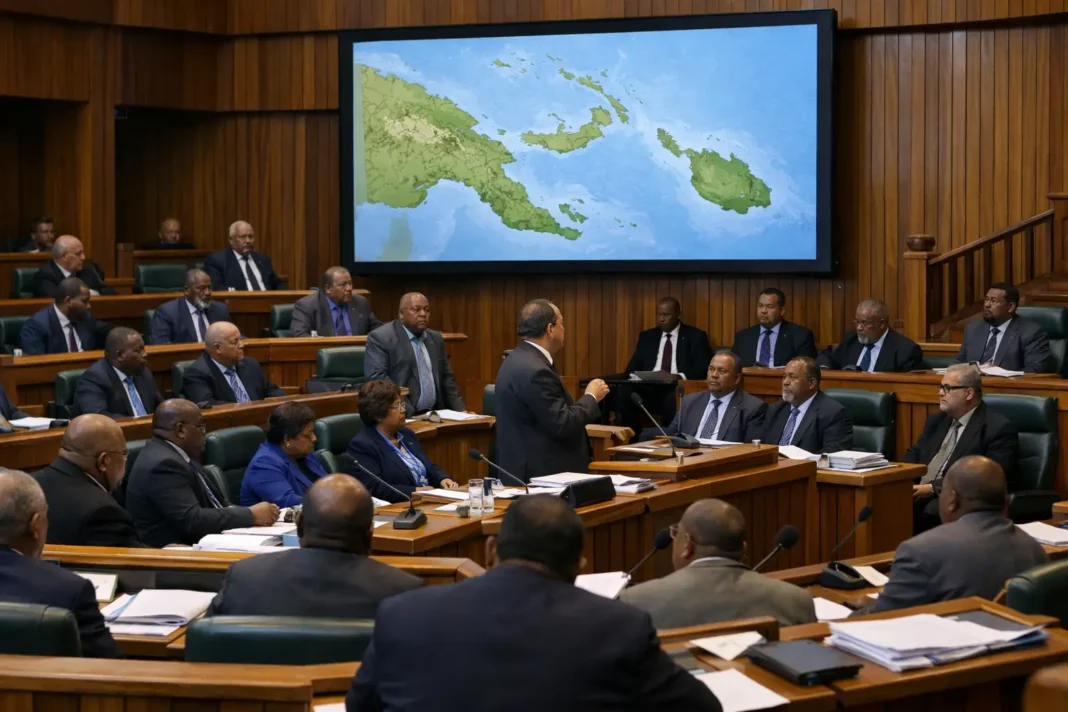
Papua New Guinea’s parliament is taking up one of the most consequential decisions in the country’s post-independence history: whether to ratify the 2019 referendum in which nearly 98% of voters in Bougainville chose independence. The vote does not, by itself, create a new state. A parliamentary endorsement would instead begin the legal and administrative process required to move the autonomous region toward full sovereignty. A rejection or delay would not close the issue, but would trigger further consultations under the framework developed by the two governments.
The decision is the product of a long peace process rather than a single ballot. Bougainville, an autonomous region of Papua New Guinea in the northern Solomon Islands chain, endured a decade of conflict from 1988 to 1998. The war was rooted in disputes over land, political self-determination, environmental damage and the distribution of mining revenues, especially around the Panguna copper and gold mine. The conflict involved the Bougainville Revolutionary Army, Papua New Guinea’s security forces and local factions, and is estimated to have cost 15,000 to 20,000 lives.
The political pathway now before parliament was set out in the Bougainville Peace Agreement, signed in 2001 after negotiations that followed years of local and regional peacebuilding. That agreement created the basis for autonomy, weapons disposal, elections and a referendum on Bougainville’s future status. The referendum delivered an overwhelming mandate for independence in 2019, but the result required consultation between the Autonomous Bougainville Government and the national government before reaching the legislature in Port Moresby.
Even with a favorable vote, major questions remain unresolved. The Panguna mine, once among the world’s largest sources of copper and gold, remains inactive and politically sensitive. For some Bougainvilleans, it represents dispossession and environmental harm; for others, it could become a source of revenue for a future state. Rio Tinto has agreed to provide US$250 million to begin addressing the mine’s long-term environmental and human impacts. Bougainville’s authorities have also promoted alternative economic priorities, including fishing, agriculture and a green-blue economy policy, as part of efforts to reduce reliance on extractive industries.
The parliamentary debate carries significance beyond constitutional mechanics. It tests whether a peace process built through local leadership, regional diplomacy and international support can complete its most delicate phase without reopening old divisions. Concerns in Papua New Guinea about national unity and precedent for other provinces remain part of the political landscape. Yet the institutions created over the past quarter-century have kept the process alive through conflict, autonomy and referendum. Whatever the immediate outcome, Bougainville’s demand for independence has now reached the central forum of the state that must decide its next legal step.