



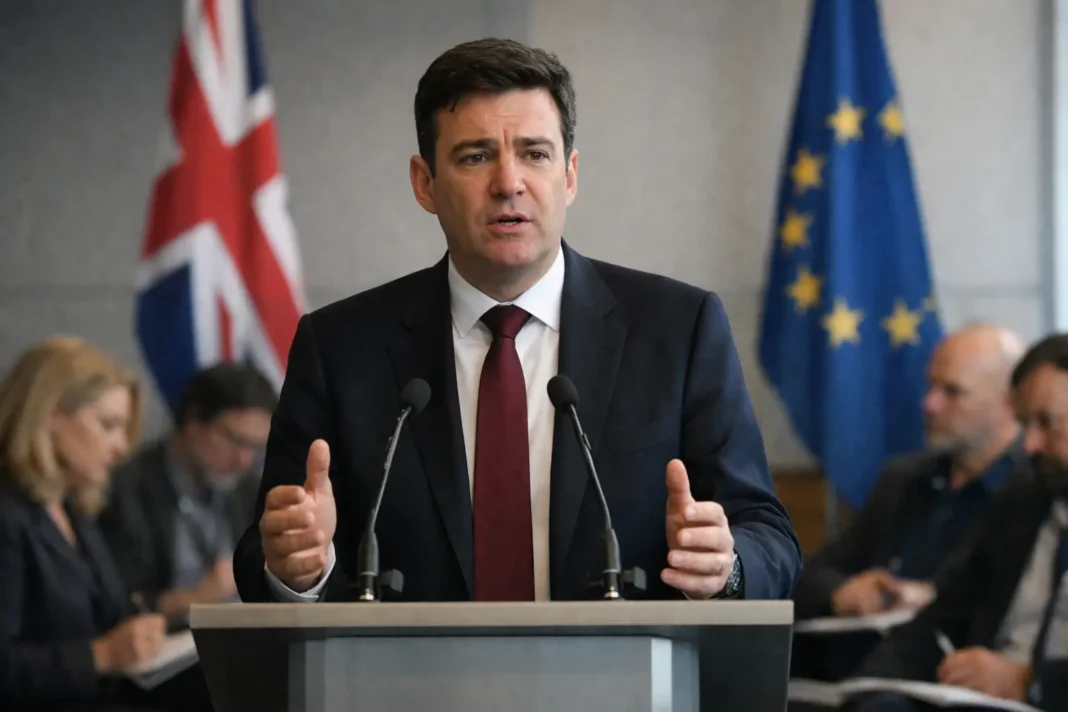
The renewed focus on Andy Burnham and Europe has put a familiar tension back at the centre of British politics: how far Labour can move toward a closer relationship with the European Union without appearing to reopen the Brexit argument. The question, examined by Chris Mason for the BBC, is not only about one senior Labour figure. It speaks to the pressures facing a governing party that wants to improve practical ties with Brussels while keeping political control of a subject that has divided the country for years.
Burnham, the Mayor of Greater Manchester, remains one of Labour’s most recognisable voices outside Westminster. His presence in the European Union discussion matters because he is both associated with Labour’s broader political family and capable of attracting attention beyond regional politics. That makes his tone significant for Downing Street, particularly when the government is seeking to present its European policy as measured, economic and pragmatic rather than symbolic or ideological.
The challenge for Prime Minister Keir Starmer is that Europe is never a neutral policy file in British public life. Labour has emphasised a reset in relations with the EU after Brexit, while avoiding a commitment to reverse the central institutional changes that followed withdrawal. That position is designed to reassure voters who want smoother trade, security and diplomatic cooperation, without alienating those who regard the 2016 referendum result as settled. The more prominent the debate becomes, the harder it is to keep that distinction clear.
For the Labour Party, available through its official site at Labour, the political risk lies in volume as much as substance. A discussion framed around practical cooperation can support the government’s message on growth and stability. A louder argument about Europe, however, can revive old dividing lines within UK politics and give opponents an opening to portray Labour’s approach as unclear. Burnham’s influence therefore raises a broader question about discipline across the party’s national and regional leadership.
The episode underlines how Brexit continues to shape Labour’s governing environment even when ministers are focused on domestic delivery. Relations with the EU affect trade, migration, security, research and regulation, but they also carry a political charge that few other policy areas match. For Starmer, the task is to keep the conversation anchored in outcomes. For Burnham and other senior Labour figures, the issue is how to contribute to that debate without increasing the political noise around it.