



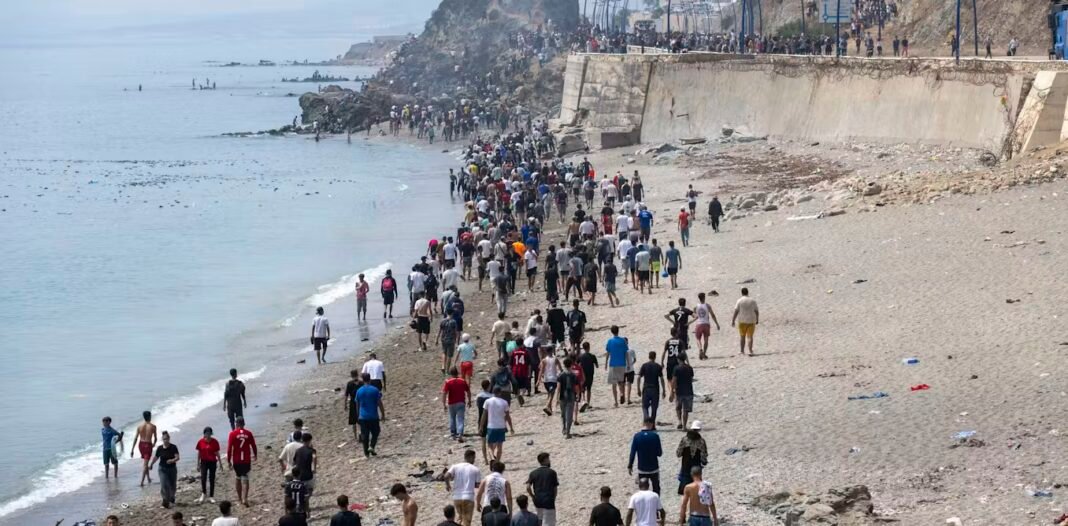

It took one night in Ceuta to end a relatively quiet summer on Europe’s southern border. Over 70,000 people entered the Spanish enclave from Morocco between July 30 and 31, most of them swimming around the heavily guarded border fences.
For comparison, at the peak of the 2015-16 migration crisis, Italy received over 180,000 irregular migrants across an entire year. This was roughly a third of Italy’s busiest year, compressed into a single day.
Most of those who crossed have since returned to Morocco. But the episode has already become an EU-wide political crisis. By the end of the day, Italy had suspended its Schengen free-movement agreement with Spain.
This choice was primarily political, but short-sighted. It ignored the fact that most people crossing at Ceuta have little interest in going to Italy. And just as new EU migration rules mandating “flexible solidarity” come into force, it sets a precedent for turning away from frontline states – Italy included – the next time they face migratory pressure.
Who is to blame for Ceuta?
Spain’s prime minister, Pedro Sánchez, attributed the sudden inflow to smuggling gangs exploiting a recent ruling by his country’s supreme court, which bars authorities from summarily returning migrants intercepted at sea.
Rightwing politicians and commentators instead pointed to Spain’s recent amnesty of nearly a million people. However, academic studies are sceptical that such policies act as pull factors for migrants.
Either way, a crossing of this scale and speed would arguably not have been possible without Morocco’s cooperation. Reports have emerged of Moroccan authorities waving people through at points where, a day earlier, they had been turning them back.
Morocco’s government has not issued an official statement, but the message appears clear: the authorities there can let people through the border, or not, largely as they choose. This is what scholars call the “weaponisation” of migration.
In this case, it is probably related to political disagreement over Western Sahara, the former Spanish colony annexed by Morocco in the 1970s.
Days before the mass border crossing, Sánchez had visited Algeria, where the contentious question of Western Sahara’s independence was raised. This indication that Spain is seeking closer ties with Algeria, which backs Western Sahara’s pro-independence movement Polisario Front, is seen as a threat to Morocco’s claim to the region.
It echoes 2021, when Morocco sanctioned Spain over its decision to allow a Western Sahara independence leader to receive treatment for COVID in Spain. Roughly 8,000 people crossed into Ceuta days later.
Such a tactic has several precedents in Europe. In 2020, Turkey’s president, Recep Tayyip Erdoğan, warned the EU it would “pay the price” for failing to increase financial aid and support the country’s military operations in Syria. Within days, around 13,000 people tried to cross into Greece via the Evros River.
A decade earlier, Libya’s then-leader Muammar Gaddafi warned that Europe would “turn into Africa” if the EU did not pay billions of euros to his country, showing how migration can be leveraged as a threat for other political goals.
Mediterranean migration routes
Beyond this latest spike, overall Mediterranean crossings are, in fact, comparatively low. Between January and June 2026, around 49,000 people crossed the EU’s external borders irregularly, down 37% on the same period last year.
This continues a multiyear decline: 2025 saw 178,000 crossings, already the lowest since 2021 and a fraction of 2015 levels.
Of the three main sea routes for migrants coming from Africa to Europe, the eastern Mediterranean (to Greece) and central Mediterranean (to Italy) remain busiest, accounting for over 60% of detections between them: 16,643 and 14,340 respectively in the first half of 2026.
The western Mediterranean route to Spain was the only one to rise this year, up 17% to 7,860 arrivals. This was driven chiefly by more departures from Algeria toward the Balearic islands. Tighter controls in Morocco and along the west African and central Mediterranean routes pushed smuggling networks toward Algerian shores instead.
The broader decline reflects improved conditions in Syria: Europe-wide asylum applications from Syrians fell from almost 360,000 in 2015 to under 40,000 in 2025.
It has also been influenced by more cooperation between EU countries and countries of origin and transit, including deals between the EU and Turkey (2016), Italy and Libya (2017), and more recent agreements between the EU and Mauritania Egypt and Senegal.
But lower numbers haven’t meant safer journeys. In 2026 alone, at least 1,545 people have been recorded missing or died crossing the Mediterranean irregularly.
Reduan Dris/EPA-EFE
What shapes where people go
Three factors tend to shape people’s choice of destination countries. The first and usually most decisive is the availability and nature of economic opportunities – work possibilities and wage levels – whether in the regular labour market or informal economy.
The second is social networks: the presence of family, friends or a wider diaspora community. They act as a safety net by offering somewhere to stay and contacts for work, and also help navigate bureaucracy – all of which lowers the practical cost of arrival and integration.
The third is language and cultural ties. This is why Francophone migrants often gravitate towards France and Anglophone migrants towards the UK.
Beyond these three factors, though, there is a considerable element of luck and coincidence. Many migrants leave without a fixed destination in mind. Their intended endpoint often shifts en route, shaped by encounters with smugglers, shifting border conditions or fellow travellers’ tips.
In response to the events in Ceuta, leaders have called for further restrictive measures. But the logic of Schengen, a Europe without internal border controls, means it is largely irrelevant where a person first enters.
Borders, in this sense, behave like balloons. Squeeze one part and the air doesn’t disappear – it just bulges out somewhere else.
The Mediterranean border works the same way. The flow of people can be pushed from one entry point to another – from Italy and Greece to Spain, or from the Canaries to Ceuta. But it is not, on the evidence of the last decade, something that can be made to simply vanish.
Source:
theconversation.com