



Introduction & Market Context
presented its second-quarter 2026 results on August 6, highlighting the completion of its Ruckus divestiture and announcing a $5 per share special distribution while simultaneously cutting full-year profitability guidance due to escalating memory chip costs and stranded expenses. The presentation detailed a quarter marked by stable revenue but sharply compressed margins, as the company transitions from a diversified portfolio to a focused Aurora Networks business supplemented by emerging growth areas.
The company’s stock traded essentially flat at $49 following the presentation, compared with a previous close of $49.05, suggesting investors had already priced in near-term headwinds while weighing the company’s strengthened capital position and long-term DOCSIS 4.0 opportunity.
Quarterly Performance Highlights
Vistance Networks reported continuing operations net sales of $320 million for the second quarter, down just 1% from $324 million in the prior-year period. However, profitability metrics deteriorated more significantly, with continuing operations adjusted EBITDA falling 32% to $36 million from $53 million, and adjusted EBITDA margin compressing to 11.2% from 16.3%.
The following table illustrates the company’s overall financial performance for the quarter, showing both consolidated results including Ruckus and continuing operations metrics.
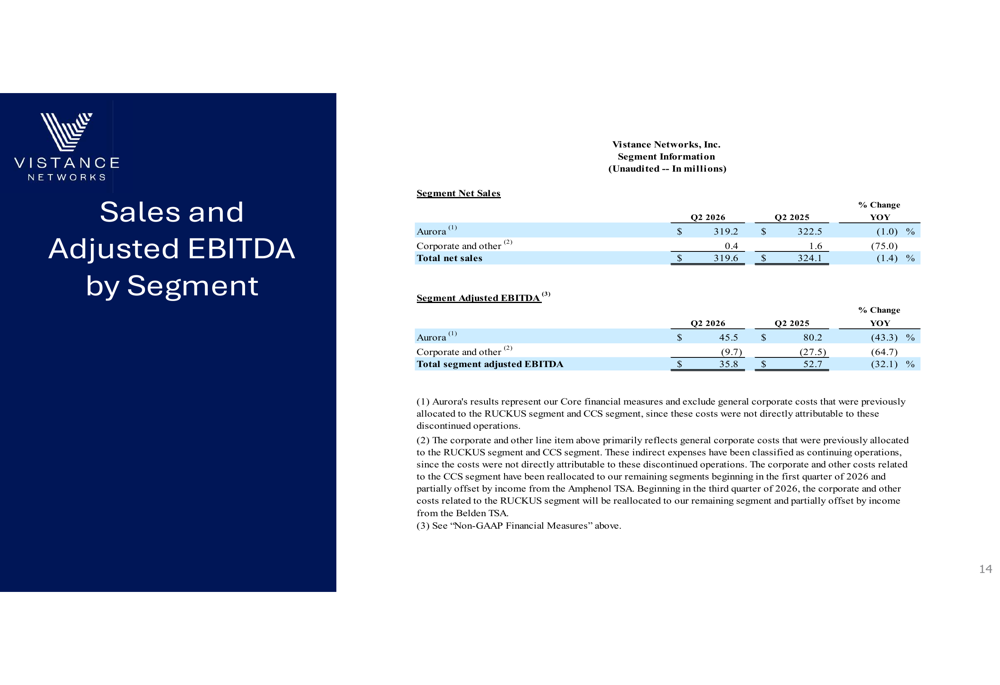
Aurora Networks, the company’s core business segment, generated $319 million in net sales, representing a modest 1% decline from $322 million in the prior year. The more pronounced impact appeared in adjusted EBITDA, which plummeted 43% to $46 million from $80 million, primarily due to three factors: the absence of unusually strong high-margin license revenue that benefited Q2 2025, increased memory chip pricing, and stranded costs from the company’s portfolio rationalization.
The segment-level performance breakdown reveals the magnitude of the profitability challenge facing Aurora Networks.

Management attributed approximately $15 million of the second-quarter EBITDA impact to memory chip pricing and stranded costs, with the memory chip situation expected to worsen in the second half of 2026. The company noted that Q2 2025 had benefited from particularly strong legacy product and license sales that did not repeat, making the year-over-year comparison especially difficult.
Ruckus Transaction and Capital Returns
The Ruckus transaction closed on July 1, 2026, generating gross proceeds of $1.846 billion. The Board approved a $5.00 per share special distribution totaling $1.15 billion, scheduled for payment by the end of August 2026 and expected to be treated as a return of capital for tax purposes. Combined with the earlier CCS divestiture, the company has now unlocked $15.00 per share in total cash distributions for shareholders.
The strategic rationale and financial impact of the Ruckus divestiture are detailed in the following slide.
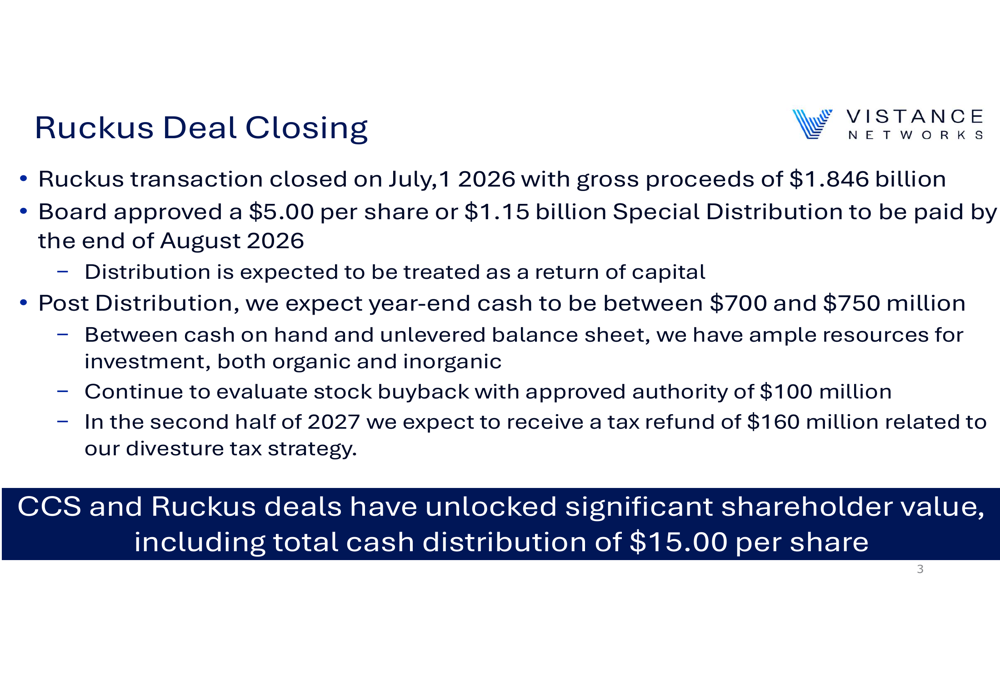
Post-distribution, Vistance Networks anticipates ending 2026 with cash between $700 million and $750 million, providing what management characterized as “ample resources for both organic and inorganic investment.” The company maintains an unlevered balance sheet with no long-term debt and an undrawn asset-based lending facility of $177 million. Additionally, the company expects to receive a $160 million tax refund in the second half of 2027 related to its divestiture tax strategy.
The company’s balance sheet strength and capital allocation plans are illustrated below.

The Board has approved a $100 million share repurchase program, which the company continues to evaluate alongside other capital deployment opportunities. Management emphasized maintaining significant financial flexibility to invest in the Aurora business and pursue strategic opportunities.
Operational Challenges and Guidance Revision
Vistance Networks lowered its full-year 2026 Aurora adjusted EBITDA guidance to a range of $200 million to $225 million, down $25 million from the prior outlook. Chief Financial Officer Kyle Lorentzen stated that “the memory pricing and availability environment has deteriorated faster and further than we expected at the end of the first quarter,” with the full-year memory chip impact now estimated at approximately $40 million.
The company’s second-quarter operating results for Aurora Networks show the pressures impacting the business.

The guidance reduction also reflects incremental stranded corporate costs resulting from the Ruckus transaction, as certain shared services and overhead previously allocated to the divested business now burden the remaining operations. Management warned that results could come in at the low end of the guidance range or below if memory conditions deteriorate further.
Cash flow metrics deteriorated significantly in the quarter, with operating cash flow of negative $73 million compared to positive $77 million in the prior-year period, driven primarily by working capital needs and Ruckus transaction expenses. Free cash flow similarly turned negative at $75 million versus positive $65 million a year earlier.
The quarterly cash flow trends demonstrate the near-term working capital pressures facing the business.

Strategic Focus and Product Portfolio
Despite near-term margin pressures, management emphasized that underlying demand for DOCSIS 4.0 products remains strong. Chief Executive Charles Treadway stated, “Now that we’ve completed the RUCKUS transaction, we will focus on growing Aurora, including taking advantage of the current DOCSIS 4.0 upgrade cycle that we believe will last for several years.”
The company expects next-generation ESD amplifiers to ramp over the coming quarters, with unified amplifiers anticipated to begin shipping in early 2027. DOCSIS 4.0 products currently represent approximately 70% of Aurora revenue and remain the primary growth driver, while legacy products such as E6000 and C100G CMTS, licenses, and head-end optic equipment constitute about 15% of Aurora revenue but contribute roughly 25% of adjusted EBITDA due to their higher margins.
Beyond its core cable market, Vistance is investing in three new growth areas: passive optical network (PON) technology, virtual broadband network gateway (vBNG) solutions, and security/public key infrastructure (PKI) offerings. These initiatives aim to diversify the revenue base and offset the gradual decline in high-margin legacy product sales.
The detailed segment performance breakdown shows how Aurora Networks contributes to overall results.
Customer concentration remains high, with the top three customers accounting for approximately 70% of revenue, a level similar to the prior year. Management noted that some customers have delayed upgrade timelines by a quarter or two as they finalize technology path decisions, though this appears to be customer-specific rather than indicative of broader market weakness.
Geographic Performance
The United States remained Vistance’s dominant market, generating $258 million in net sales during the second quarter, representing 81% of total revenue and posting a modest 1.1% year-over-year increase. International markets showed mixed results, with particularly weak performance in Europe, Middle East and Africa, where sales declined 26.3% to $15 million, and Canada, where revenue fell 15.3% to $15 million.
The regional sales breakdown provides insight into the company’s geographic revenue distribution.

Asia Pacific showed resilience with sales of $15 million, up 2.8% year-over-year, while Caribbean and Latin America generated $17 million, representing a 1.8% increase. The geographic concentration in the U.S. market reflects the company’s focus on North American cable operators as its primary customer base.
Forward Outlook and Reconciliation
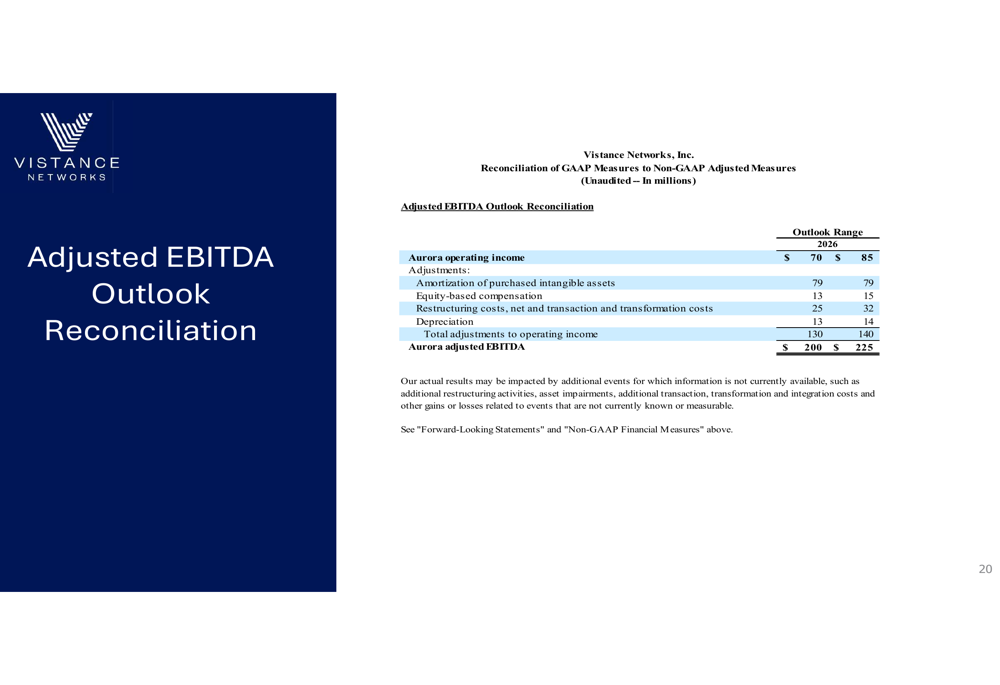
Looking ahead, Vistance Networks faces a challenging balance between near-term margin pressures and longer-term growth opportunities. The company’s revised Aurora adjusted EBITDA outlook of $200 million to $225 million for full-year 2026 incorporates ongoing headwinds from memory chip pricing, stranded costs, and the difficult comparison with high-margin legacy product sales from 2025.
The reconciliation of Aurora’s operating income to adjusted EBITDA for the full-year 2026 outlook demonstrates the components of the guidance range.
Management expects memory chip pricing and availability to continue impacting the business through the second half of 2026, with further incremental pressure anticipated. However, the company maintains that the DOCSIS 4.0 upgrade cycle represents a multi-year opportunity that should drive growth once near-term cost pressures moderate.
With a strong balance sheet, significant cash resources post-distribution, and no debt, Vistance Networks retains financial flexibility to invest organically in product development and potentially pursue inorganic opportunities to expand its portfolio. The company’s ability to navigate the current margin compression while positioning for the DOCSIS 4.0 cycle and new growth areas will be critical to delivering shareholder value in the coming quarters.
The stock’s muted reaction to the mixed quarter—trading near its 52-week high despite the guidance cut—suggests investors are balancing near-term operational challenges against the company’s improved capital structure and long-term strategic positioning following the portfolio rationalization.
Full presentation:
This article was generated with the support of AI and reviewed by an editor. For more information see our T&C.
Source:
www.investing.com